



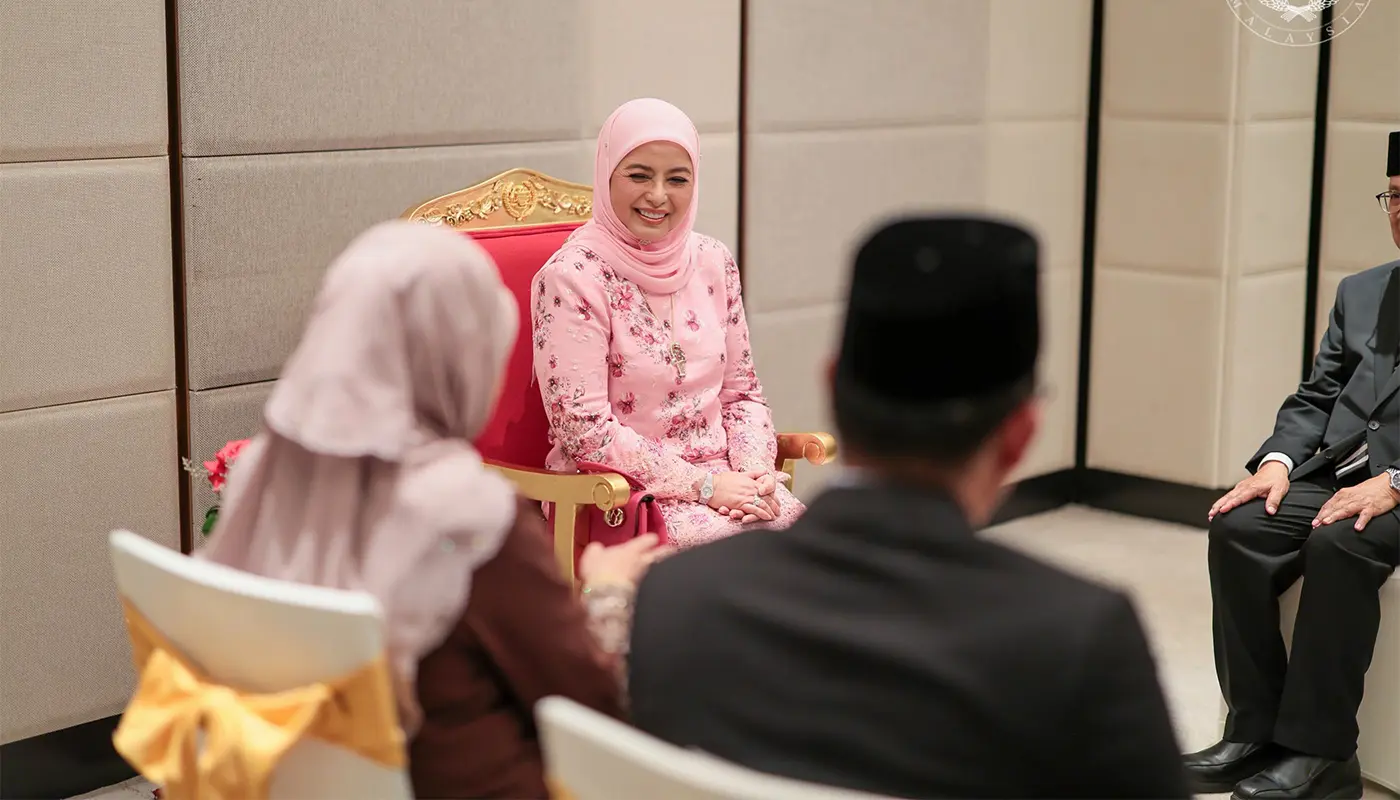
KUCHING – The nation’s highest literary honour has been conferred honourarily upon a prominent figure in Malay letters during the National Literary Awards ceremony held in Kuala Lumpur. Her Majesty Raja Permaisuri Agong Raja Zarith Sofiah presided over the 16th National Literary Awards presentation at M Resort Hotel on Wednesday.

Upon arrival, the Queen was received by Education Minister YB Fadhlina Sidek alongside senior ministry officials. Also present were Secretary-General Datuk Wan Hashim Wan Rahim and Language and Literature Department Director-General Datuk Dr Hazami Jahari.
DBP Governing Board Chairman Datuk Dr Mohd Anuar Rethwan joined the welcoming delegation for the significant cultural occasion. Their collective presence underscored governmental commitment to preserving and advancing national literary heritage.
The late Abdul Rahman Napiah, widely known by his pen name Mana Sikana, was named the 16th recipient of this distinguished accolade. His recognition affirms decades of transformative contributions that reshaped modern Malay literary discourse fundamentally.
Puan Hajah Salmah Ali accepted the award on behalf of her deceased husband during the emotional investiture. Her dignified reception of the honour symbolised enduring family legacy intertwined with national cultural memory.
Mana Sikana’s influence spans more than sixty years across multiple intellectual domains simultaneously. As a creative author, scholar, critic, theorist, and educator, he enriched language development through multifaceted engagement rarely matched by contemporaries.
His scholarly work established theoretical frameworks still referenced by researchers studying Malay literary traditions today. Critical analyses produced throughout his career continue shaping academic understanding of textual interpretation methodologies.
Creative outputs demonstrated remarkable range, spanning poetry, prose, and experimental forms that challenged conventions. Such versatility inspired generations of writers to explore new expressive possibilities within Malay linguistic boundaries.
Educational mentorship extended his impact far beyond published works alone. Students and protégés carry forward pedagogical approaches emphasising rigorous thinking combined with deep cultural appreciation.
The National Literary Awards represent the Malaysian Government’s supreme recognition for Malay-language writers. Eligibility requires sustained excellence in creative production, intellectual contribution, and community engagement over extended periods.
Selection processes involve comprehensive evaluation by expert panels assessing both artistic merit and societal impact. Rigorous standards ensure that recipients genuinely embody the award’s founding ideals of literary distinction.
Institutional continuity depends on celebrating such figures publicly to inspire emerging talents. Visible recognition validates literary careers as worthy pursuits deserving national investment and social respect.
Language preservation efforts benefit substantially from honouring masters who expanded expressive capacities. Their legacies demonstrate that linguistic vitality requires constant renewal through creative innovation alongside traditional conservation.
Cultural policy frameworks integrate literary awards into broader nation-building narratives. Intellectual achievements become inseparable from national identity formation when officially acknowledged at the highest levels.
Posthumous recognitions carry particular poignancy by affirming that contributions transcend mortal lifespans. Institutional memory preserves what individual mortality cannot, ensuring knowledge transmission across generations.
Family members accepting awards bear dual roles as personal mourners and public custodians of legacy. Their grace under ceremonial pressure humanises institutional honours whilst maintaining formal dignity appropriate to occasion.
Future laureates will inevitably measure themselves against benchmarks set by predecessors like Mana Sikana. Such comparative standards drive continuous elevation of quality expectations within literary communities.
Educational curricula frequently incorporate awarded authors’ works as canonical texts for study. Classroom exposure ensures that younger generations encounter foundational voices shaping their cultural inheritance directly.
Digital archiving initiatives increasingly preserve laureates’ oeuvres for global accessibility. Technological mediation extends reach beyond physical ceremonies to engage diaspora communities and international scholars.
Ultimately, literary awards function as cultural infrastructure supporting intangible heritage transmission. They create structured moments where societies pause to reflect on words’ power to shape collective consciousness across time.
