



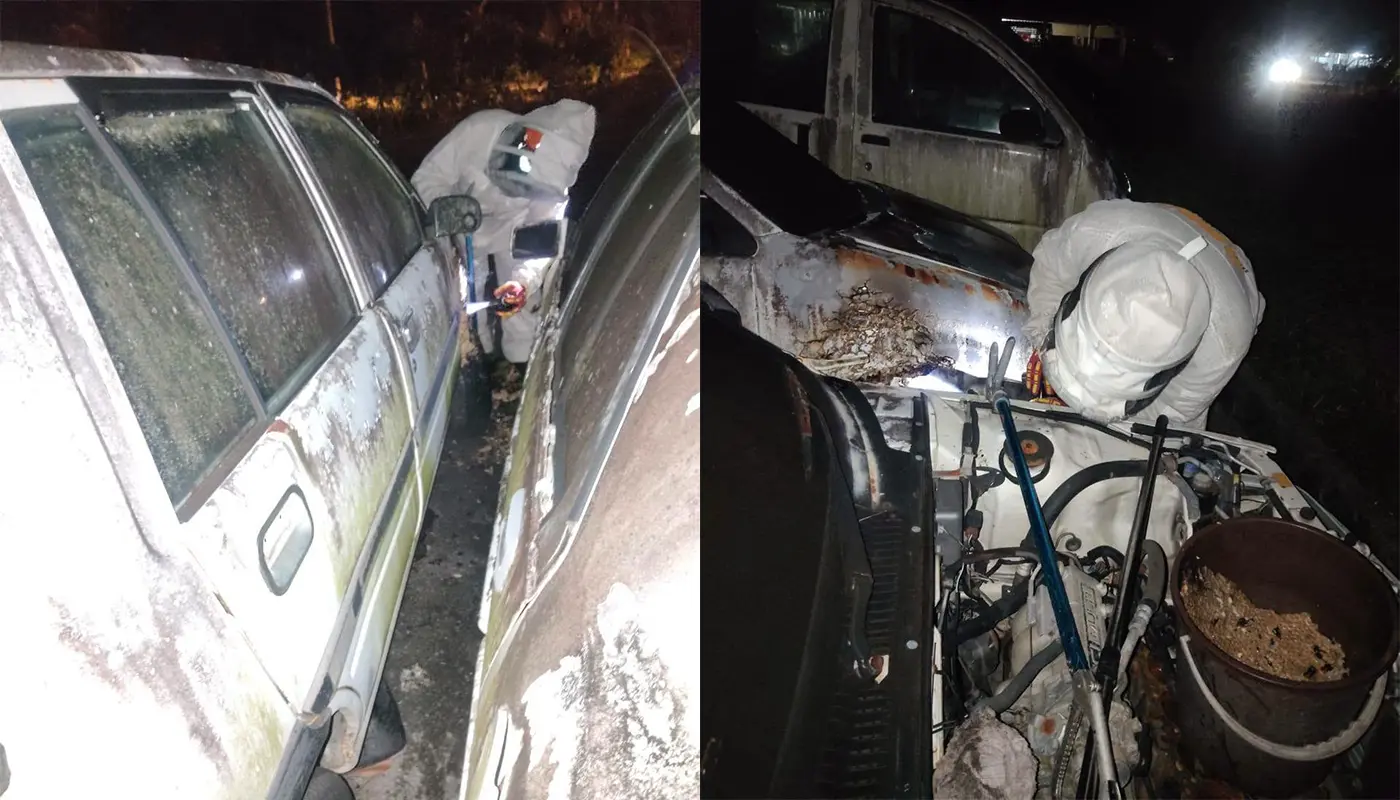
SIBU – Civil defence personnel successfully neutralised a hazardous ground wasp colony discovered near residential premises in Lorong 3A, Jalan Kaland on Thursday evening. The operation eliminated potential stinging risks for local inhabitants after a member of the public reported the presence of an unusually large nest associated with discarded vehicle debris.

Emergency services received notification from a sixty-year-old resident who had observed the insect activity adjacent to his property. His vigilance in identifying and reporting the hazard enabled authorities to respond before any injuries occurred or the colony expanded further. Community awareness and prompt communication remain critical first lines of defence against biological threats in urban environments.
Upon arrival at the scene, a three-member response team conducted a thorough risk assessment to determine appropriate intervention methods. Inspection revealed a nest approximately the size of a car tyre situated within or beside an abandoned Kancil wheel rim left on the roadside. Such neglected items frequently provide sheltered microhabitats attractive to ground-nesting hymenopterans seeking protected nesting sites.
Responders employed targeted poison spray application to eliminate the colony safely and effectively. This technique allows precise delivery of control agents directly into nest entrances whilst minimising chemical drift into surrounding soil, vegetation, or drainage systems. Proper personal protective equipment and established safety protocols safeguarded both operators and nearby residents throughout the treatment process.
The operation proceeded without incident and concluded with confirmation that the site posed no further danger to the public. Post-treatment verification ensures complete colony elimination rather than temporary suppression that might allow recovery and renewed aggression. Thorough follow-up distinguishes professional interventions from inadequate amateur attempts that often exacerbate problems through incomplete eradication.
Ground-nesting wasps present distinct challenges compared to aerial colonies due to concealed locations and defensive behaviours triggered by ground vibrations. Unlike visible paper nests suspended from eaves or branches, subterranean habitats remain hidden until disturbed accidentally during gardening, construction, or pedestrian traffic. Early detection through community reporting prevents surprise encounters that typically result in multiple stings.
Discarded tyres and similar waste materials create ideal conditions for pest proliferation beyond mere aesthetic concerns. Water retention, thermal insulation, and physical protection combine to support diverse arthropod communities including disease vectors alongside stinging insects. Proper waste disposal and regular property maintenance reduce habitat availability and associated public health risks substantially.
Urban wildlife management increasingly recognises ecological roles played by native pollinators and predators even when coexistence requires careful negotiation. Not all wasp species warrant destruction; some provide valuable ecosystem services controlling crop pests or decomposing organic matter. Accurate identification informs proportionate responses balancing human safety with environmental stewardship responsibilities.
Training programmes for civil defence volunteers include practical instruction on insect behaviour, chemical handling, and decontamination procedures specific to ground nest scenarios. Classroom theory combines with supervised field exercises to build competence and confidence amongst new recruits facing unpredictable subterranean colonies. Refresher courses maintain skill levels and incorporate updated safety standards reflecting current best practices in urban entomology.
Equipment readiness directly influences operational effectiveness for biological hazard responses in confined spaces. Spray apparatus with extension wands, protective suits rated for stinging insects, first aid kits containing epinephrine auto-injectors, and communication devices require regular inspection and replenishment. Maintenance discipline prevents equipment failures that could compromise responder safety or mission success during nocturnal deployments.
Environmental considerations increasingly inform pest management decisions alongside immediate human safety priorities. Selective treatments targeting only problematic colonies preserve beneficial species populations essential for urban ecosystem health. Balanced approaches protect both public wellbeing and biodiversity values within shared landscapes where development interfaces with natural habitats.
Inter-agency collaboration enhances overall emergency management capacity beyond individual organisational boundaries. Municipal councils may address underlying waste accumulation issues whilst health departments provide medical guidance for sting prevention and treatment. Integrated response frameworks ensure comprehensive solutions addressing root causes rather than merely treating symptoms repeatedly over time.
Public education initiatives complement reactive removal services by promoting preventative behaviours and early recognition skills. Residents benefit from guidance on distinguishing aggressive species from benign ones, safe distance maintenance, and appropriate reporting procedures when discovering nests. Empowered households can make informed decisions about when professional assistance is genuinely necessary versus situations manageable through simple avoidance measures.
Data collection from individual incidents supports evidence-based resource allocation and strategic planning across districts. Analysis of response times, treatment outcomes, seasonal patterns, and geographic distribution identifies coverage gaps or capacity constraints needing attention. Continuous improvement cycles transform operational experience into systemic enhancements benefiting entire populations through better preparedness and more efficient service delivery.
Volunteer dedication forms the foundation of auxiliary emergency services throughout urban and rural Sarawak alike. Individuals balance civilian employment or studies with unpaid service commitments driven by civic responsibility and community solidarity. Recognition programmes and appreciation events help sustain morale and encourage ongoing participation essential for organisational resilience in addressing diverse local hazards.
Long-term community safety depends on adaptive management responding to changing land use patterns and environmental conditions. Urban expansion into previously undeveloped areas increases interface zones where human activities encounter wildlife habitats more frequently. Forward-looking planning integrates ecological knowledge with public safety strategies for sustainable coexistence outcomes that respect both human needs and natural processes.
