



KUCHING – The Kuching Festival Food Fair 2026 has emerged as a significant platform for inter-governmental dialogue and international cultural exchange this week.

A high-level delegation from Kuala Lumpur recently arrived in the city to conduct a working visit, underscoring the growing importance of the event beyond its reputation as a culinary destination.
YB Hannah Yeoh, the Minister in the Prime Minister’s Department responsible for Federal Territories, led the federal team. She was accompanied by YBhg Datuk Seri TPr Fadlun bin Mak Ujud, the Mayor of Kuala Lumpur, alongside officials from the Kuala Lumpur City Hall (DBKL).
Their presence highlights the strengthening ties between federal and state administrations through shared interests in tourism and urban development.
Discussions during the visit touched upon comparative fiscal capacities. While DBKL manages an annual budget of approximately three billion ringgit, Sarawak’s financial allocation stands significantly higher at 12.9 billion ringgit for a population of 2.6 million.
This contrasts with Sabah, which operates on 6.4 billion ringgit for 3.8 million people, and Selangor, with 3.23 billion ringgit serving 7.4 million residents. These figures illustrate the distinct economic landscapes governing different Malaysian territories.
On the ground, the visiting delegates toured the fair extensively, inspecting over eighty individual stalls. A focal point of their itinerary was the UNESCO Creative Cities Network Gastronomy Pavilion.
Running from 3 August to 9 August 2026, this pavilion serves as a unique hub within Malaysia that connects global communities through culinary arts whilst celebrating Sarawak’s indigenous food heritage.
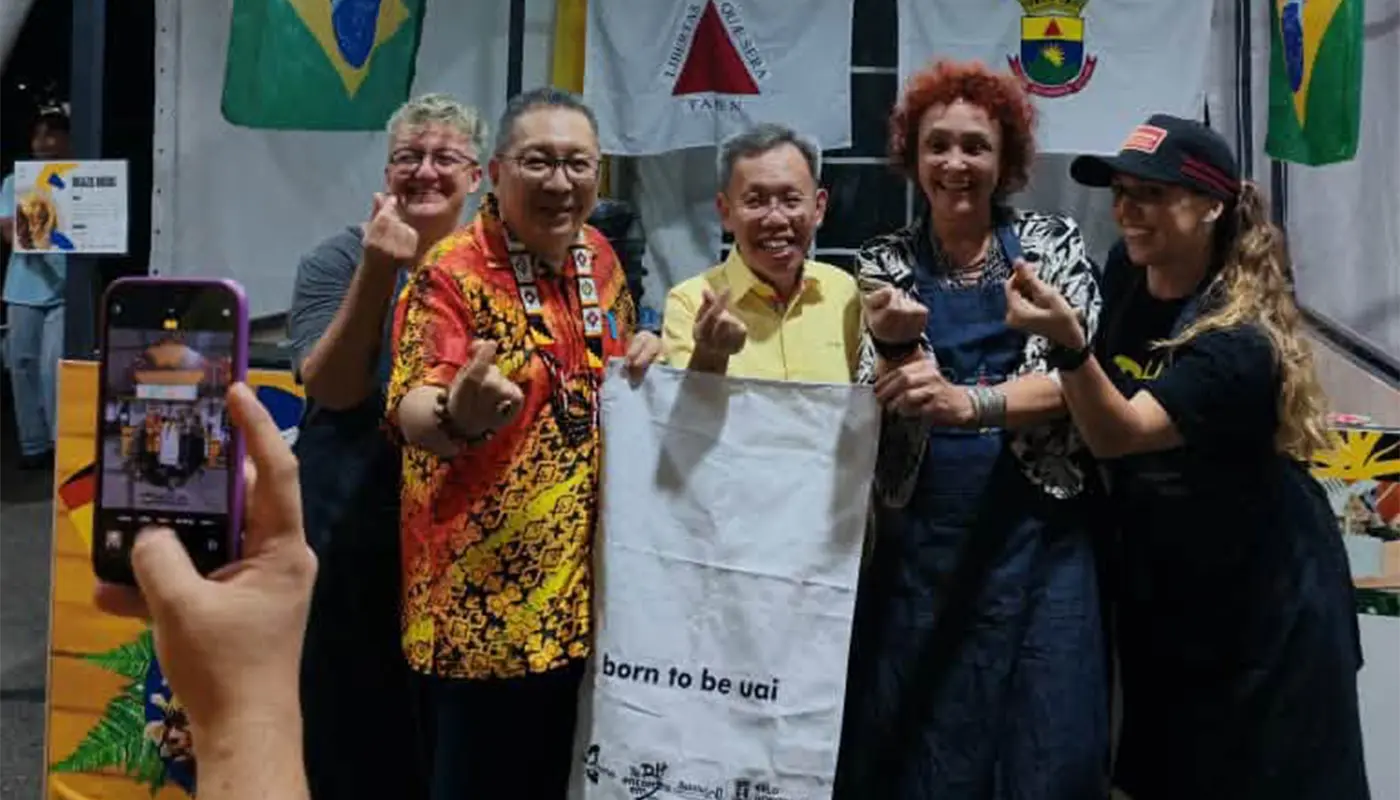
The pavilion currently hosts distinguished chefs from multiple UNESCO-designated cities worldwide. Representatives have arrived from Chengdu and Quanzhou in China, Buraydah and Madinah in Saudi Arabia, Iloilo in the Philippines, Belo Horizonte in Brazil, Lucknow in India, and Nkongsamba in Cameroon.
Their participation transforms the fair into a celebration of friendship and cross-cultural understanding, positioning it as a signature attraction for international visitors.
Dr Sim Kui Hian, the Deputy Premier of Sarawak, who documented the visit, expressed appreciation for the creativity displayed by local vendors. He noted that many stall operators are participating exclusively for this festival, with some travelling specifically from Miri and Sibu.
Engaging directly with these entrepreneurs provided valuable insights into their personal stories and business innovations.
Demographic observations at the event also revealed shifting trends in student attendance. Unlike previous years, the current cohort is predominantly comprised of students from Swinburne University.
Dr Sim highlighted the positive impact of free tertiary education policies but observed that many beneficiaries remain unaware of additional financial support mechanisms available to them.
Under current state initiatives, students receive monthly allowances based on household income criteria. Those from families with a per capita income below 1,500 ringgit are eligible for 800 ringgit monthly.
Furthermore, all Sarawakian university students receive a universal stipend of 100 ringgit each month. With tuition fees of 25,000 to 30,000 ringgit waived, guidance on negotiating living expenses with parents remains a relevant topic for youth welfare.
Operational aspects of the fair also drew attention, particularly regarding the workforce composition. Cleaning teams were observed to be primarily recruited from Tabuan Melayu and Pending.
During interactions with these workers, updates were shared concerning affordable housing projects under the Housing Development Corporation. Progress on apartment construction in those areas was described as satisfactory, and eligible staff were encouraged to submit applications.
Amidst the official duties, moments of levity occurred when Dr Sim successfully obtained one of only 200 limited-edition soft toy charms featuring the CCK mascot. This exclusive collectible was preferred over standard corporate merchandise, adding a personal touch to the extensive programme of engagements.
Organisers and officials alike are urging the public to attend before the event concludes. With eight nights remaining, the fair offers an extensive array of choices that will not return until next year.
The emphasis remains on supporting local vendors and international guests alike, ensuring the continued success of this major cultural gathering in the state capital.
