



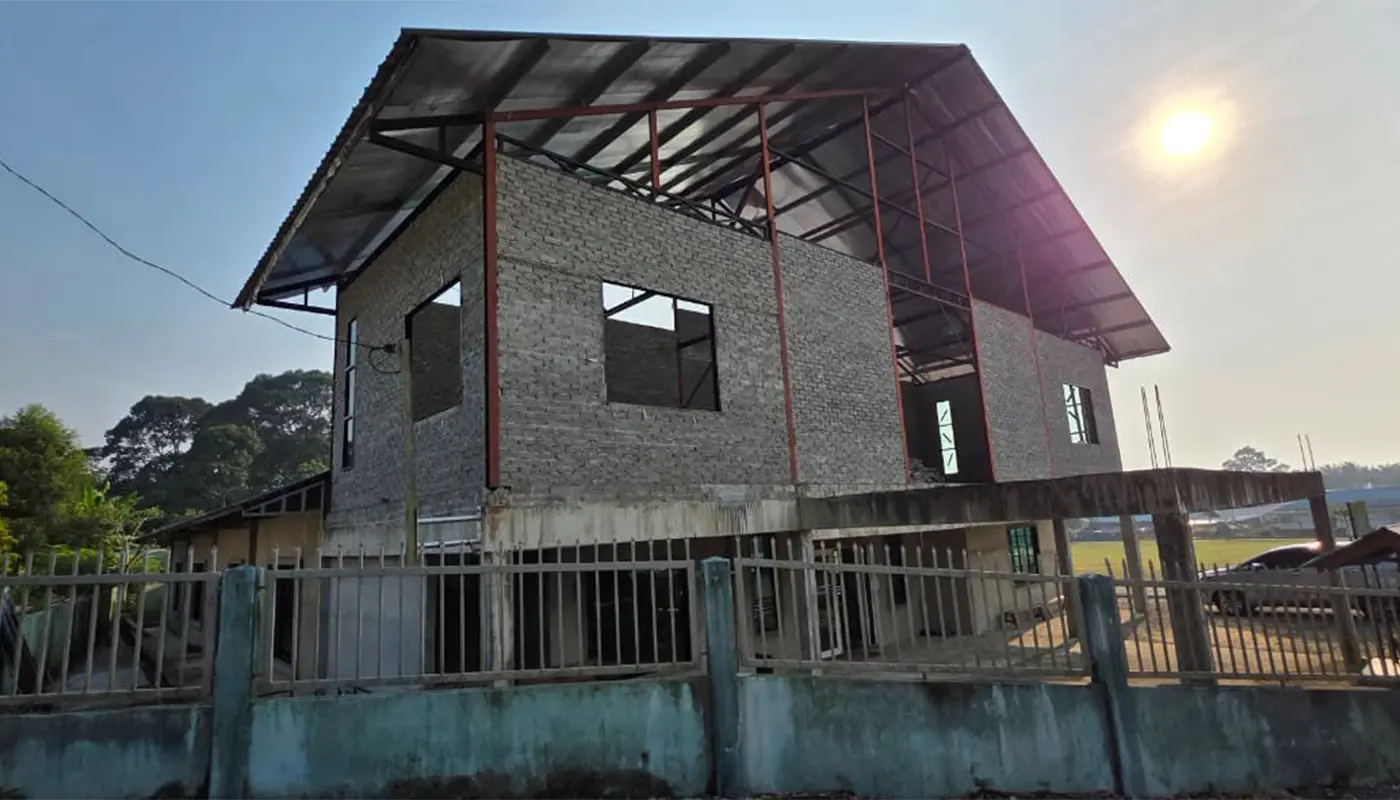
KUCHING – A two-day verification and monitoring exercise targeting religious infrastructure projects was conducted across the Kuching and Serian divisions earlier this week. The Unit for Other Religions (UNIFOR) led inspections at eleven houses of worship between Thursday and Friday to assess funding applications and evaluate ongoing construction compliance against approved specifications.

The Principal Assistant Director of the Monitoring and Compliance Division headed the delegation, supported by an Administrative Officer from the same unit. Technical expertise was provided through the inclusion of two Quantity Surveyor Officers from the Sarawak Public Works Department (JKR), whose specialised knowledge proved essential for evaluating structural integrity, material quality, and cost alignment with project scopes.
Thursday’s itinerary focused exclusively on Serian Division, covering six sites that spanned both accessible roadside locations and more remote interior settlements. St Peter’s Church in Kampung Lebor and St Joseph’s Church in Kampung Seroban were among the first venues inspected, followed by the Seventh-day Adventist Church in Sibala and St Paul’s Church at Kampung Tarat Melawi.
The day’s schedule also included visits to the Seventh-day Adventist Church in Kampung Braang Payang and St Michael’s Church at Teng Bukap. These rural congregations often face unique logistical challenges during construction phases, making physical site assessments particularly valuable for understanding contextual factors that documentation alone cannot convey.
Friday’s programme shifted focus to the Kuching Division, beginning with St Simon & Jude Chapel in Tian Mawang and the Seventh-day Adventist Church in Kampung Rituh Mawang. Urban and peri-urban sites present different oversight considerations compared to rural counterparts, including denser regulatory environments and varied contractor availability.
Three additional Buddhist and Taoist institutions were inspected on the second day, reflecting the diverse faith communities served under UNIFOR’s mandate. Che Hui Khor Temple, which operates under the Kuching and Samarahan Division Moral Upliftment Society, received attention alongside Kuching Poh Ka Buddhist Temple and Lo San Miaw Temple. This denominational breadth demonstrates equitable application of monitoring protocols across all eligible religious traditions.
On-site verification serves multiple critical functions within public fund administration. Physical inspection confirms that reported progress matches observable reality, preventing discrepancies between paperwork and actual implementation. Direct observation also identifies potential safety concerns or workmanship issues before they become costly remediation problems.
Quantity surveyors play indispensable roles in assessing whether expenditure aligns with market rates and technical standards. Their professional evaluations protect against both overpayment and substandard construction that could compromise facility longevity or user safety. Independent technical assessment adds credibility to funding decisions and maintains accountability throughout project lifecycles.
Compliance monitoring extends beyond mere box-ticking to encompass genuine partnership with beneficiary communities. Site visits create opportunities for dialogue about challenges encountered during implementation, enabling timely problem-solving rather than retrospective penalty imposition. Collaborative approaches yield better outcomes than purely punitive enforcement models.
Application assessment based on actual site conditions ensures that funding allocations reflect genuine needs rather than aspirational proposals disconnected from ground realities. Factors such as soil stability, access road conditions, utility availability, and existing structure states significantly influence realistic budgeting and timeline projections. Field verification grounds decision-making in empirical evidence.
Scope adherence monitoring protects both public funds and congregational interests by ensuring delivered facilities match what was approved and funded. Unauthorised modifications or substitutions can introduce safety risks, functional deficiencies, or maintenance burdens that undermine long-term sustainability. Consistent oversight maintains programme integrity across all beneficiaries.
Inter-agency collaboration between UNIFOR and JKR exemplifies integrated governance approaches that leverage complementary expertise. Religious affairs administrators understand community contexts and policy frameworks, whilst engineers bring technical rigour to infrastructure evaluation. Combined perspectives produce more holistic assessments than either discipline could achieve independently.
Transparency in monitoring processes builds trust amongst taxpayers, beneficiary communities, and oversight bodies alike. When procedures are visible, consistent, and professionally executed, confidence in fair resource distribution strengthens. Demonstrated diligence reinforces social licence for continued public investment in religious infrastructure development.
Lessons gathered from these eleven site visits will inform future programme refinements and capacity-building initiatives. Patterns observed across multiple locations reveal systemic strengths and areas requiring attention, guiding strategic improvements beyond individual case resolutions. Continuous learning ensures that assistance mechanisms evolve responsively alongside changing community needs and construction industry practices.
Completion of this Kuching-Serian cycle contributes to statewide coverage goals that ensure no eligible community is overlooked due to geographic isolation or administrative boundaries. Systematic rotation through divisions maintains equitable attention distribution whilst building comprehensive institutional knowledge of Sarawak’s diverse religious infrastructure landscape.
