



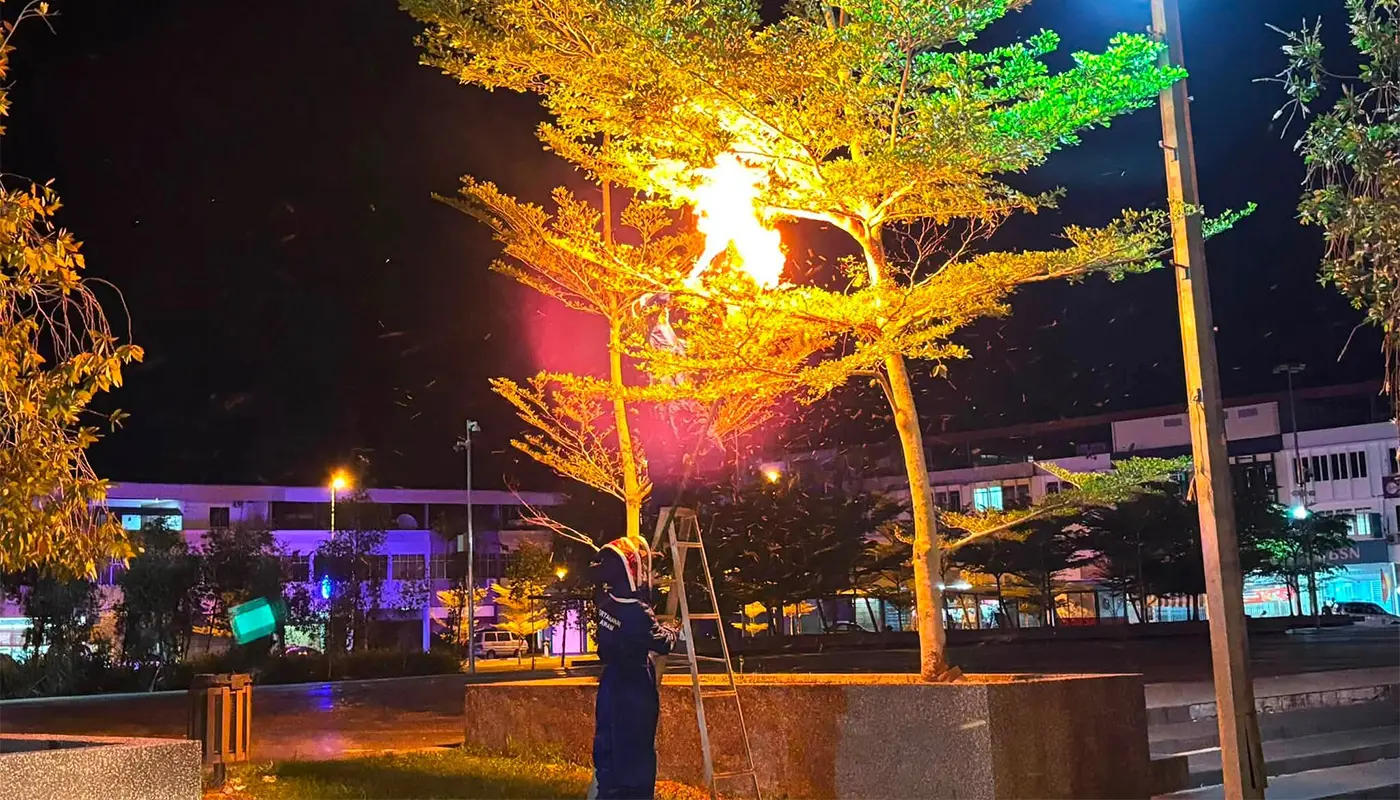
MARUDI – Civil defence personnel successfully eliminated a hazardous insect colony located near a popular public recreation area following an emergency report on Thursday afternoon.

The operation at Marudi Waterfront concluded safely without injury to responders or bystanders, restoring security for visitors and workers frequenting the riverside promenade.
District operations control centre received notification at 4:41 pm from Telekom Malaysia staff who had identified the nest during routine activities in the vicinity.
Alpha Squad was immediately mobilised under the leadership of Sjn. (PA) Siti Naquiah Binti Abdullah to address the situation given its proximity to high-traffic pedestrian zones.
The three-kilometre journey from base allowed rapid deployment whilst ensuring adequate equipment preparation for biological hazard response in public spaces.
Upon reaching the scene, responders met with the complainant, a thirty-four-year-old individual who confirmed no stings or injuries had occurred despite close proximity to the active colony.
Accurate reporting enabled authorities to assess threat levels before conditions deteriorated or accidental disturbance triggered defensive swarm behaviour near unsuspecting members of the public.
Early intervention prevents minor nuisances from escalating into serious medical emergencies requiring mass casualty response capabilities.
Inspection revealed a insect nest measuring approximately two feet by two feet situated within tree foliage adjacent to waterfront pathways. Species identification informed selection of appropriate control methods balancing immediate human safety with ecological considerations specific to pollinator taxa.
Proper assessment distinguishes genuinely dangerous colonies warranting destruction from benign or beneficial populations suitable for relocation by specialist beekeepers when feasible.
Responders employed combined ridsect spray application and controlled burning techniques to neutralise the colony effectively in situ.
This dual-method approach ensures complete elimination of adult insects and brood stages whilst minimising chemical drift into the surrounding environment or water bodies below.
Personal protective equipment and established safety protocols safeguarded both operators and nearby pedestrians throughout treatment activities in this exposed public location.
Post-operation verification confirmed successful colony eradication and absence of residual aggression risks for area users. Thorough follow-up inspection prevents partial success that might allow recovery and renewed defensive behaviour towards future visitors.
Comprehensive completion demonstrates commitment to service excellence beyond mere technical execution of primary control objectives in shared recreational environments.
Insects occupying urban trees present unique management challenges due to their ecological importance alongside potential sting hazards in crowded settings.
Unlike aggressive wasp species, Apis colonies typically defend nests only when directly threatened, making avoidance often preferable to destruction when safe distances can be maintained.
However, high-traffic locations like waterfronts necessitate proactive intervention when nest placement creates unavoidable conflict zones incompatible with public access patterns.
Community education initiatives complement reactive removal services by promoting awareness of pollinator roles and appropriate reporting thresholds.
Residents and businesses benefit from guidance distinguishing urgent threats requiring professional assistance from situations manageable through simple avoidance or referral to beekeeping associations for live relocation.
Empowered stakeholders can make informed decisions supporting both human safety and biodiversity conservation values within shared landscapes.
Training programmes for civil defence volunteers include practical instruction on insect behaviour, chemical handling, fire safety, and species identification specific to regional hymenopteran fauna encountered in public settings.
Classroom theory combines with supervised field exercises using simulated scenarios under expert supervision to build competence and confidence amongst new recruits facing unpredictable colony responses in exposed environments.
Refresher courses maintain skill levels and incorporate updated safety standards reflecting current best practices in integrated pest management across diverse Sarawak habitats.
Equipment readiness directly influences operational effectiveness for biological hazard responses involving live insects in public spaces.
Spray apparatus with precision nozzles, ignition tools for controlled burning, protective suits rated for stinging insects, first aid kits containing epinephrine auto-injectors, and communication devices require regular inspection and replenishment.
Maintenance discipline prevents equipment failures that could compromise responder safety, public protection, or mission success during time-sensitive deployments in high-visibility locations.
Environmental considerations increasingly inform pest management decisions alongside immediate human safety priorities in ecologically sensitive areas.
Selective treatments targeting only problematic colonies preserve beneficial pollinator populations essential for ecosystem health and agricultural productivity.
Balanced approaches protect both public wellbeing and biodiversity values within shared landscapes where recreational infrastructure interfaces closely with natural habitats along Sarawak’s extensive riverine networks.
Inter-agency collaboration enhances overall emergency management capacity beyond individual organisational boundaries.
Municipal councils may address underlying vegetation management issues whilst agricultural departments provide expertise on pollinator health and relocation options when appropriate.
Integrated response frameworks ensure comprehensive solutions addressing multiple dimensions of complex human-insect interaction scenarios rather than treating symptoms in isolation repeatedly over time.
Data collection from individual incidents supports evidence-based resource allocation and strategic planning across districts with significant public recreation assets.
Analysis of response times, species distributions, seasonal patterns, and geographic clustering identifies coverage gaps or capacity constraints needing attention given varying visitor volumes and habitat types.
Continuous improvement cycles transform operational experience into systemic enhancements benefiting entire populations through better preparedness and more efficient service delivery tailored to local ecological and social contexts.
Volunteer dedication forms the foundation of auxiliary emergency services throughout rural and semi-urban Sarawak where formal agency presence remains limited relative to service demand. Individuals balance civilian employment or studies with unpaid service commitments driven by civic responsibility and environmental stewardship values.
Recognition programmes and appreciation events help sustain morale and encourage ongoing participation essential for organisational resilience in addressing diverse community needs ranging from disaster response to everyday wildlife assistance requests across expansive territories.
Long-term public safety depends on adaptive management responding to changing land use patterns and environmental conditions affecting human-insect interfaces in recreational zones.
Urban development, landscaping practices, and climate variability influence colony establishment patterns and foraging ranges in ways requiring continuous monitoring and strategy adjustment.
Forward-looking planning integrates ecological knowledge with public safety approaches for sustainable coexistence outcomes respecting both community enjoyment and natural heritage shaping Marudi’s unique riverside environment.
