



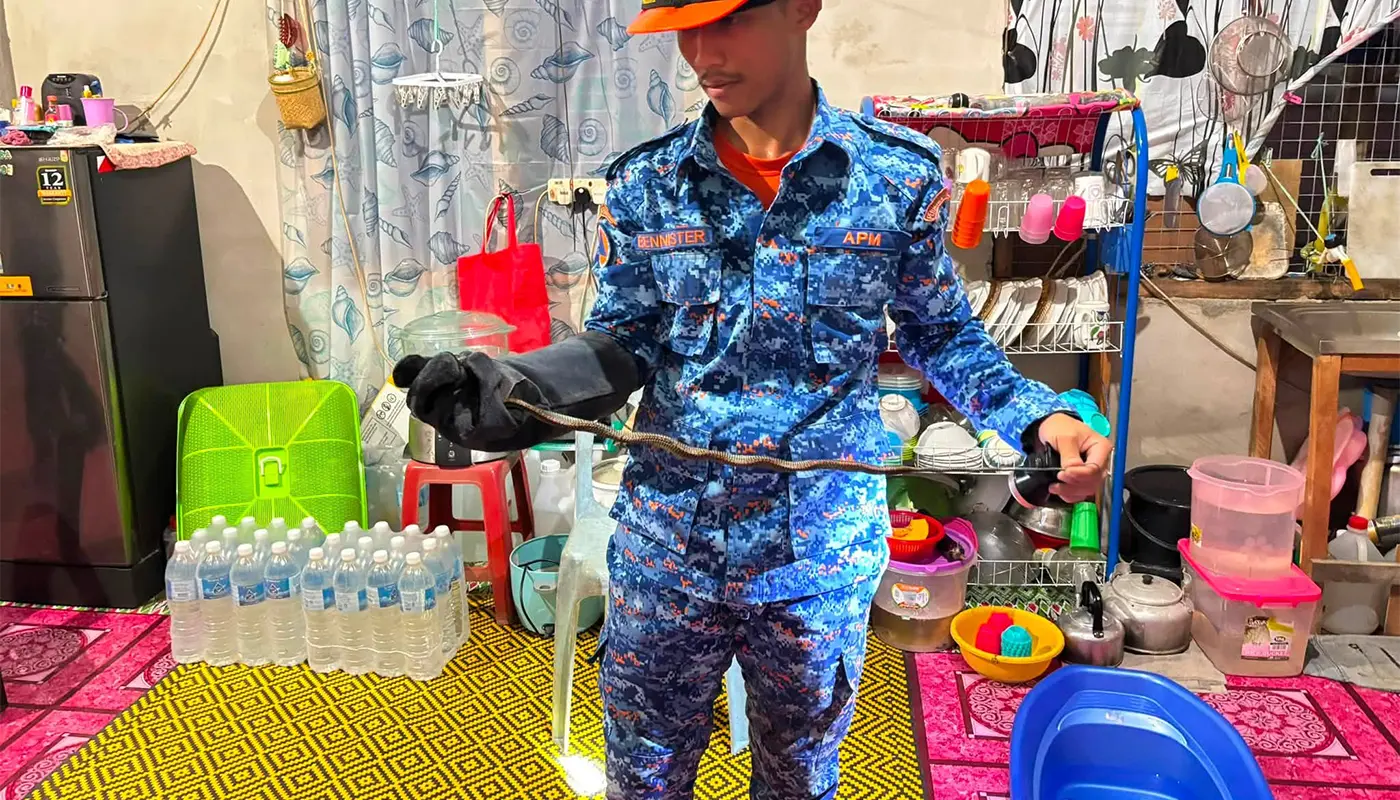
MARUDI – Civil defence personnel successfully extracted two reptiles from the ceiling space of a residential longhouse unit following an emergency call on Thursday evening.

The operation at Rumah Singgan Anak Bawim in Sungai Muam concluded safely without injury to occupants or animals, restoring security for a young family sharing the dwelling with unexpected wildlife visitors.
The district operations control centre received notification at 5:10 pm regarding snakes discovered inside the home located along Jalan SK Sungai Brit. Alpha Squad was immediately mobilised under the leadership of Pbt. (PA) Bennister Bana Ak Sulang to address the situation despite the considerable distance involved.
The thirty-five-kilometre journey to the remote location required careful navigation through rural road networks to ensure timely arrival before darkness complicated indoor search efforts.
Upon reaching the scene, responders met with the complainant, who confirmed no injuries had occurred amongst household members despite close proximity to the reptiles.
The residence housed four individuals, including two children, one adult aged thirty-two, and a four-month-old infant whose vulnerability heightened the urgency of safe removal.
The presence of such young dependents underscored the importance of methodical extraction, preventing accidental encounters during capture attempts.
Inspection revealed both specimens concealed within ceiling voids above living quarters where they had sought thermal refuge and hunting opportunities.
Accurate location identification preceded any physical intervention to avoid driving animals deeper into inaccessible spaces or triggering defensive behaviours near occupied areas below.
Thorough preliminary assessment distinguishes professional operations from hasty actions that often exacerbate risks for all parties involved.
Responders employed specialised pinching equipment designed specifically for safe arboreal snake restraint during elevated removal tasks.
This precision tool allows secure grip without causing physical harm to delicate specimens whilst maintaining adequate distance between handler and animal in confined overhead environments.
Proper equipment selection proves especially critical when working above vulnerable occupants who cannot easily relocate during active capture procedures.
Both leaf snakes, each measuring approximately one metre in length, were successfully captured and contained without incident.
Species identification confirmed non-venomous status, allowing subsequent relocation to suitable habitat distant from human settlements rather than euthanasia.
Accurate taxonomic knowledge informs proportionate responses balancing human safety concerns with conservation ethics and ecological stewardship responsibilities.
Post-operation verification ensured no additional reptiles remained hidden within ceiling cavities or adjacent structural voids. Comprehensive follow-up inspection prevents partial success that might leave residents anxious about potential future encounters or undiscovered nest sites.
Thorough completion demonstrates commitment to service excellence beyond mere technical execution of primary capture objectives.
Leaf-nosed vine snakes frequently enter traditional wooden structures seeking prey abundance, thermal stability, or sheltered roosting sites aligned with their arboreal ecology. Slender body morphology enables navigation through narrow gaps and beam spaces inaccessible to bulkier terrestrial species.
Understanding these behavioural adaptations helps responders anticipate likely hiding spots and implement effective search strategies during indoor callouts involving this particular taxon.
Community education initiatives complement reactive removal services by promoting preventative measures tailored to longhouse architecture and lifestyle patterns.
Residents benefit from guidance on sealing roof entry points, managing vegetation contact with eaves, and installing physical barriers denying access to ceiling voids without compromising ventilation needs.
Empowered households can reduce recurrence likelihood through proactive maintenance rather than relying solely on emergency response after incidents occur.
Training programmes for civil defence volunteers include practical instruction on reptile behaviour, safe handling techniques, and species identification specific to regional herpetofauna encountered in domestic settings.
Classroom theory combines with supervised field exercises using live animals under expert supervision to build competence and confidence amongst new recruits facing unpredictable wildlife encounters in elevated or confined spaces.
Refresher courses maintain skill levels and incorporate updated safety standards reflecting current best practices in herpetological rescue operations across diverse Sarawak habitats.
Equipment readiness directly influences operational effectiveness for biological hazard responses involving live animals in challenging architectural contexts.
Capture tools with extended reach, headlamps for dark voids, protective gloves, containment vessels, and reference materials require regular inspection and replenishment to ensure reliability during deployments.
Maintenance discipline prevents equipment failures that could compromise responder safety, animal welfare, or mission success during time-sensitive residential callouts in remote locations.
Environmental considerations increasingly inform wildlife management decisions alongside immediate human safety priorities.
Relocation protocols prioritise suitable forest habitat release sites supporting population viability whilst preventing recurrent conflicts near human dwellings.
Balanced approaches protect both public wellbeing and biodiversity values within shared landscapes where traditional settlement patterns interface closely with natural ecosystems across Sarawak’s interior districts.
Inter-agency collaboration enhances overall emergency management capacity beyond individual organisational boundaries. Wildlife departments may provide taxonomic expertise or regulatory guidance, whilst veterinary services assist with injured specimen rehabilitation when needed.
Integrated response frameworks ensure comprehensive solutions addressing multiple dimensions of complex human-wildlife interaction scenarios rather than treating symptoms in isolation repeatedly over time.
Data collection from individual incidents supports evidence-based resource allocation and strategic planning across remote districts.
Analysis of response times, species distributions, seasonal patterns, and geographic clustering identifies coverage gaps or capacity constraints needing attention given vast distances and limited infrastructure.
Continuous improvement cycles transform operational experience into systemic enhancements benefiting entire populations through better preparedness and more efficient service delivery tailored to local ecological and logistical realities.
Volunteer dedication forms the foundation of auxiliary emergency services throughout rural Sarawak, where formal agency presence remains sparse relative to population dispersion.
Individuals balance civilian employment or subsistence activities with unpaid service commitments driven by civic responsibility and compassion for both people and wildlife.
Recognition programmes and appreciation events help sustain morale and encourage ongoing participation essential for organisational resilience in addressing diverse community needs ranging from disaster response to everyday wildlife assistance requests across expansive territories.
Long-term community safety depends on adaptive management responding to changing land use patterns and environmental conditions affecting human-wildlife interfaces.
Agricultural expansion, forest fragmentation, and climate variability influence reptile movement patterns and habitat preferences in ways requiring continuous monitoring and strategy adjustment.
Forward-looking planning integrates ecological knowledge with public safety approaches for sustainable coexistence outcomes, respecting both cultural traditions and natural heritage, shaping Marudi’s unique biocultural landscape.
