



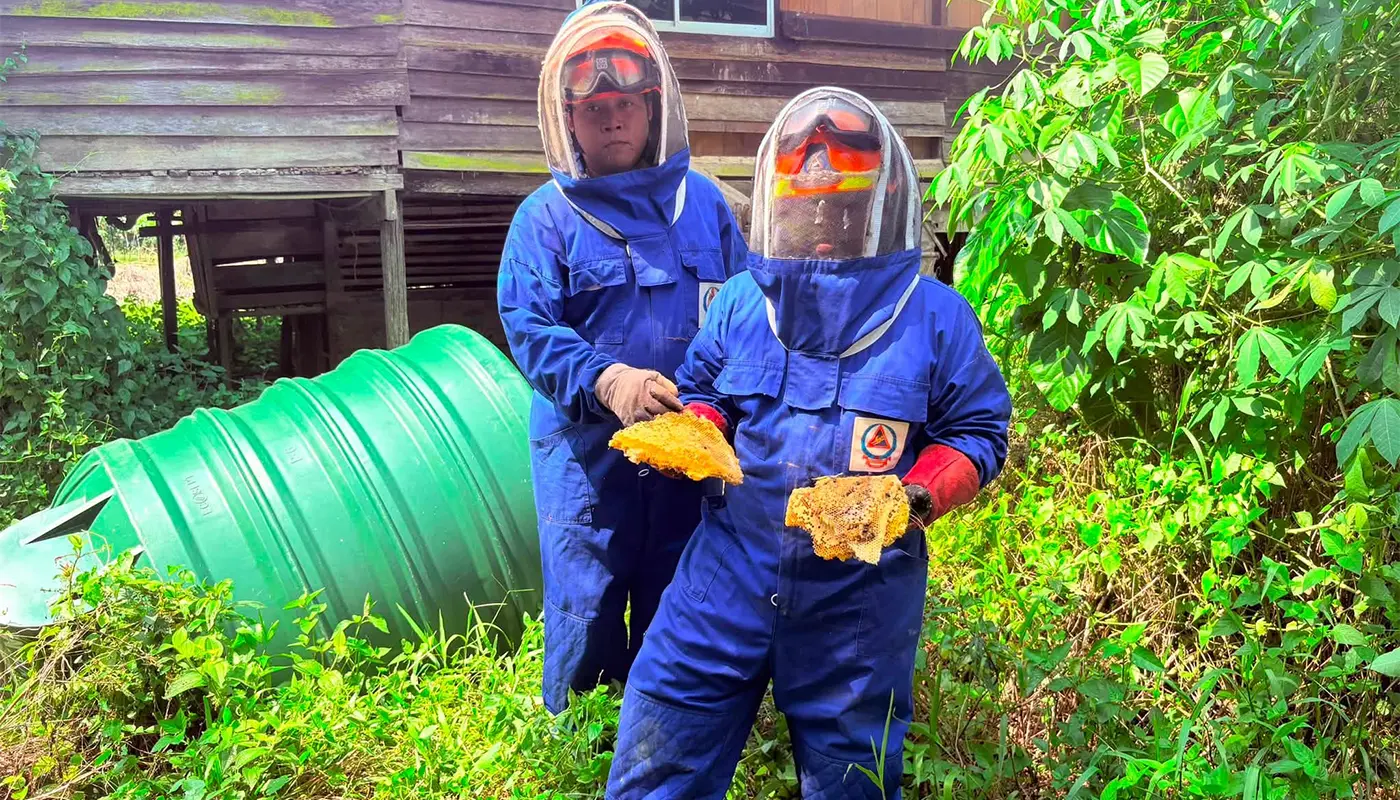
SELANGAU – Civil defence personnel successfully eliminated a hazardous insect colony discovered on the exterior wall of a longhouse in Sungai Duat on Friday. The operation at Rumah Jawa was initiated following a public report concerning potential safety risks posed by the nest’s proximity to residential living spaces.

District operations control centre received the alert and immediately dispatched the duty squad to assess the situation. Rapid mobilisation ensured that trained responders arrived promptly to evaluate threat levels before conditions could deteriorate or endanger occupants. Timely intervention prevents minor nuisances from escalating into serious health or safety emergencies for vulnerable community members.
On-site inspection revealed a combined bee and fly nest approximately the size of a volleyball attached to the building’s outer surface. Accurate identification of species and nest characteristics informed selection of appropriate removal methods whilst minimising unnecessary environmental impact. Proper assessment distinguishes genuinely dangerous colonies from benign pollinators warranting relocation rather than destruction.
Responders employed targeted insecticide spray techniques to neutralise the colony safely and effectively. This method allows precise application without excessive chemical dispersal into surrounding areas or water sources. Personal protective equipment and established safety protocols protected both operators and nearby residents during treatment activities.
Successful elimination of the nest restored peace of mind for longhouse inhabitants concerned about stinging incidents or allergic reactions. Children, elderly individuals, and those with known sensitivities face elevated risks when aggressive insects establish nests near doorways, windows, or communal areas. Proactive removal mitigates these vulnerabilities whilst maintaining habitability standards.
Insect-related emergencies occur frequently in rural Sarawak where traditional architecture interfaces closely with natural ecosystems. Wooden structures, open eaves, and vegetation proximity create ideal nesting sites for various hymenopteran species throughout the year. Seasonal patterns influence activity peaks, requiring adaptive response strategies aligned with biological cycles.
Community education plays a vital complementary role alongside reactive removal services. Residents benefit from guidance on early detection signs, safe distance maintenance, and appropriate reporting procedures when discovering nests. Empowered households can distinguish between urgent threats requiring professional assistance and situations manageable through simple avoidance measures.
Preventative maintenance reduces recurrence likelihood following successful nest elimination. Sealing cracks, trimming overhanging branches, and installing physical barriers deny future colonisation opportunities on treated structures. Integrated pest management approaches combine immediate intervention with long-term exclusion strategies for sustainable results.
Equipment readiness directly influences operational effectiveness for biological hazard responses. Spray apparatus, protective suits, first aid kits, and communication devices require regular inspection and replenishment to ensure reliability during deployments. Maintenance discipline prevents equipment failures that could compromise responder safety or mission success.
Training programmes for civil defence volunteers include practical instruction on insect behaviour, chemical handling, and decontamination procedures. Classroom theory combines with supervised field exercises to build competence and confidence amongst new recruits. Refresher courses maintain skill levels and incorporate updated safety standards reflecting current best practices.
Environmental stewardship considerations increasingly inform pest management decisions alongside human safety priorities. Selective treatments targeting only problematic colonies preserve beneficial pollinator populations essential for ecosystem health. Balanced approaches protect both public wellbeing and biodiversity values within shared landscapes.
Inter-agency collaboration enhances overall emergency management capacity beyond individual organisational boundaries. Health departments may provide medical support for sting victims whilst agricultural agencies offer expertise on species identification and ecological impacts. Integrated response frameworks ensure comprehensive solutions addressing multiple dimensions of complex incidents.
Public communication channels facilitate efficient information exchange between communities and emergency services. Dedicated hotlines operating twenty-four hours daily enable instant reporting regardless of time or day. Accessible contact numbers like 084-891285 for APM Selangau remove barriers to seeking assistance during urgent situations involving biological hazards.
Data collection from individual incidents supports evidence-based resource allocation and strategic planning. Analysis of response times, treatment outcomes, and geographic distribution identifies coverage gaps or capacity constraints needing attention. Continuous improvement cycles transform operational experience into systemic enhancements benefiting entire populations over time.
Volunteer dedication forms the foundation of auxiliary emergency services throughout rural Sarawak. Individuals balance civilian responsibilities with unpaid service commitments driven by civic pride and community solidarity. Recognition programmes and appreciation events help sustain morale and encourage ongoing participation essential for organisational sustainability in remote districts.
Long-term community resilience depends on adaptive management responding to changing environmental conditions and land use patterns. Climate variability influences insect population dynamics and range expansions, creating novel challenges for traditional settlement areas. Forward-looking planning integrates ecological knowledge with public safety strategies for sustainable coexistence outcomes.
