



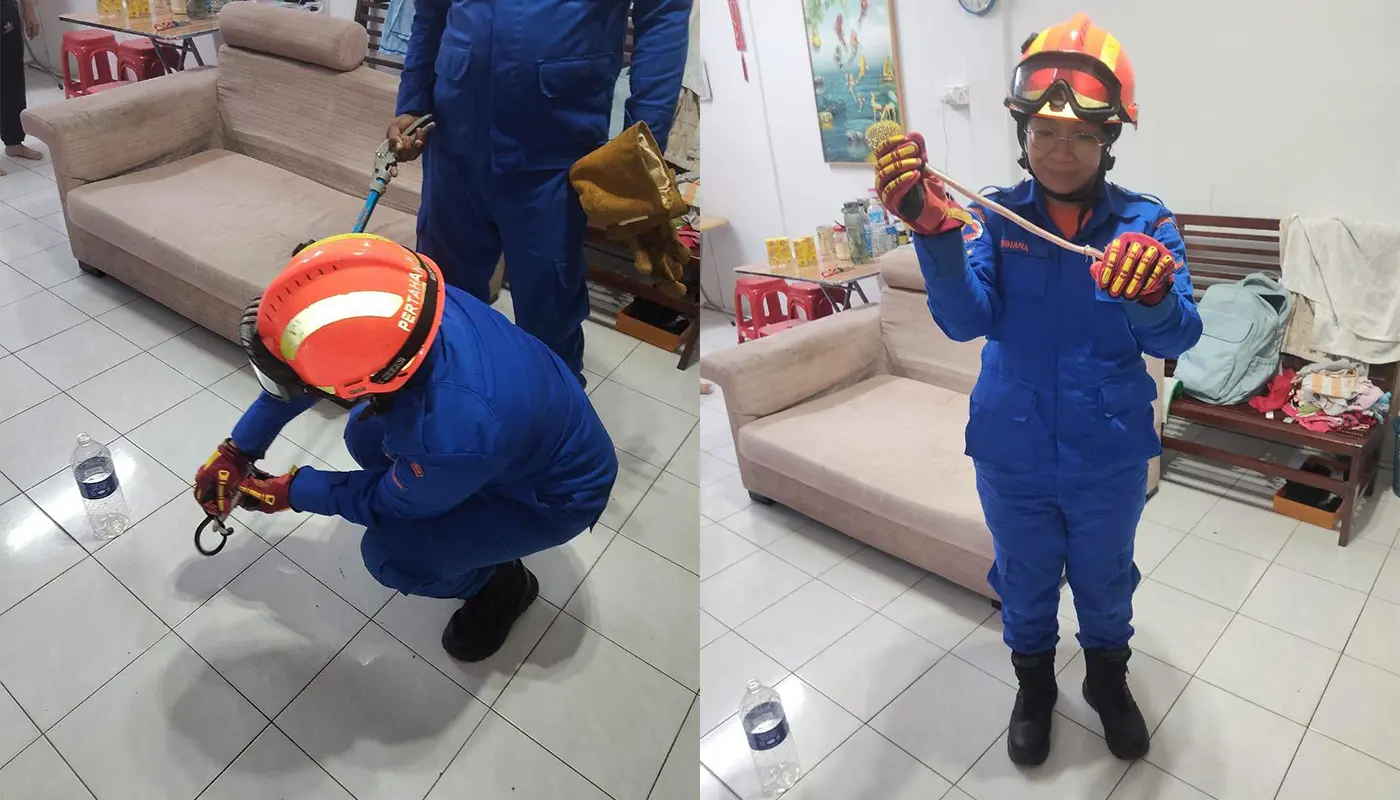
SIBU – Civil defence personnel successfully removed a juvenile snake discovered inside a private residence on Jalan Mantis Timur during an evening operation on Thursday.

The incident concluded safely after trained responders captured the reptile without injury to either the animal or household occupants, restoring peace of mind for the affected family.
Emergency services received notification from a female resident in her forties who had spotted the creature concealed near furniture in her living room.
Her prompt reporting enabled authorities to respond before the situation escalated or the snake relocated to less accessible areas within the dwelling. Early detection and immediate communication remain essential for managing human-wildlife encounters in domestic settings effectively.
Upon arrival at the scene, a three-member response team conducted a careful assessment to locate and identify the specimen before attempting capture. Inspection revealed a juvenile snake approximately one foot in length hiding along the edge of a sofa where it had sought shelter and warmth.
Accurate species identification informs appropriate handling techniques and determines whether relocation or retention is necessary based on venom status and conservation value.
Responders employed specialised tweezers designed specifically for safe reptile restraint during removal operations. This precision tool allows secure grip without causing physical harm to delicate specimens whilst maintaining adequate distance between handler and animal.
Proper equipment selection distinguishes professional interventions from improvised methods that risk injury to both parties involved in wildlife rescues.
The capture proceeded smoothly and concluded with confirmation that no additional snakes remained hidden within the premises.
Post-operation verification ensures complete resolution rather than partial success that might leave residents anxious about potential future encounters. Thorough follow-up demonstrates commitment to comprehensive service delivery beyond mere technical execution of capture tasks.
Juvenile snakes frequently enter homes seeking thermal refuge, prey opportunities, or accidental shelter during dispersal phases of their life cycles.
Young individuals are particularly prone to wandering into human structures as they establish independent territories away from natal sites. Understanding these behavioural patterns helps responders anticipate likely hiding spots and implement effective search strategies during indoor callouts.
Urban wildlife management increasingly recognises ecological roles played by native reptiles even when coexistence requires careful negotiation.
Many snake species provide valuable ecosystem services controlling rodent populations, insect numbers, or other pest organisms that impact public health and agricultural productivity. Accurate identification prevents unnecessary elimination of beneficial animals whilst ensuring genuine threats receive appropriate attention.
Community education initiatives complement reactive removal services by promoting preventative behaviours and early recognition skills. Residents benefit from guidance on sealing entry points, managing vegetation near foundations, and distinguishing venomous species from harmless ones through reliable identification resources.
Empowered households can make informed decisions about tolerance thresholds and when professional assistance becomes genuinely necessary versus situations manageable through simple exclusion measures.
Training programmes for civil defence volunteers include practical instruction on reptile behaviour, safe handling techniques, and species identification specific to regional fauna. Classroom theory combines with supervised field exercises using live animals under expert supervision to build competence and confidence amongst new recruits facing unpredictable wildlife encounters.
Refresher courses maintain skill levels and incorporate updated safety standards reflecting current best practices in herpetological rescue operations.
Equipment readiness directly influences operational effectiveness for biological hazard responses involving live animals. Capture tools, containment vessels, protective gloves, first aid kits, and reference materials require regular inspection and replenishment to ensure reliability during deployments.
Maintenance discipline prevents equipment failures that could compromise responder safety, animal welfare, or mission success during time-sensitive residential callouts.
Environmental considerations increasingly inform wildlife management decisions alongside immediate human safety priorities. Relocation protocols prioritise suitable habitat release sites distant from human settlements to prevent recurrent conflicts whilst supporting population viability.
Balanced approaches protect both public wellbeing and biodiversity values within shared landscapes where urban development interfaces with natural ecosystems across Sarawak’s diverse biogeographical regions.
Inter-agency collaboration enhances overall emergency management capacity beyond individual organisational boundaries. Wildlife departments may provide taxonomic expertise or regulatory guidance whilst veterinary services assist with injured specimen rehabilitation when needed.
Integrated response frameworks ensure comprehensive solutions addressing multiple dimensions of complex human-wildlife interaction scenarios rather than treating symptoms in isolation repeatedly over time.
Data collection from individual incidents supports evidence-based resource allocation and strategic planning across districts. Analysis of response times, species distributions, seasonal patterns, and geographic clustering identifies coverage gaps or capacity constraints needing attention.
Continuous improvement cycles transform operational experience into systemic enhancements benefiting entire populations through better preparedness and more efficient service delivery tailored to local ecological contexts.
Volunteer dedication forms the foundation of auxiliary emergency services throughout urban and rural Sarawak alike. Individuals balance civilian employment or studies with unpaid service commitments driven by civic responsibility and compassion for both people and wildlife.
Recognition programmes and appreciation events help sustain morale and encourage ongoing participation essential for organisational resilience in addressing diverse community needs ranging from disaster response to everyday wildlife assistance requests.
Long-term community safety depends on adaptive management responding to changing land use patterns and environmental conditions. Urban expansion into previously undeveloped areas increases interface zones where human activities encounter wildlife habitats more frequently than historical baselines suggest.
Forward-looking planning integrates ecological knowledge with public safety strategies for sustainable coexistence outcomes that respect both human needs and natural processes shaping Sarawak’s unique biodiversity heritage.
