



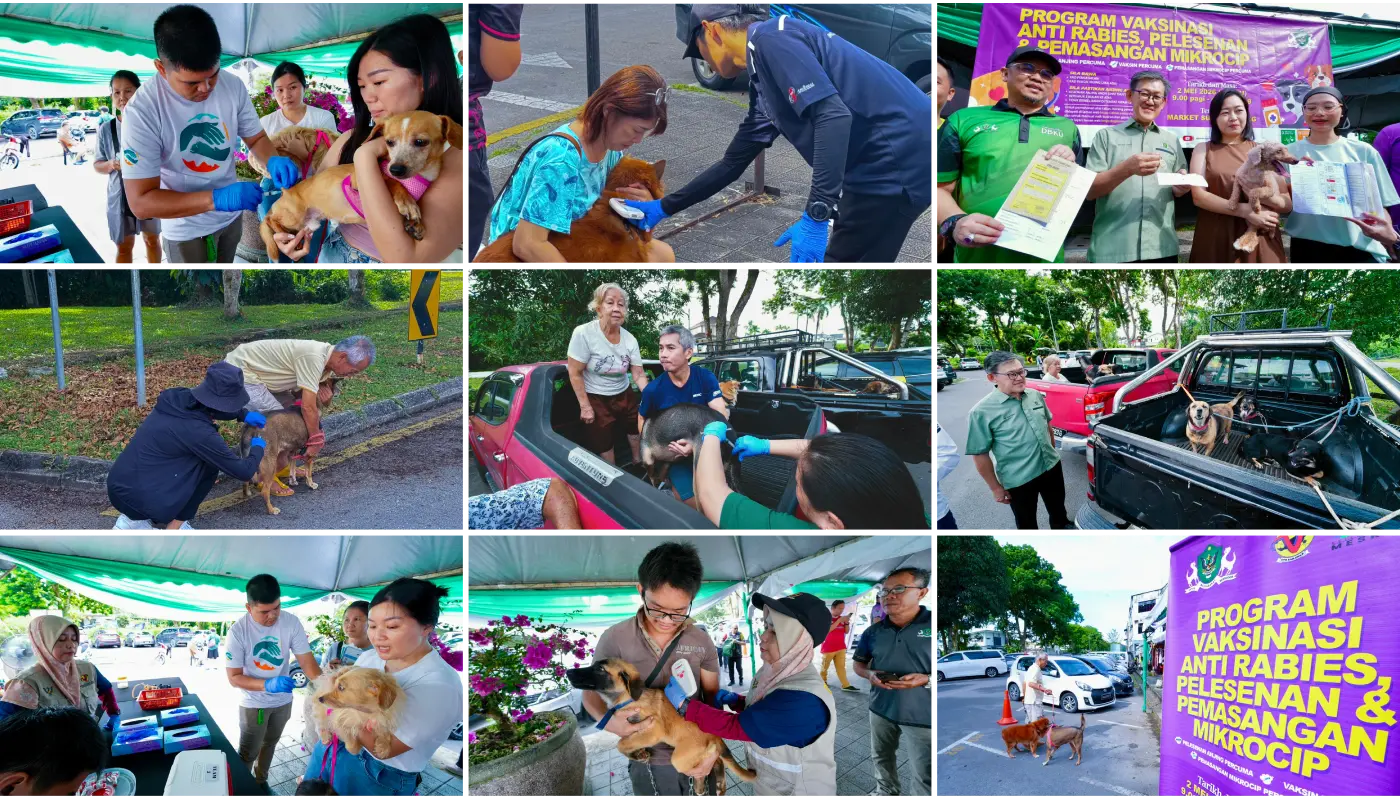
KUCHING – Kuching North City Hall (DBKU) has stepped up its campaign against rabies with the launch of an integrated anti-rabies vaccination, licensing and microchip installation programme at Sungai Maong Market today.

The initiative, carried out in collaboration with the Department of Veterinary Services Sarawak (DVSS), is designed to safeguard public health while promoting responsible pet ownership.
The programme is part of Sarawak’s wider strategy to control rabies, a disease that remains a serious public health concern.
By combining vaccination, licensing, and microchipping, authorities aim to reduce infection risks among pets and strengthen community resilience.
The effort is guided by the One Health approach, which recognises the interconnectedness of human and animal health in building a safer environment.
Organisers targeted 100 dogs for free vaccination, licensing registration, and microchip installation during the event.
This measure not only ensures compliance with existing regulations but also helps create herd immunity, a critical step in reducing the risk of rabies transmission to humans.
Under the Veterinary Public Health Ordinance 1999, annual rabies vaccination is mandatory, reinforcing the state’s commitment to disease prevention.
Sarawak has also introduced a pilot oral rabies vaccination (ORV) programme beginning in April 2026.
This initiative is aimed at reaching stray or hard-to-capture dogs, complementing conventional vaccination methods offered through veterinary clinics and mass community campaigns.
The ORV programme reflects the state’s proactive stance in tackling rabies beyond domestic settings.
Dog licensing remains a legal requirement under the Local Authorities (Dog Licensing and Control) By-laws 2018, which limit ownership to three dogs per household.
Non-compliance can result in fines of up to RM5,000, alongside enforcement action by local authorities.
Licensing ensures better regulation of pet ownership, while microchipping provides permanent identification, enabling swift tracking of owners and strengthening accountability.
The programme’s opening ceremony was officiated by DBKU Council Member Mr Sih Hua Tong. He was joined by Mr Rudzaimeir bin Malek, Deputy Director of the DBKU Community Services Department, and Dr Ainul Riza Abu Seman, Veterinary Officer from DVSS.
Their presence underscored the importance of collaboration between local authorities and veterinary experts in combating rabies.
Community awareness remains a central focus of the campaign. By educating dog owners on their responsibilities, DBKU and DVSS hope to foster a culture of compliance and care that benefits both animals and humans.
The integrated programme is expected to encourage more residents to vaccinate and license their pets, thereby contributing to Sarawak’s long-term goal of a rabies-free state.
Observers note that the combination of vaccination, licensing, and microchipping represents a comprehensive approach to rabies control.
With continued enforcement and public participation, Sarawak aims to strengthen its defences against zoonotic diseases and protect the well-being of its communities.
