



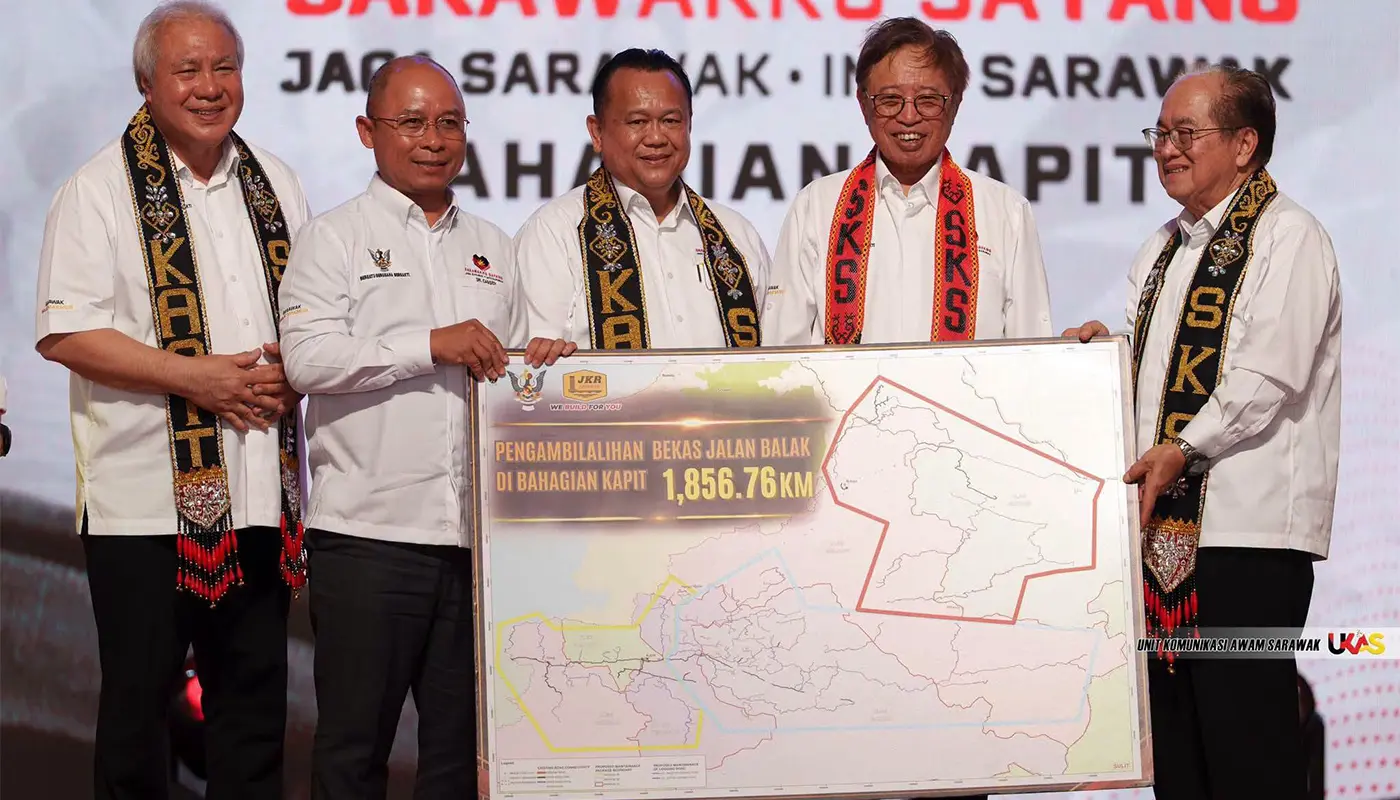
KAPIT – Sarawak’s growing reputation as the “battery of the region” has been reinforced, with Kapit Division recognised as the backbone of the state’s hydroelectric power generation.

Public Works Minister Dato Sri Alexander Nanta Linggi said residents of Kapit can take pride in their role as the powerhouse driving Sarawak’s industry, economy and development.
Speaking during the Sarawakku Sayang Programme (SKS) 2026 for Kapit’s elderly community, he highlighted the contribution of mega hydroelectric projects such as Bakun, Murum and Baleh, which have become symbols of Sarawak’s successful energy agenda.
Sarawak’s current generation capacity stands at 5,898 megawatts (MW), with more than 58 per cent produced from hydroelectric plants in Kapit.
The Bakun Dam alone generates 2,520 MW, while Murum contributes 944 MW. Once completed, the Baleh Hydroelectric Project is expected to add another 1,000 MW, further cementing Kapit’s role as a national energy hub.
By 2030, Sarawak aims to increase its total generation capacity to 10 gigawatts (GW). To achieve this, the state is diversifying its energy mix with solar projects at Bakun and Murum, alongside cascading power sources and pumped hydro storage initiatives.
These measures are designed to ensure reliable supply while supporting Sarawak’s transition to a low-carbon economy.
Dato Sri Alexander also pointed to the importance of coal-fired support from Merit Pila, which supplies 40,000 metric tonnes of coal monthly to the Sejingkat Power Station, sustaining its 120 MW capacity.
He stressed that while hydroelectricity remains the cornerstone of Sarawak’s energy strategy, complementary sources are vital to maintaining grid stability.
The Premier of Sarawak, Datuk Patinggi Tan Sri (Dr) Abang Abdul Rahman Zohari Tun Datuk Abang Openg, has consistently championed the vision of Kapit as the “Green Energy Powerhouse of Sarawak”.
He believes the division’s role in energy production will underpin economic growth, attract investment and support the state’s broader transformation under PCDS 2030.
Efforts are also being made to extend power supply chains along the Belaga and Merit corridors, ensuring communities benefit directly from Sarawak’s energy development.
Authorities emphasised that reliable electricity access is essential for improving education, commerce and quality of life in rural areas.
Community leaders echoed the sentiment, noting that Kapit’s contribution to renewable energy not only strengthens Sarawak’s economy but also positions the state as a regional leader in sustainable power.
The combination of hydroelectricity, solar and supporting energy sources is expected to provide long-term resilience and stability.
