



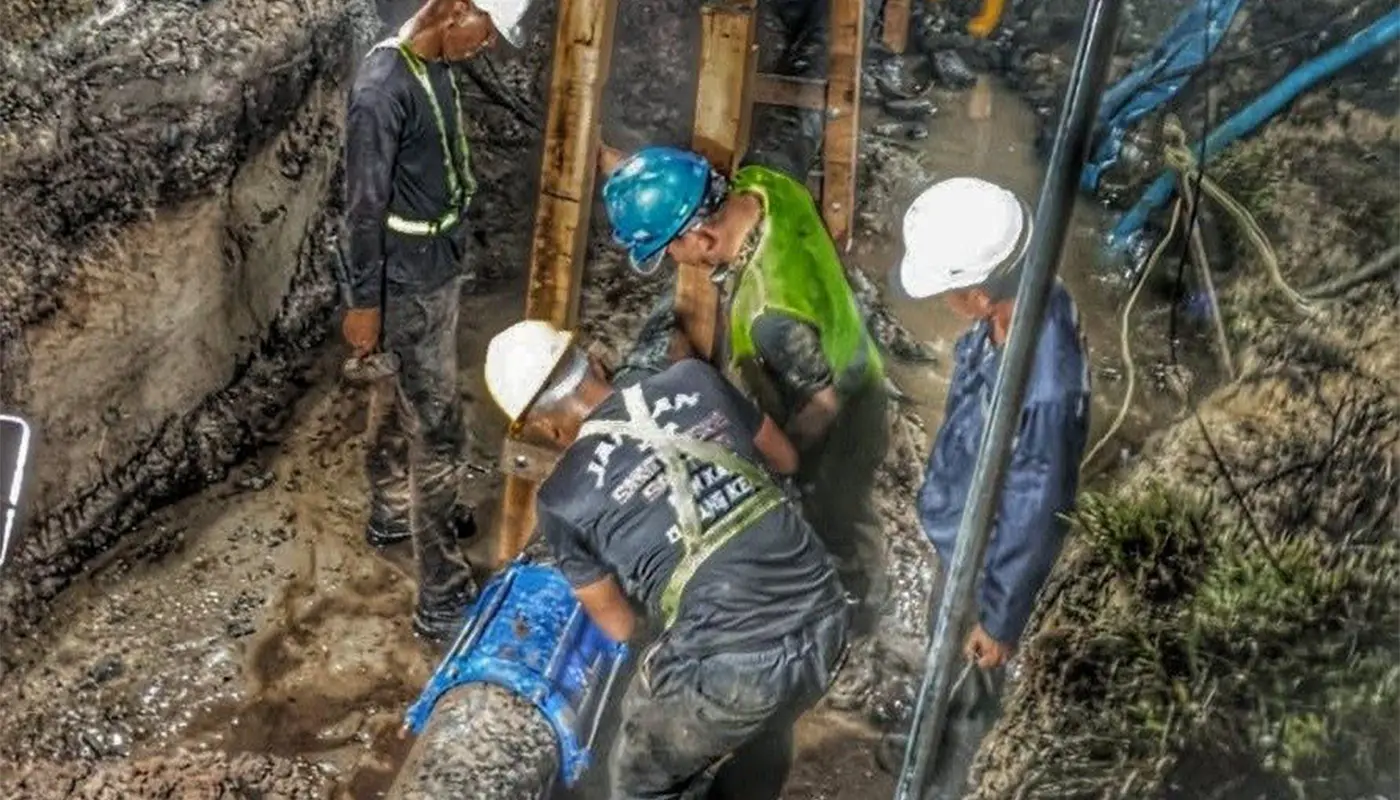
MIRI – Water supply services have begun returning to normal across affected areas following the successful completion of emergency maintenance works at GK Roundabout. Sarawak Water Sdn Bhd confirmed that repair activities concluded at 9.00 pm last night, with the main valve subsequently reopened at 9.47 pm to facilitate gradual system repressurisation.

The restoration process is being implemented in stages rather than instantaneously to prevent pressure surges that could damage household plumbing or create additional leaks within the distribution network. This controlled approach, whilst requiring patience from consumers, protects infrastructure integrity and ensures sustainable service recovery over subsequent hours.
Residents may observe temporary visual changes in water quality during the initial restoration phase. Tap water might appear white, cloudy, or milky due to dissolved air bubbles introduced during pipe depressurisation and refilling cycles. This phenomenon is entirely harmless and does not indicate contamination or treatment failures.
Utility officials advise allowing taps to run for several minutes until clarity returns before using water for consumption or domestic purposes. Air naturally dissipates as water flows through open fixtures, restoring normal appearance without requiring filtration or boiling. Simple flushing resolves the issue efficiently whilst confirming full service restoration at individual connection points.
Emergency repairs at critical junctions like GK Roundabout require coordinated mobilisation of technical teams, equipment, and traffic management resources. Completion within scheduled timeframes reflects effective operational planning and dedicated workforce commitment despite challenging nighttime working conditions. Such responsiveness minimises disruption duration for thousands of dependent households and businesses.
Staged restoration protocols represent industry best practice for post-repair system reactivation. Abrupt full-pressure reinstatement risks water hammer effects that can burst aging pipes, damage valves, or dislodge sediment deposits causing secondary quality issues. Gradual pressurisation allows engineers to monitor system response and intervene if anomalies emerge during recommissioning.
Public cooperation during service interruptions enables utility providers to execute repairs safely and efficiently. Reduced demand during outage periods lowers system stress and facilitates faster diagnostics. Community understanding of necessary maintenance windows fosters constructive relationships between service providers and ratepayers built on mutual respect rather than adversarial expectations.
Infrastructure resilience depends upon proactive maintenance alongside reactive repairs. Whilst emergency responses address immediate failures, long-term reliability requires systematic asset renewal programmes that replace components before catastrophic breakdowns occur. Balancing corrective and preventive investments optimises lifecycle costs whilst maintaining acceptable service continuity standards.
Communication transparency during disruptions helps manage public expectations and reduces anxiety amongst affected consumers. Timely updates regarding completion status, restoration timelines, and post-repair precautions demonstrate institutional accountability and respect for customer needs. Clear guidance prevents confusion and unnecessary support calls that strain already-engaged operational staff.
Water quality monitoring continues throughout restoration phases to verify compliance with safety standards at multiple sampling points. Laboratory testing confirms absence of microbial contamination or chemical imbalances that could arise from repair activities or stagnant conditions during outages. Regulatory adherence remains non-negotiable regardless of operational pressures or timeline constraints.
GK Roundabout’s strategic location within Miri’s distribution network amplifies impact significance when failures occur there. Redundancy improvements and alternative routing capabilities form part of ongoing infrastructure enhancement plans aimed at reducing single-point vulnerability exposures. System diversification increases resilience against future unplanned disruptions.
Nighttime repair scheduling balances urgency with traffic management considerations in busy urban corridors. Daytime works would cause severe congestion impacts on commercial activity and commuter flows, extending indirect economic costs beyond direct service interruption effects. Off-peak execution demonstrates sensitivity to broader community functioning beyond utility customers alone.
Consumer awareness of post-repair water characteristics prevents unnecessary alarm and wasteful responses. Educational messaging about harmless aeration phenomena builds public literacy regarding water system operations and reduces misinterpretation of normal transient conditions as safety threats. Informed communities respond more rationally to service fluctuations.
Sarawak Water Sdn Bhd expressed appreciation for public patience and cooperation throughout the maintenance period. Such acknowledgements recognise that service reliability is co-produced through provider competence and consumer adaptability. Partnership mindsets yield better outcomes than entitlement-based expectations on either side of the utility relationship.
Looking forward, lessons from this incident will inform preventive maintenance scheduling, spare parts inventory management, and crew deployment strategies. Continuous operational improvement transforms individual disruption experiences into systemic enhancements benefiting all ratepayers over time. Responsive learning organisations convert challenges into opportunities for sustained service excellence.
