



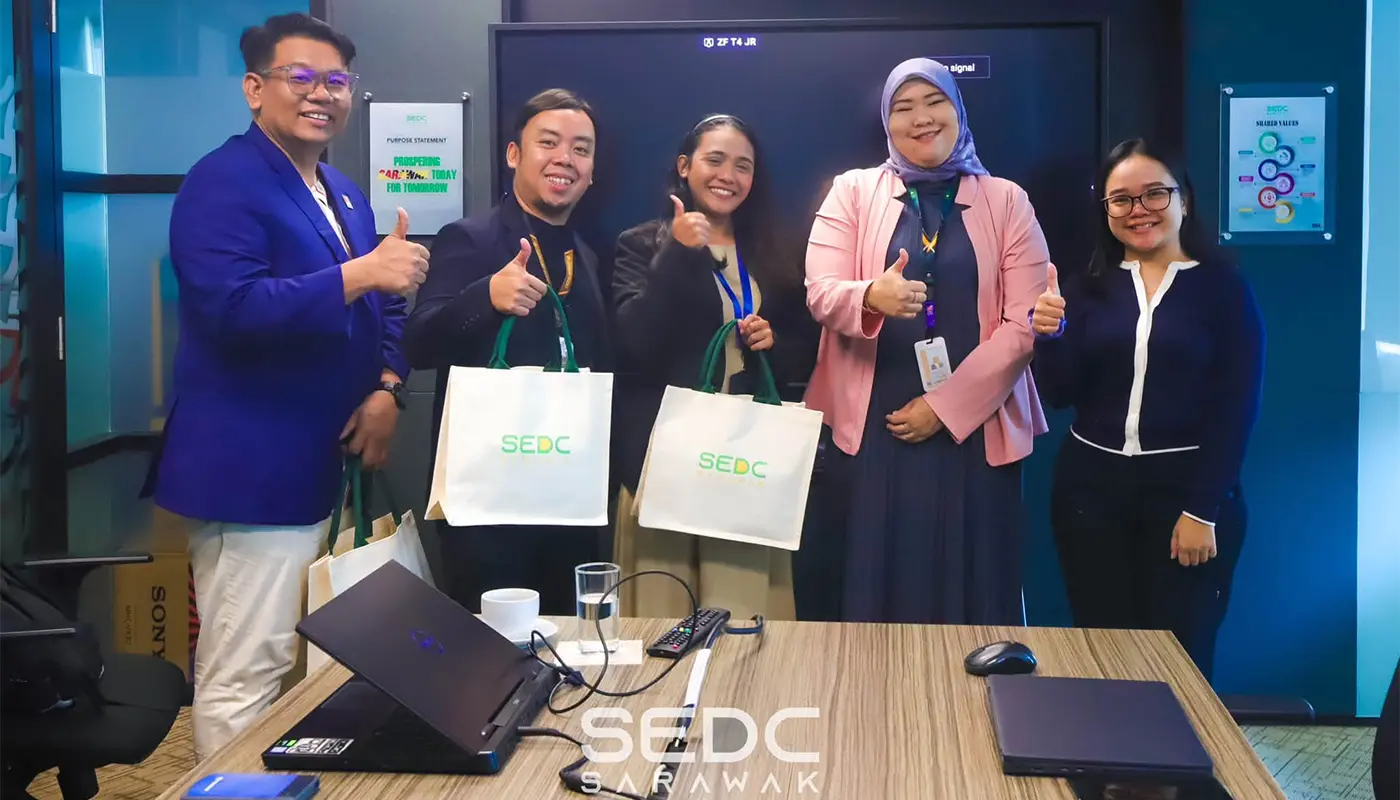
KUCHING – The Sarawak Economic Development Corporation (SEDC) continues to prioritise external collaboration as a driver of institutional growth and innovation. A recent courtesy visit from Lightcube Studio exemplifies this ongoing commitment to fostering partnerships through structured dialogue and mutual exploration of shared objectives.

Mr Azizul led the Lightcube Studio delegation during the engagement session held at SEDC headquarters. The visiting team was received by Cik Nur Khairanie Nasya Jasni, Head of Group Corporate Communications, who facilitated discussions on behalf of the corporation. This direct interaction between communication professionals from both organisations established immediate common ground for substantive exchange.
Strategic engagements of this nature function as catalysts for relationship-building that extends beyond transactional encounters. When organisations invest time in understanding each other’s capabilities, challenges, and aspirations before negotiating specific projects, foundations for sustainable collaboration emerge organically. Premature contracting without relational groundwork often yields superficial partnerships lacking resilience when difficulties arise.
Communication approaches featured prominently in the day’s discussions, reflecting recognition that effective messaging underpins all successful organisational endeavours. Whether conveying development initiatives to stakeholders, promoting investment opportunities, or managing crisis situations, communication quality determines whether strategic intentions translate into public understanding and support. Shared learning in this domain benefits both parties regardless of eventual collaboration scope.
Creative solutions represent another focal area where cross-sectoral exchange generates value beyond individual organisational boundaries. External creative agencies bring fresh perspectives unencumbered by institutional routines and historical assumptions that can constrain internal thinking. Conversely, development corporations possess contextual knowledge about policy environments, community dynamics, and implementation realities that inform realistic creative briefs.
Potential collaborative opportunities were explored without predetermined outcomes or binding commitments, allowing honest assessment of alignment and feasibility. Low-pressure preliminary conversations enable candid evaluation of whether partnership would genuinely serve mutual interests or merely consume resources without proportional returns. Discernment prevents overcommitment whilst preserving goodwill for future possibilities.
Mutual objective identification requires active listening rather than unilateral pitching from either side. Understanding what success looks like for potential partners enables customised value propositions that address actual needs rather than assumed ones. Reciprocal curiosity distinguishes strategic engagement from sales presentations disguised as dialogue.
Future growth depends upon networks of trusted relationships more than isolated organisational capacities. No single entity possesses all necessary expertise, resources, or legitimacy to tackle complex development challenges alone. Ecosystem thinking recognises that collective impact emerges from coordinated contributions across complementary actors rather than heroic individual efforts.
Corporate communications functions increasingly intersect with business development, stakeholder management, and reputation cultivation in ways demanding integrated approaches. Siloed departments operating independently miss synergies available through cross-functional collaboration. External partnerships introduce integrative thinking models that can inspire internal restructuring towards greater coherence.
Courtesy visits carry symbolic significance alongside practical utility, signalling respect and genuine interest in counterpart organisations. Ritual acknowledgements matter because they establish tone and expectation for subsequent interactions. Dismissing ceremonial aspects as mere formality overlooks their role in building interpersonal trust that sustains professional relationships through inevitable challenges.
Lightcube Studio’s initiative in requesting the visit demonstrates proactive partnership-seeking behaviour valued by development institutions. Organisations that approach potential collaborators with prepared questions and demonstrated homework earn credibility faster than those arriving with generic pitches. Preparation signals seriousness and reduces discovery costs for host institutions.
SEDC’s openness to receiving diverse external visitors reflects institutional confidence and learning orientation. Organisations secure in their mission welcome external perspectives as enrichment rather than threat. Receptivity attracts higher-quality partners who seek collaborative environments characterised by mutual respect and intellectual honesty.
Knowledge exchange during such sessions often yields immediate practical insights applicable to current workstreams regardless of whether formal partnerships materialise. Exposure to alternative methodologies, tools, and case studies expands professional repertoires incrementally through accumulated learning. Serendipitous value creation occurs alongside intentional agenda pursuit.
Documentation and follow-up protocols determine whether initial engagements convert into sustained collaboration or fade into forgotten encounters. Systematic tracking of discussion points, action items, and relationship milestones maintains momentum between meetings. Institutional memory prevents reinvention and demonstrates reliability to external partners evaluating long-term commitment.
Looking ahead, strategic engagement practices refined through experiences like the Lightcube Studio visit will continue evolving based on lessons learned and changing partnership landscapes. Continuous improvement ensures that SEDC remains an attractive collaborator for innovative organisations seeking meaningful contribution to Sarawak’s development trajectory. Adaptive relationship management converts discrete encounters into enduring ecosystem strength supporting shared prosperity.
