



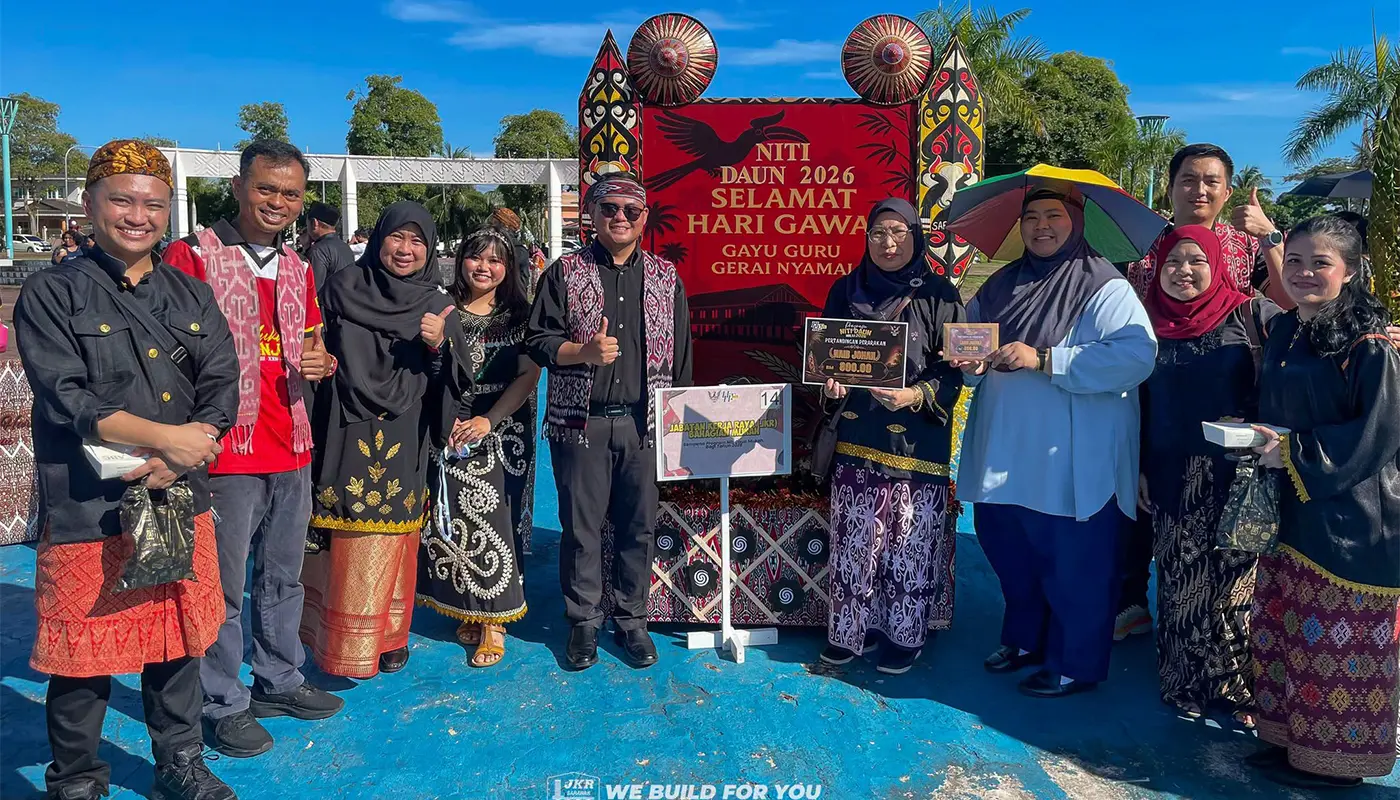
MUKAH – The Mukah District Level Niti Daun Programme 2026 was held on 20 June, bringing together leaders, government officers, and local residents in a celebration of unity and cultural heritage.

Around 40 officers from the Mukah Division Public Works Department (JKR) took part in the event, which included a parade competition.
The division secured the runner-up position overall, reflecting their strong participation and commitment to community activities.
The Niti Daun Programme has become an annual fixture in Mukah, serving as a platform to strengthen ties between leaders and the multi-racial communities of the district.
Beyond its cultural significance, the event highlights the values of togetherness, cooperation, and mutual respect that underpin Sarawak’s social fabric.
Deputy Minister of Health Malaysia and Member of Parliament for P213 Mukah, YB Hajjah Hanifah Hajar Taib, was among the distinguished guests.
She was joined by YB Royston Valentine, State Assemblyman for N57 Tellian, alongside Mukah Division Resident Tn. Bujang Rahman bin Seli and Mukah District Officer Tn. Paleazman anak Ahip.
Representatives from government departments, agencies, community leaders, and local residents also attended, underscoring the broad support for the programme.
Speeches delivered during the event emphasised the importance of unity in sustaining Sarawak’s progress.
Leaders noted that cultural programmes such as Niti Daun not only preserve traditions but also foster harmony among diverse communities.
The gathering provided an opportunity for residents to engage directly with leaders, reinforcing trust and cooperation at the grassroots level.
The programme’s success reflects the collaborative spirit of Mukah’s community. By combining cultural celebration with civic participation, Niti Daun continues to play a vital role in promoting inclusivity and strengthening social bonds.
As Sarawak advances its development agenda, events like the Niti Daun Programme remain essential in ensuring that cultural heritage and community values are preserved while contributing to the state’s unity and resilience.
