



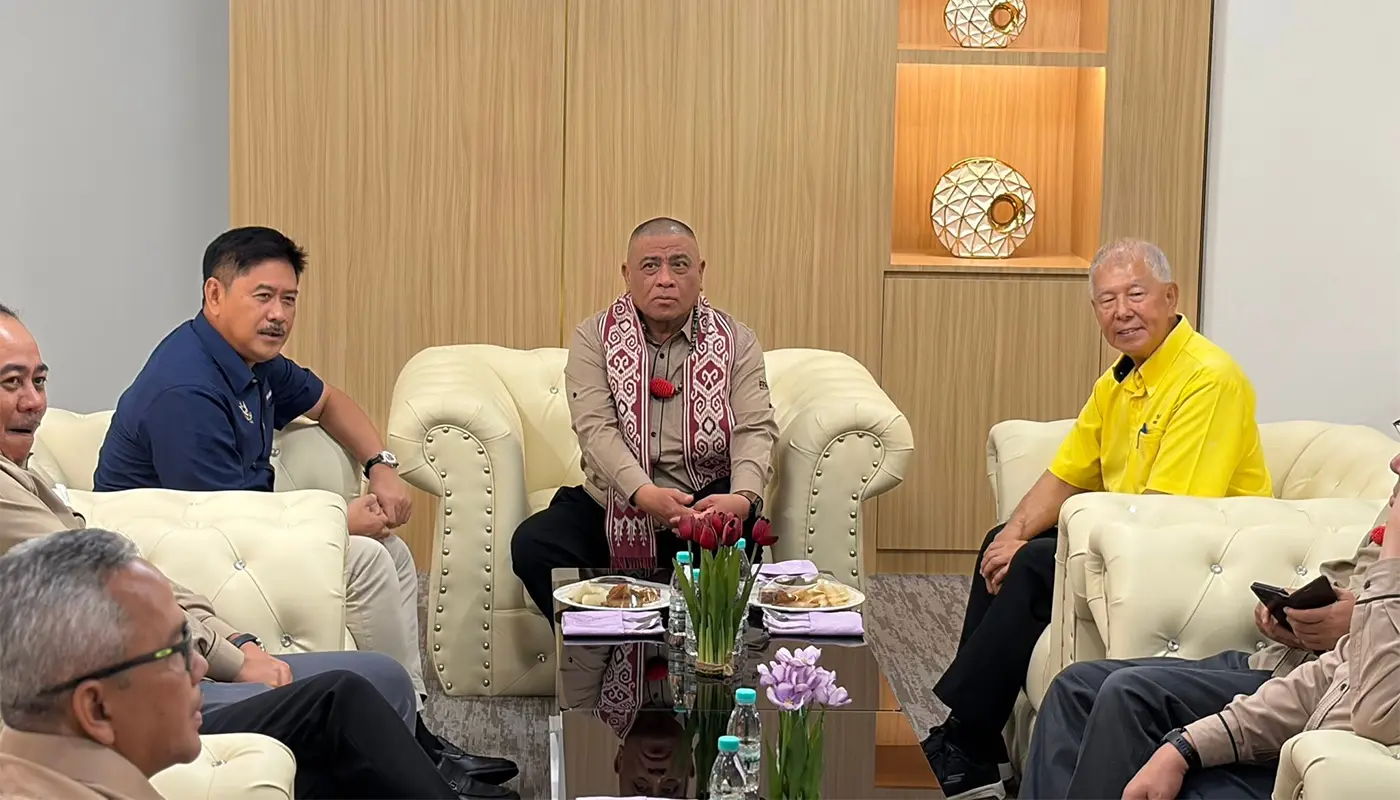
MIRI – A high-level delegation from Perak arrived in northern Sarawak on Saturday to commence a four-day official working visit aimed at deepening interstate collaboration. Dato’ Seri Saarani Mohamad, the Menteri Besar of Perak, touched down at Miri Airport at approximately 11.20 am, marking the beginning of an engagement scheduled to run through 11 August 2026.

The visiting leader was received upon arrival by two senior members of the Sarawak state cabinet. Datuk Dr Ripin Lamat, Deputy Minister of Youth, Sports and Entrepreneur Development, and Datuk Sebastian Ting Chiew Yew, Deputy Minister of Tourism, Creative Industries and Performing Arts, were present to extend official welcomes. Their joint presence signalled the breadth of sectors under discussion during this bilateral exchange.
Strengthening cooperative ties between the Perak and Sarawak state governments forms the central objective of this mission. Discussions are expected to span multiple domains including economic development, tourism promotion, entrepreneurship support, and public welfare enhancement. Such comprehensive agendas reflect recognition that modern governance challenges rarely conform to single-sector boundaries.
Following airport reception procedures, the delegation proceeded to Muara Restaurant at Imperial Miri for a welcome lunch. This initial gathering provided informal opportunities for relationship-building before transitioning into structured afternoon programming. Hospitality rituals serve important diplomatic functions by establishing personal rapport that facilitates candid dialogue during subsequent formal sessions.
The afternoon itinerary included a briefing and site visit at the Sungai Tujuh Immigration, Customs, Quarantine and Security (ICQS) Complex. This border facility represents critical infrastructure managing cross-boundary movement between Malaysia and neighbouring territories. First-hand observation enables visiting officials to understand operational realities that differ significantly from peninsular contexts.
Knowledge exchange regarding public service delivery constitutes another key dimension of the visit. Both states bring distinct experiences shaped by differing demographic profiles, geographic conditions, and administrative histories. Comparative learning allows each jurisdiction to identify transferable practices whilst avoiding replication of approaches unsuited to local circumstances.
Strategic development discussions benefit from perspectives grounded in actual implementation experience rather than theoretical frameworks alone. When practitioners share successes and failures openly, collective institutional knowledge expands beyond individual organisational silos. Interstate dialogue accelerates problem-solving by pooling diverse solution repertoires accumulated through separate evolutionary paths.
Tourism cooperation holds particular promise given complementary attractions offered by both states. Perak’s heritage sites and culinary reputation combine naturally with Sarawak’s biodiversity and cultural diversity to create multi-destination packages appealing to international markets. Coordinated marketing and product development amplify reach beyond what either state could achieve independently.
Entrepreneurship ecosystem development represents another area ripe for collaborative intervention. Cross-border market access, shared incubation resources, and joint investor attraction efforts can overcome scale limitations facing smaller enterprises in either jurisdiction. Regional integration creates larger addressable markets that justify investments impossible within isolated domestic contexts.
Youth development and sports exchanges offer people-to-people connections that sustain institutional partnerships beyond political cycles. Athlete training programmes, coaching certifications, and youth leadership exchanges build interpersonal networks that outlast individual administrations. Human capital linkages provide durable foundations for continued cooperation regardless of electoral outcomes.
Public welfare improvements often emerge from adapting successful interventions tested elsewhere to local conditions. Social protection innovations, healthcare delivery models, and community empowerment approaches validated in one context may require modification but retain core principles applicable across settings. Systematic comparison prevents reinvention whilst respecting necessary adaptation.
Border management observations at Sungai Tujuh carry implications beyond immigration administration alone. Trade facilitation, security coordination, and cross-border community relations intersect at such interfaces in ways affecting broader regional integration prospects. Understanding these nexus points informs policy design across multiple portfolios simultaneously.
The delegation’s extended stay through Monday allows sufficient time for substantive engagement rather than ceremonial gestures alone. Meaningful cooperation requires adequate duration for trust-building, detailed discussion, and joint planning that transcends photo opportunities. Investment in relationship depth yields returns measured in sustained collaboration rather than momentary publicity.
Interstate visits of this nature contribute to national cohesion by demonstrating functional federalism where states actively cooperate as peers rather than competing for central attention. Horizontal linkages complement vertical relationships with federal authorities, creating multidimensional governance networks better suited to complex contemporary challenges.
Saturday’s arrival marks merely the opening chapter of what organisers hope will become recurring engagement patterns. Institutionalised exchange mechanisms transform episodic visits into enduring partnerships capable of addressing evolving shared interests systematically. Continuity converts goodwill into tangible outcomes benefiting citizens across both jurisdictions.
