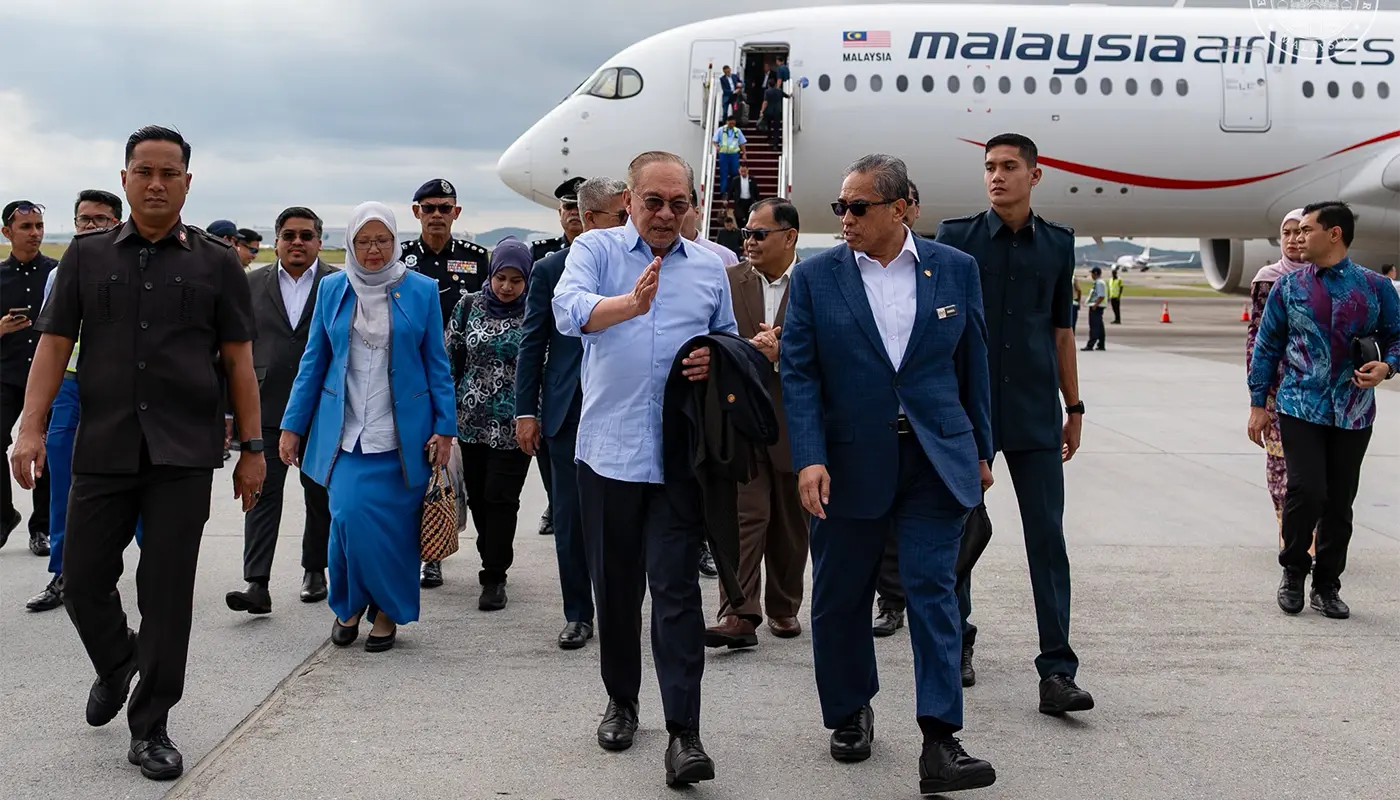
KUALA LUMPUR – Prime Minister Datuk Seri Anwar Ibrahim returned to Malaysia this morning following a week-long diplomatic mission across Africa, which officials described as a landmark effort to deepen ties with the Global South. The delegation landed at Kuala Lumpur International Airport at 9.15 am, marking the conclusion of the MADANI Diplomacy Mission.
The visit spanned three countries – Ethiopia, South Africa, and Kenya – and was aimed at strengthening bilateral relations, expanding trade opportunities, and fostering cooperation in education and technology.
The mission also coincided with the 60th anniversary of Malaysia-Kenya diplomatic relations, underscoring the historical significance of the engagements.
In Ethiopia, the Prime Minister met with Prime Minister Abiy Ali, President Taye Atske-Selassie, and African Union Commission Chair Mahmoud Youssouf. Discussions centred on regional integration, trade expansion, and Malaysia’s role in supporting Africa’s fast-growing economies.
The African Union welcomed the visit as a milestone, noting that Malaysia-Africa trade had surpassed USD 7.5 billion in 2024, reflecting a 20 per cent increase over two years.
During his stop in South Africa, Anwar attended the G20 Summit and held talks with President Cyril Ramaphosa.
Malaysia sought South Africa’s support for candidacies in several international bodies, including the UN Security Council and the International Maritime Organisation. Both leaders reaffirmed their commitment to enhancing cooperation in industry, economy, and human rights.
The final leg of the mission took place in Nairobi, where Anwar and President William Ruto signed agreements to remove trade barriers, opening Malaysian markets to Kenyan exports such as tea, coffee, flowers, avocados, and titanium ores.
The pact also included provisions for youth training programmes in technology and digital innovation, reflecting a shared vision for future-oriented collaboration.
Beyond trade, Malaysia and Kenya also advanced cooperation in higher education. A new framework was announced to promote student exchanges, joint research, and vocational training, strengthening South-South collaboration in knowledge and innovation.
Anwar emphasised that the mission was not only about diplomatic symbolism but about concrete outcomes. “It is now time to translate these commitments and agreements into policies and actions that bring real benefits to the people and the nation,” he said upon arrival in Kuala Lumpur.
The Prime Minister also announced plans to establish a Centre for African Studies in Malaysia, aimed at improving understanding of Africa’s diverse economies and societies.
He noted that Malaysia’s engagement with Africa was stronger in the 1980s and 1990s, and the new initiative would revive and modernise those ties.
Observers have described the mission as a strategic move to position Malaysia as a trusted partner in a multipolar world, while also opening pathways to new markets and reinforcing solidarity with developing nations.
With agreements spanning trade, education, and international cooperation, the mission is expected to deliver long-term benefits for both Malaysia and its African partners.