



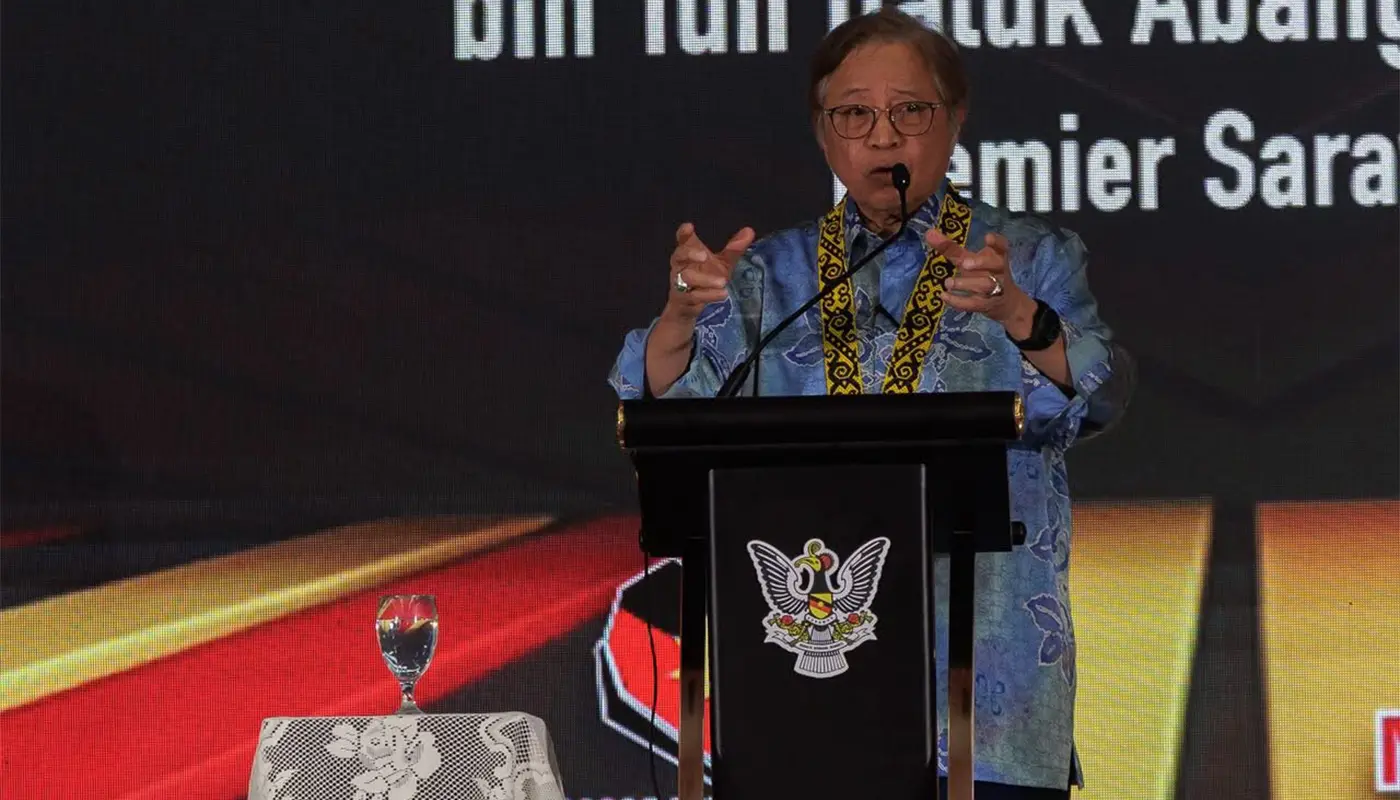
SARIKEI – The vital function of community and tribal leaders as intermediaries between state administration and grassroots populations was emphasised during a significant gathering on Friday evening. Datuk Patinggi Tan Sri Abang Abdul Rahman Zohari Tun Datuk Abang Openg, the Premier of Sarawak, addressed members of the Ketua Masyarakat dan Kampung Kecil (KMKK) at the Sarikei Central Hall as part of the division’s Sarawakku Sayang programme.

The Premier articulated that accurate comprehension of government policies among local leaders forms the foundation for effective governance at the community level. When KMKK possess clear understanding of development agendas and initiatives, they can convey these messages faithfully to residents without distortion or omission. This accuracy prevents misinformation from undermining policy implementation and eroding public trust.
Structured relationships between administration, community leaders, and citizens depend fundamentally upon shared understanding rather than mere hierarchical authority. The Premier noted that when leaders grasp policy intent and rationale, their interactions with both government officials and constituents become more coherent and productive. Such alignment transforms bureaucratic directives into locally meaningful actions that resonate with community realities.
Feedback mechanisms represent an equally critical dimension of the KMKK role beyond downward information transmission. Community leaders serve as the government’s eyes and ears, collecting ground-level perspectives, concerns, and needs that might otherwise remain invisible to central planners. This upward flow ensures that policy design remains responsive to actual conditions rather than abstract assumptions disconnected from lived experiences.
Effective service delivery depends upon bidirectional communication channels functioning reliably in both directions. Policies crafted without grassroots input risk irrelevance or resistance, whilst community feedback lacking structured pathways dissipates before reaching decision-makers. KMKK occupy the essential middle position enabling functional dialogue across administrative and social distances.
The Premier specifically called upon community leaders to guide younger generations toward educational opportunities and technological literacy alongside their traditional governance responsibilities. Intergenerational mentorship extends the KMKK mandate beyond immediate service delivery to encompass long-term human capital development. Youth empowerment today determines community resilience and adaptability tomorrow.
Artificial intelligence received particular mention as a competency area requiring proactive attention from young Sarawakians. Mastery of emerging technologies prepares future workforces for evolving economic landscapes where digital fluency increasingly determines employability and entrepreneurial success. Early exposure prevents skill gaps that could marginalise rural communities within knowledge-based economies.
Educational advocacy by trusted local figures often carries greater persuasive weight than external promotional campaigns. When respected elders endorse learning pathways and technological adoption, scepticism diminishes and participation increases. Cultural legitimacy amplifies institutional messaging through relational credibility that formal authorities cannot manufacture artificially.
Friday’s dinner gathered numerous senior officials who underscored the event’s significance within broader governance frameworks. Tan Sri Datuk Amar Mohamad Asfia Awang Nasar, Speaker of the Sarawak State Legislative Assembly, attended alongside Dato Sri Abdul Karim Rahman Hamzah, Minister of Tourism, Creative Industries and Performing Arts. Their presence signalled cross-portfolio recognition of grassroots leadership importance.
Datuk Amar Mohamad Abu Bakar Marzuki, the Sarawak State Secretary, joined Dato Sri Huang Tiong Sii, Deputy Minister of Plantations and Commodities who also serves as Member of Parliament for Sarikei and State Assemblyman for Repok. Multi-level representation demonstrated integrated commitment to strengthening community-administration linkages across federal, state, and local governance tiers.
Community leader gatherings create informal spaces where hierarchical barriers soften sufficiently for candid exchange. Dinner settings facilitate conversations that formal meetings often constrain through procedural rigidity and time limitations. Relational governance complements bureaucratic processes by building interpersonal trust that sustains cooperation during challenging periods.
Policy communication effectiveness varies significantly depending upon messenger credibility and cultural congruence. Technical language translated through familiar idioms and locally relevant examples achieves comprehension rates far exceeding standardised materials distributed uniformly across diverse contexts. Localisation is not optional embellishment but essential adaptation for meaningful engagement.
Grassroots feedback quality depends upon whether community members perceive genuine receptiveness rather than performative consultation. When leaders demonstrate that constituent input influences actual decisions, participation deepens and honesty increases. Trust accumulates incrementally through demonstrated responsiveness rather than rhetorical assurances alone.
Youth guidance responsibilities assigned to KMKK acknowledge that generational transitions require active facilitation rather than passive succession. Elders who bridge traditional wisdom with contemporary opportunities help young people navigate identity formation without false dichotomies between heritage and modernity. Integration prevents alienation whilst preserving cultural continuity.
Technological preparedness intersects directly with rural development objectives as digital infrastructure expands across Sarawak. Access alone proves insufficient without complementary capacity-building that enables meaningful utilisation. Community leaders positioned at technology adoption frontlines can accelerate uptake through peer modelling and contextualised troubleshooting support.
Looking forward, sustained investment in KMKK capacity development will determine whether grassroots linkages strengthen or weaken amidst accelerating social change. Training programmes, resource provisions, and recognition mechanisms must evolve alongside expanding expectations placed upon community leaders. Institutional support validates their indispensable contributions to Sarawak’s distinctive governance model rooted in relational accountability.
