



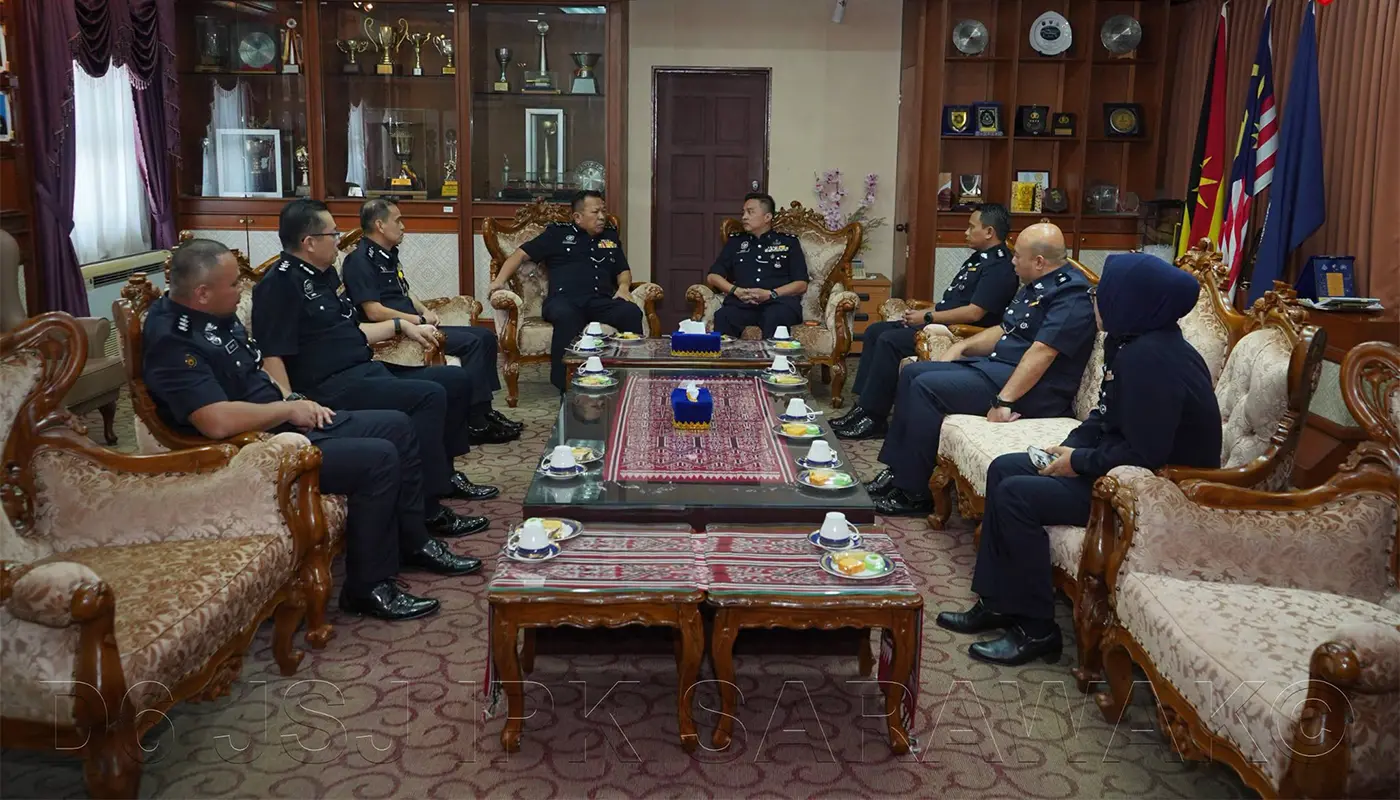
KUCHING – Senior law enforcement leadership in Sarawak has engaged in high-level discussions with federal counterparts regarding security preparedness for upcoming state elections. The meeting focused specifically on specialised capabilities required to maintain stability during the electoral period.

Deputy Commissioner of Police Saifullizan bin Ishak received a courtesy visit from Superintendent Ts. Wan Iswadi bin Wan Yusof on Wednesday, 6 August 2026. The visiting officer serves as Assistant Director of Arms for CBRNE and UPB at Bukit Aman headquarters.
The session was convened at the Sarawak PJP Guest Room within the State Police Contingent Headquarters. This venue provided an appropriate setting for confidential strategic dialogue between command-level personnel.
Primary context for the engagement involves ongoing in-service training for CBRNE Unit Zone 3. These specialised teams are currently undergoing intensive preparation to ensure operational readiness ahead of anticipated polling activities across Sarawak.
CBRNE capabilities encompass chemical, biological, radiological, nuclear, and explosive threat response. Such units play critical roles in safeguarding public events against asymmetric threats that conventional policing cannot address alone.
Electoral periods inherently elevate security risks due to heightened political tensions and large public gatherings. Proactive coordination ensures that contingency plans align with current intelligence assessments and resource availability.
Several key department heads participated in the discussions alongside the principal officers. Their presence underscored the multi-disciplinary nature of election security planning requiring integrated logistical and administrative support.
Assistant Commissioner Boniface anak Banjai attended in his capacity as Head of Logistics and Technology Department. His expertise is vital for ensuring equipment deployment and communication systems function seamlessly during operations.
Administrative Staff Officer ACP James anak Jonathan represented the Management Department during the session. Administrative coordination underpins effective personnel deployment and welfare management throughout extended operational periods.
Senior officers from both Bukit Aman Arms Division and Sarawak IPK were also present to facilitate technical exchanges. Their involvement ensures that strategic directives translate accurately into tactical implementation at ground level.
Knowledge transfer between federal specialists and state units enhances local capacity building significantly. Exposure to national best practices helps standardise response protocols across different jurisdictions within Malaysia.
The timing of this visit reflects deliberate sequencing within broader election security timelines. Early engagement allows sufficient lead time for identifying gaps and implementing corrective measures before voting commences.
Inter-agency familiarity developed through such visits proves invaluable during actual crisis response. Pre-existing relationships accelerate decision-making and reduce friction when joint operations become necessary.
Resource allocation discussions likely featured prominently given the logistical complexity of Sarawak’s geography. Remote constituencies require tailored approaches differing substantially from urban centre security arrangements.
Training validation forms another probable agenda item during the high-level exchange. Observers can assess whether current programmes meet expected competency standards or require curriculum adjustments.
Federal oversight combined with local execution creates balanced accountability structures. Neither top-down mandates nor isolated local initiatives suffice for managing nationwide democratic processes securely.
Public confidence in electoral integrity depends heavily on visible yet unobtrusive security postures. Professional preparation demonstrated through such engagements reassures citizens that authorities take their safety seriously.
Future coordination mechanisms will likely be formalised following this initial consultation. Established communication channels enable rapid escalation of emerging issues throughout the election cycle.
Ultimately, these preparatory efforts aim to create conditions where democratic expression proceeds without fear or disruption. Security forces work behind the scenes so that voters can focus entirely on civic participation.
