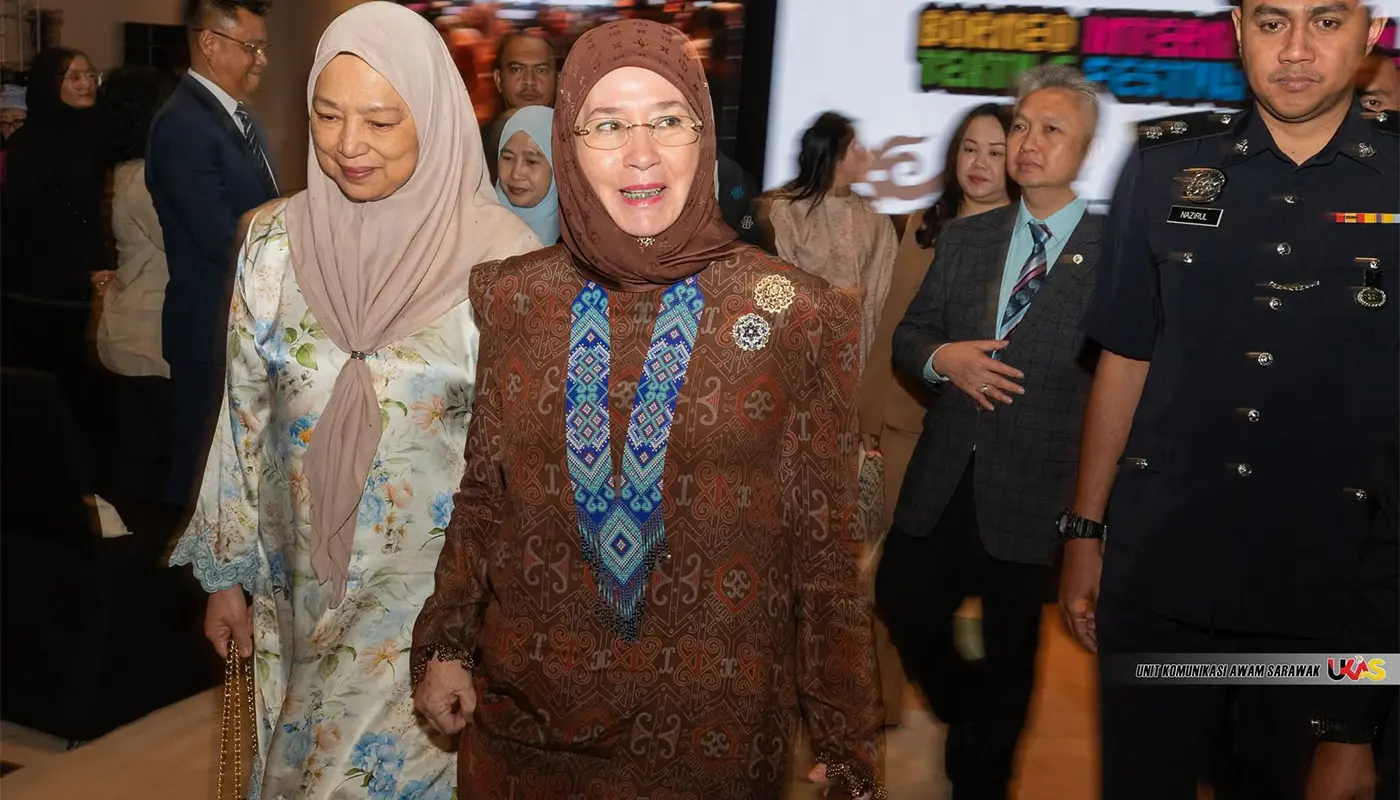
KUCHING – Her Majesty Tengku Ampuan Pahang Tunku Azizah Aminah Maimunah Iskandariah Almarhum Sultan Iskandar Al-Haj has called for the revival of Sarawak’s traditional pottery art, describing it as a unique cultural heritage that must be preserved for future generations.
Speaking at the opening of the Borneo International Textile Festival (BiTF) 2025 Seminar on Monday, she emphasised that pottery, with its distinctive motifs and craftsmanship, represents the identity of Sarawak’s people and should not be forgotten.
“I see the art of vases is being forgotten in Sarawak, so I ask that the art of vases be revived because I still remember, vases are the ones that are often brought home when I visit Sarawak and are still in my house in Kuantan,” she said.

Her Majesty expressed hope that the Sarawak Government would take steps to rejuvenate the craft, noting that the state has long been recognised for its strong support in preserving heritage.
She highlighted Sarawak’s institutions as examples of how cultural traditions can be developed and sustained, creating an ecosystem that strengthens identity and community spirit.

“Sarawak is an example of how heritage should be viewed, how heritage should be developed and maintained, where Sarawak has institutions that shape the development of heritage in the future. When all these elements are combined, we create an ecosystem that sustains fundraising, strengthens identity and people,” she explained.
She also commended the Sarawak Government for its willingness to invest in heritage-related initiatives, citing the establishment of the Songket Centre at Puncak Borneo Prison, which was supported immediately after her request.
The centre has since become a platform for preserving traditional weaving while empowering inmates with valuable skills.
The Queen Consort’s remarks at BiTF 2025 reinforced the importance of integrating heritage preservation with modern development.
By reviving pottery art alongside other traditional crafts such as songket weaving, Sarawak can continue to showcase its rich cultural diversity while ensuring that these traditions remain relevant in contemporary society.
Observers note that her call to action highlights the broader role of heritage in shaping community identity and economic opportunities.
Pottery, once a hallmark of Sarawak’s artisanal culture, could see renewed interest if revitalised through government support, institutional backing, and community participation.