



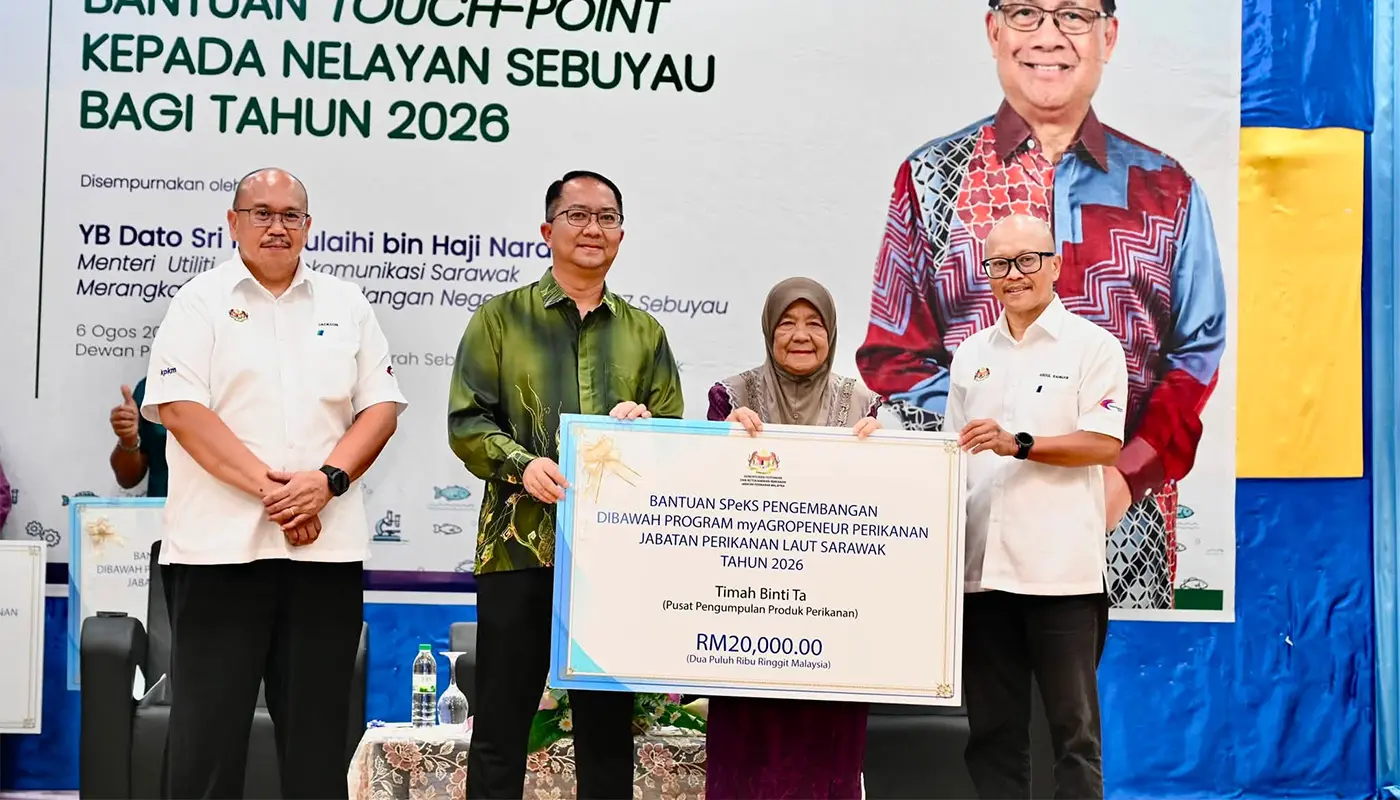
SEBUYAU – Thirty local fishers received essential safety equipment during a significant engagement session held at the Sebuyau Development Hall on Wednesday. The event underscored ongoing government efforts to bolster maritime livelihoods and ensure operational safety within the coastal community.

The Sarawak Marine Fisheries Department (JPLS) organised the Touch-Point Interaction and Handing Over Ceremony 2026 as a direct channel for supporting industry players. This initiative reflects a sustained commitment to enhancing sector development through tangible assistance and open communication with stakeholders.
Life jackets constituted the primary physical aid distributed during the gathering. Providing this critical gear aims to safeguard fishermen whilst simultaneously reducing individual operating expenses, thereby promoting more sustainable fishing practices across the district’s waters.
Beyond safety equipment, financial support was also extended to entrepreneurial ventures within the sector. Three participants in the myAP programme received cheques totalling RM52,000, earmarked specifically for outboard engine workshop operations and fishery product collection projects.
These monetary allocations serve as seed funding for value-chain improvements. By investing in maintenance infrastructure and aggregation facilities, authorities hope to stimulate productivity gains that translate directly into higher household incomes for participating families.
Sebuyau District Officer Encik Ayuradiman bin Bujang officiated the proceedings, highlighting the administration’s focus on grassroots economic empowerment. His presence signalled strong inter-agency coordination in delivering development programmes to rural maritime communities.
The ceremony functioned as more than a distribution exercise; it served as a vital dialogue platform. Officials utilised the opportunity to brief attendees on broader industry development initiatives and explain available government assistance schemes designed to elevate socio-economic status.
Strengthening relationships between regulators and resource users remains a core objective of such engagements. Direct interaction fosters mutual understanding, ensuring policies remain responsive to actual ground-level challenges faced by those working daily on the water.
Senior Director of JPLS, Mr Abdul Rahman bin Abdul Wahab, attended alongside key regional personnel. Their participation demonstrated headquarters-level attention to local implementation, reinforcing institutional accountability for programme outcomes.
Mr Jackson anak Clive Jusak, Head of Fisheries Region 1 Kuching, and Mr Fairol Tajuddin bin Suhaili, Head of Fisheries Development Branch, were also present. Staff from PPW 1 Kuching and JPLS Headquarters completed the official delegation, showcasing comprehensive departmental representation.
Department officials expressed profound gratitude towards collaborating agencies and community leaders whose support enables successful programme delivery. Such partnerships prove indispensable for translating policy intentions into meaningful impacts on beneficiary lives.
Recipients are encouraged to utilise all provided resources maximally for intended purposes. Proper stewardship of safety gear and business capital determines whether interventions achieve lasting benefits or merely offer temporary relief without structural improvement.
Safety compliance carries dual significance for fishing communities. Protecting human life prevents tragic losses whilst preserving skilled labour essential for industry continuity, making safety investments fundamentally economic as well as humanitarian in nature.
Entrepreneurial grants target specific bottlenecks in local value chains. Functional engine workshops reduce vessel downtime and repair costs, whilst efficient product collection systems minimise post-harvest losses and improve market access for small-scale producers.
Knowledge transfer accompanied material distributions during the session. Information sharing about best practices, regulatory updates, and market opportunities empowers fishers to make informed decisions beyond immediate aid receipt.
Community feedback mechanisms embedded in such events help refine future programming. Listening to recipient experiences allows administrators to adjust assistance modalities based on empirical evidence rather than assumptions about effectiveness.
Maritime resource sustainability underpins all development interventions. The department’s guiding motto, “Together Empowering the Fishing Community, Ensuring the Sustainability of Fisheries Resources,” encapsulates this balanced approach linking livelihood security with ecological stewardship.
Long-term industry resilience depends on adaptive capacity amongst practitioners. Equipping fishers with modern tools and business skills enhances their ability to navigate environmental changes and market fluctuations independently over time.
Youth retention in fishing occupations links directly to perceived viability of maritime careers. Visible government support signals sectoral potential to younger generations who might otherwise seek employment elsewhere due to perceived instability or lack of opportunity.
Women’s roles in post-harvest processing and marketing deserve recognition within development frameworks. Inclusive programming ensures female contributors benefit equitably from sectoral investments, strengthening overall community resilience through gender-balanced empowerment.
Climate adaptation considerations increasingly inform fisheries assistance design. Safety equipment and business models must account for changing weather patterns and fish stock distributions to remain relevant amidst environmental uncertainty affecting coastal livelihoods.
Digital literacy components could enhance future iterations of such programmes. Mobile applications for weather forecasting, market pricing, and catch reporting offer efficiency gains that complement traditional hardware and financial supports already being provided.
Cross-learning amongst beneficiary groups amplifies individual grant impacts. Peer networks facilitate knowledge exchange about successful business strategies and safety practices, creating multiplier effects beyond direct recipient households.
Monitoring and evaluation systems track intervention effectiveness over time. Systematic assessment identifies what works well versus what requires modification, enabling continuous improvement in public spending efficiency and developmental impact.
Inter-generational knowledge transfer merits deliberate facilitation. Combining elder wisdom about local marine ecosystems with youth technological fluency creates hybrid expertise suited to contemporary sustainability challenges facing traditional fishing communities.
Market linkage support complements production-focused assistance. Connecting fishers directly to buyers, processors, and exporters captures greater value locally rather than allowing intermediaries to absorb margins that should accrue to primary producers.
Ultimately, ceremonies like this represent investments in human capital rather than mere charitable distributions. Building capable, confident, and connected fishing communities lays foundations for enduring prosperity rooted in sustainable marine resource utilisation across Sarawak’s coastal regions.
