



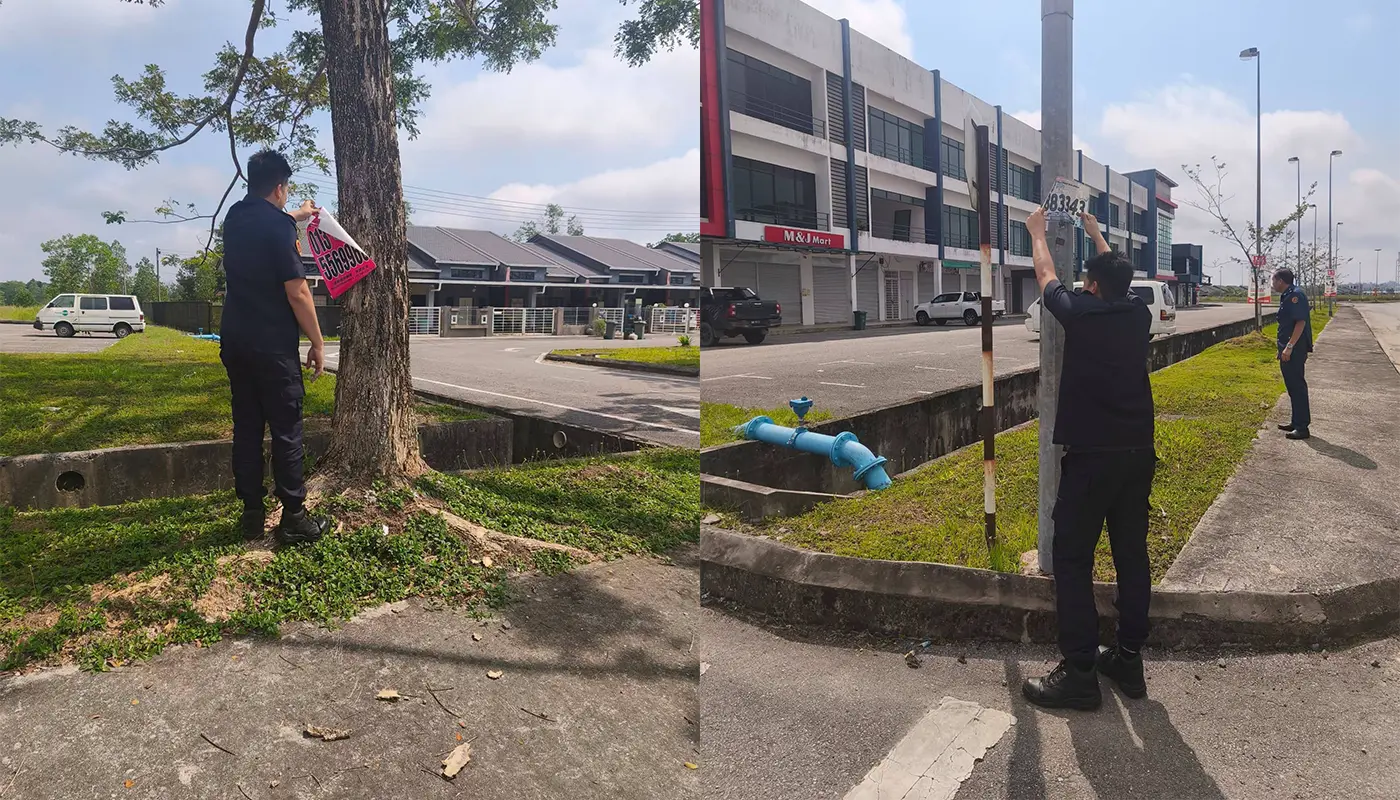
SIBU – Maintenance of public order and environmental cleanliness remains a priority for local authorities in the rural district, as demonstrated by recent enforcement operations targeting unauthorised signage. The Sibu Rural District Council (SRDC) has undertaken systematic removal of illegal advertisements across multiple locations within its jurisdiction to uphold community standards.

Enforcement teams have been conducting regular patrols and responding to public complaints to identify non-compliant materials. Items removed during these operations include posters, stickers, banners, and bunting that were affixed without prior council approval. These materials were found attached to street lamp posts, road signs, trees, building walls, and other public infrastructure throughout the administrative area.
The presence of unauthorised advertisements creates multiple concerns beyond mere aesthetic degradation. In certain instances, improperly placed signage obstructs sightlines for motorists and pedestrians, introducing tangible safety hazards on public roads. Such obstructions can contribute to traffic accidents and compromise emergency response efficiency in affected areas.
Unlicensed money lending promotions represent one category of prohibited advertising that has drawn particular attention during recent operations. However, enforcement actions extend equally to commercial advertisements promoting legitimate businesses, services, and activities that simply lack proper permits. The distinction lies not in content but in procedural compliance with established regulatory frameworks.
All enforcement activities are conducted pursuant to The Local Authorities (Advertisements) By-laws 2012, which mandate that any public display of advertising material requires valid prior approval from the relevant local authority. This legal framework provides clear guidelines for both regulators and advertisers, establishing predictable standards for permissible promotional activities.
Business owners and event organisers are reminded that permit applications must be submitted well in advance of intended display dates. Retroactive approvals are generally not granted, making proactive compliance essential for avoiding enforcement action. The council maintains established procedures for processing applications efficiently when complete documentation is provided.
Public cooperation plays a vital role in maintaining orderly environments across the district. Residents who observe unauthorised advertisements are encouraged to report them through official channels, enabling targeted follow-up by enforcement personnel. Community vigilance supplements routine patrol schedules and extends monitoring coverage beyond what staff resources alone can achieve.
Environmental cleanliness encompasses visual order as much as physical waste management. Cluttered public spaces with overlapping, weathered, or damaged signage create impressions of neglect that can discourage civic pride and community investment. Consistent enforcement helps maintain standards that benefit all residents and visitors alike.
Safety considerations drive much of the urgency behind advertisement regulation. Materials attached to traffic control devices or navigation signage can confuse drivers and compromise road safety systems designed through careful engineering. Removal of such hazards protects vulnerable road users including cyclists, pedestrians, and children.
The SRDC has indicated that monitoring and enforcement intensity will continue at current levels or increase as needed. This sustained commitment signals that compliance expectations remain constant rather than episodic. Advertisers who adapt to regulatory requirements avoid repeated enforcement encounters and associated costs.
Permit systems serve legitimate purposes beyond revenue generation or bureaucratic procedure. They enable authorities to track advertising density, prevent location monopolisation, ensure structural safety of installations, and coordinate timing with other municipal activities. These administrative functions support equitable access to public space for all stakeholders.
Educational outreach accompanies enforcement efforts to ensure widespread understanding of regulatory requirements. Many violations stem from ignorance rather than intentional non-compliance, particularly amongst small business operators unfamiliar with formal processes. Clear communication reduces inadvertent breaches and fosters voluntary adherence.
Long-term environmental protection depends on cultivating shared responsibility amongst all community members. When residents, businesses, and authorities collaborate towards common standards, outcomes improve sustainably without requiring perpetual external enforcement. Cultural norms around civic respect ultimately prove more durable than regulatory compulsion alone.
The council’s ongoing dedication to clean, safe, tidy, and orderly public environments reflects broader commitments to quality of life in rural Sibu. Consistent application of advertisement regulations contributes incrementally to this larger vision, demonstrating that attention to detail matters in creating communities where people want to live, work, and visit.
