



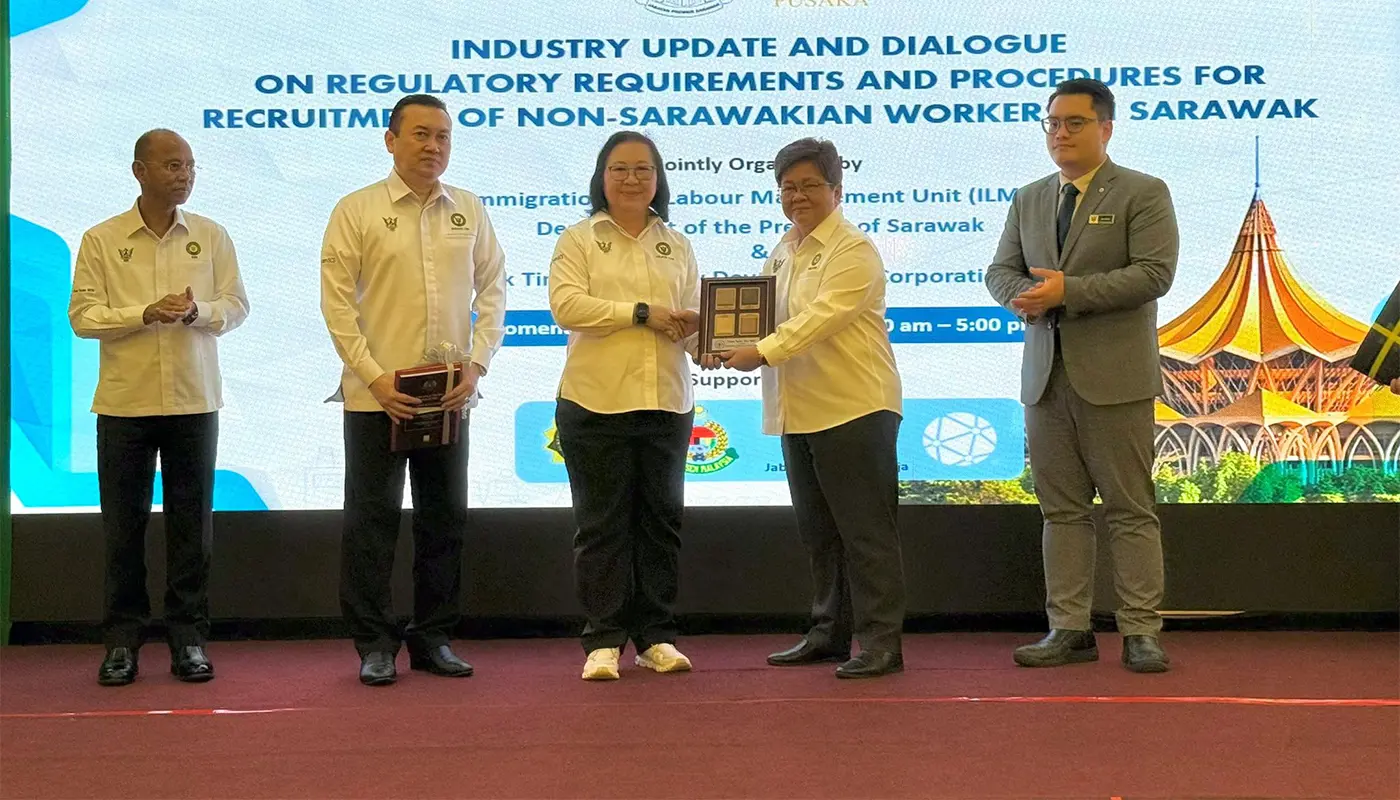
BINTULU – Industry representatives, government officials, and stakeholders convened at the Promenade Hotel on 16 April for a one-day dialogue addressing the recruitment of non-Sarawakian workers.

The event, jointly organised by the Sarawak Timber Industry Development Corporation (STIDC) and ILMU, centred on improving labour regulations, streamlining employment processes, and strengthening collaboration between sectors.
Delivering remarks on behalf of STIDC General Manager YBhg. Datu Haji Zainal Abidin, Deputy General Manager YBrs Cik Hajah Haluyah binti Awi underscored the importance of staying aligned with regulatory updates.
She explained that compliance not only safeguards employers and employees but also ensures that industry operations remain stable and sustainable in the long term.
Deputy State Secretary (Administration) YBhg. Datu Felicia Tan Ya Hua, who presented the keynote address, described the dialogue as a significant first collaboration with STIDC.
She noted that similar sessions are planned for Kuching, emphasising that industry feedback is vital in shaping effective labour policies.
“Industry feedback is essential for shaping effective policies,” she said, highlighting the government’s commitment to listening to stakeholders.
The programme included practical updates on labour regulations, employment procedures, and the use of digital platforms to manage workforce requirements.
Participants engaged in open discussions to address challenges faced by industries, ranging from recruitment bottlenecks to regulatory clarity.
The dialogue also aligned with Sarawak’s Post-COVID Development Strategy 2030 (PCDS 2030), which aims to strengthen economic resilience and improve workforce management.
By addressing labour needs and regulatory frameworks, the session supported broader state objectives of sustainable growth and inclusive development.
Stakeholders expressed that such engagements are crucial for balancing industry demands with government oversight.
The dialogue provided a platform for constructive exchange, ensuring that both employers and policymakers could work towards solutions that benefit Sarawak’s economic landscape.
With further sessions planned in other cities, the initiative is expected to foster stronger partnerships between government agencies and industry players.
The organisers highlighted that continuous dialogue will be key to addressing workforce challenges and supporting Sarawak’s long-term development goals.
