



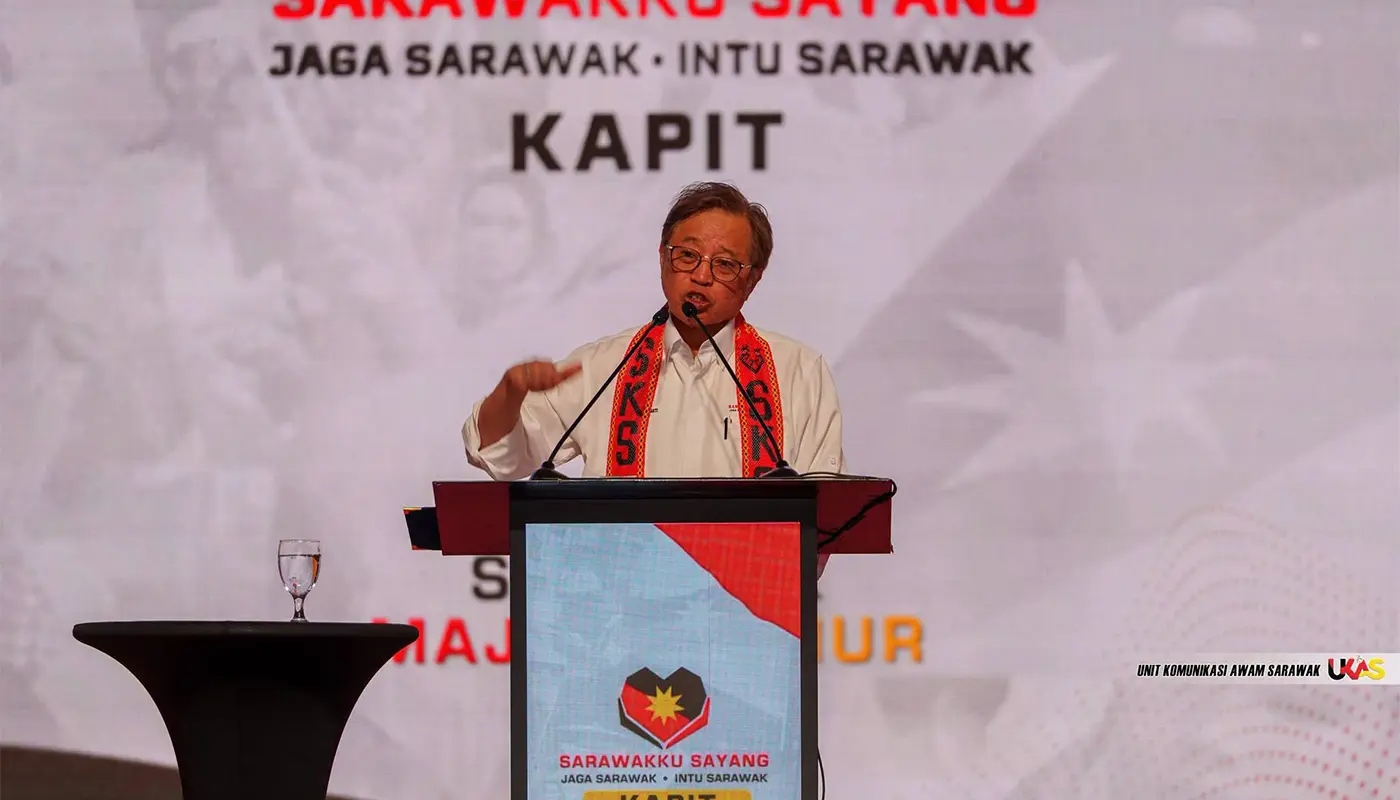
KAPIT – Sarawak is pressing ahead with its Post-COVID Development Strategy (PCDS) 2030, focusing on renewable energy, artificial intelligence, capital investment and sustainable growth.

The Premier of Sarawak, Datuk Patinggi Tan Sri (Dr) Abang Abdul Rahman Zohari Tun Datuk Abang Openg, reaffirmed the state’s commitment to transforming its economy in line with global low-carbon initiatives.
Speaking in Kapit, the Premier highlighted that Sarawak’s forests and natural resources play a vital role in absorbing carbon, positioning the state to participate in international carbon trading markets.
He noted that this aligns with the objectives of the Paris Agreement, enabling Sarawak to contribute to global climate goals while benefiting economically.
The Premier also emphasised the importance of embracing rapid technological change. He pointed to Kapit as an example of how rural areas can be integrated into development plans, ensuring that communities benefit from innovation and infrastructure expansion.
In the energy sector, discussions are ongoing between Petroleum Sarawak Berhad (PETROS) and PETRONAS to explore collaborative opportunities.
These talks aim to strengthen Sarawak’s power industry, enhance energy security and support broader economic growth.
Investment in education and training is another key pillar of PCDS 2030. Authorities have directed efforts towards encouraging investors to support 64 programmes in science, technology, management, finance and psychology.
The initiative is designed to build a skilled workforce capable of driving Sarawak’s transformation agenda. Infrastructure development remains central to the state’s plans.
Public Works Minister Dato Sri Alexander Nanta Linggi has outlined projects to improve road connectivity across Kapit, including bridge construction to link communities and support the creation of green townships.
These projects are expected to boost socio-economic activity and improve access for residents. The Premier also underscored the importance of community-focused programmes such as the Sarawakku Sayang Programme (SKS) 2026, aimed at supporting Kapit’s elderly population.
Other initiatives, including the Sarawak Used Goods Aid (SKAS) and the Sarawak High Income Student Scheme (FTES), reflect the government’s commitment to welfare and education.
Senior leaders including Deputy Premiers Datuk Amar Douglas Uggah Embas and Datuk Amar Awang Tengah Ali Hasan, alongside Cabinet members and officials from the Regional Corridor Development Authority (RECODA), joined the Premier in Kapit to review progress and reaffirm support for the transformation agenda.
Sarawak’s PCDS 2030 strategy is designed to position the state as a leader in sustainable development, balancing economic growth with environmental responsibility.
By investing in renewable energy, technology, infrastructure and human capital, the government aims to create a resilient economy that benefits both urban and rural communities.
