



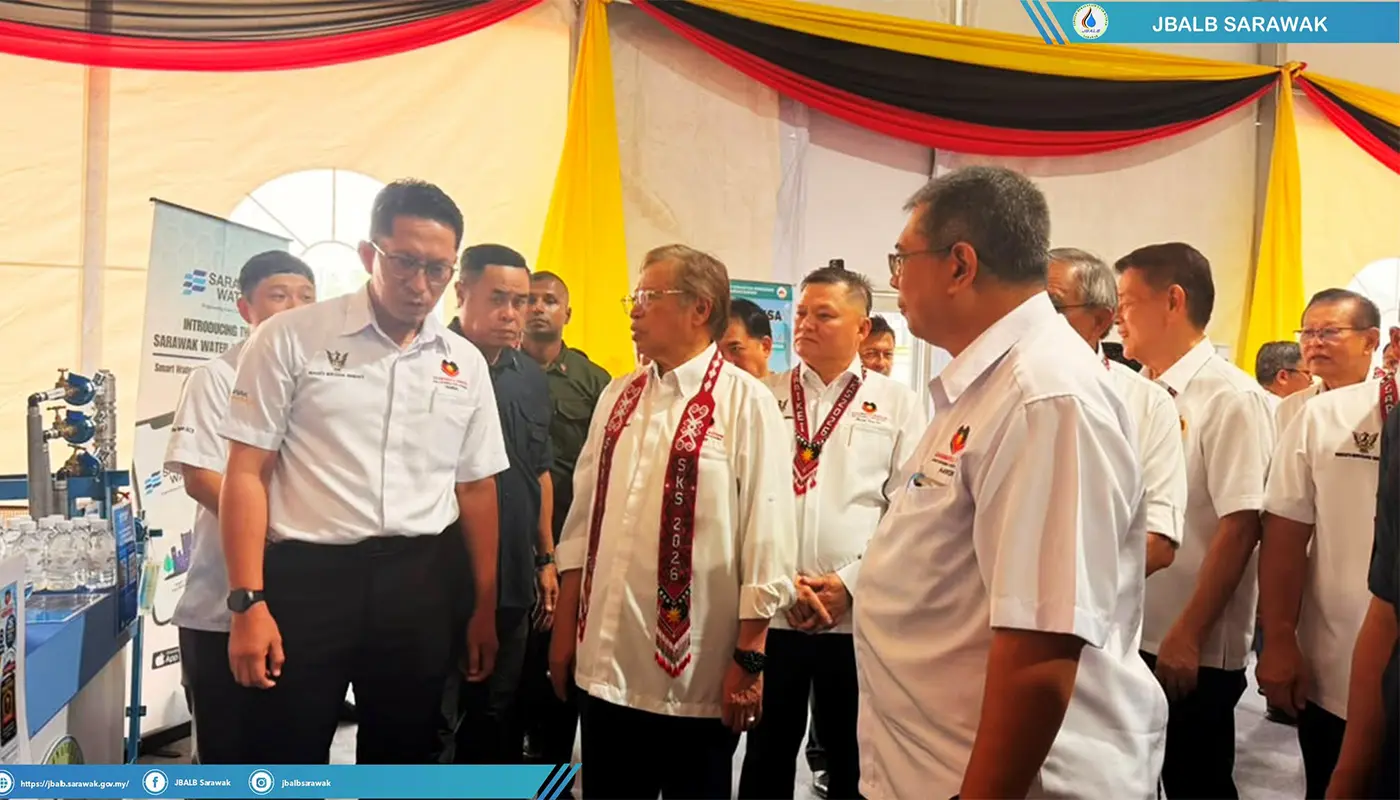
SARIKEI – Rural water infrastructure and service delivery took centre stage during the second day of the Sarawakku Sayang 2026 programme at the Sarikei Sports Complex. The Sarawak Rural Water Supply Department (JBALB) exhibition attracted significant attention from both senior government officials and members of the public throughout Saturday’s activities.

Datuk Patinggi Tan Sri Abang Haji Abdul Rahman Zohari bin Tun Datuk Abang Haji Openg, the Premier of Sarawak, made a dedicated visit to the JBALB booth as part of the opening ceremony proceedings. Accompanied by his entourage, he toured the exhibition to receive briefings on current initiatives aimed at strengthening rural water supply services across the state.
The Premier’s engagement focused specifically on understanding how departmental efforts translate into tangible improvements for community wellbeing. Discussions covered the department’s evolving role, expanded service offerings, and latest technological or infrastructural developments designed to enhance reliability and coverage in underserved areas. Such direct dialogue ensures leadership remains informed about ground-level implementation realities.
Senior technical staff were present to facilitate detailed exchanges with visiting dignitaries and public attendees alike. Ir Ts Haji Tamida bin Haji Da’adi, Deputy Director for Development, represented the JBALB Director during the Premier’s visit. He was joined by Ts Aaron Gorino, Deputy Director for Operations, and Ts Chieng Ghin Wei, the Sarikei Division Water Engineer, ensuring comprehensive expertise was available across development planning, operational management, and local implementation dimensions.
Earlier that morning, prior to the official opening ceremony, the booth received separate high-level visits from ministry leadership. Datu Haji Jafri bin Lias, Permanent Secretary of the Ministry of Utilities and Telecommunications, stopped by alongside Datu Ir Ts Awg Mohammad Fadillah Awg Redzuan, Director of the Sarawak Economic Planning Unit. Their presence underscored inter-agency coordination supporting rural water access expansion.
Public response to the JBALB presence proved enthusiastic throughout the day. Visitors from diverse backgrounds within Sarikei Division utilised the opportunity to obtain first-hand information about rural water supply programmes, eligibility criteria, and application processes. Face-to-face interactions often clarify complexities that printed materials or digital platforms cannot adequately convey.
Beyond informational services, the booth facilitated practical transactions including bill payments for existing customers. This convenience eliminates separate trips to payment centres and integrates utility administration within broader community engagement events. Embedded service delivery reduces friction for residents managing household obligations amidst busy schedules.
Interactive elements such as quiz competitions with prize draws helped maintain visitor engagement whilst reinforcing key messages about water conservation and service awareness. Gamified learning approaches prove particularly effective for reaching younger demographics and families who might otherwise overlook technical exhibitions. Entertainment and education combine to create memorable touchpoints.
Participation in Sarawakku Sayang represents a deliberate strategy to decentralise government services beyond urban administrative hubs. Bringing departmental representatives directly to divisional communities demonstrates institutional commitment to accessibility and responsiveness. Physical proximity builds trust through visible presence rather than distant bureaucracy.
Information dissemination effectiveness increases when delivered conversationally rather than through one-way broadcasting. Staff can tailor explanations to individual circumstances, answer follow-up questions immediately, and gather feedback about communication gaps or misunderstandings. Responsive messaging adapts to audience needs in real time.
Rural water access remains foundational to health outcomes, economic productivity, and quality of life across Sarawak’s interior regions. Continued investment in infrastructure expansion and service strengthening reflects recognition that equitable development requires universal basic service provision regardless of geographic remoteness or population density.
Technical personnel stationed at the booth gain valuable exposure to user experiences and perceptions that inform future service design improvements. Direct feedback loops between providers and consumers help identify pain points, unmet needs, and successful practices worthy of replication. Ground-truth validation prevents policy drift from lived realities.
The exhibition continues through Sunday, offering additional opportunities for residents who could not attend earlier sessions. Extended duration accommodates varying work schedules, travel distances, and family commitments that constrain single-day participation. Inclusive timing maximises reach across demographic segments.
Community members are encouraged to visit before the programme concludes to explore available services, settle outstanding accounts, or simply learn more about ongoing rural water initiatives. Sustained public engagement strengthens accountability partnerships between utilities and ratepayers built on mutual understanding rather than transactional encounters alone.
Saturday’s activities exemplify governance approaches prioritising accessibility, transparency, and relational connection over purely procedural compliance. When institutions meet people where they gather, public service transforms from abstract entitlement into tangible partnership supporting shared prosperity across Sarawak’s diverse communities.
