



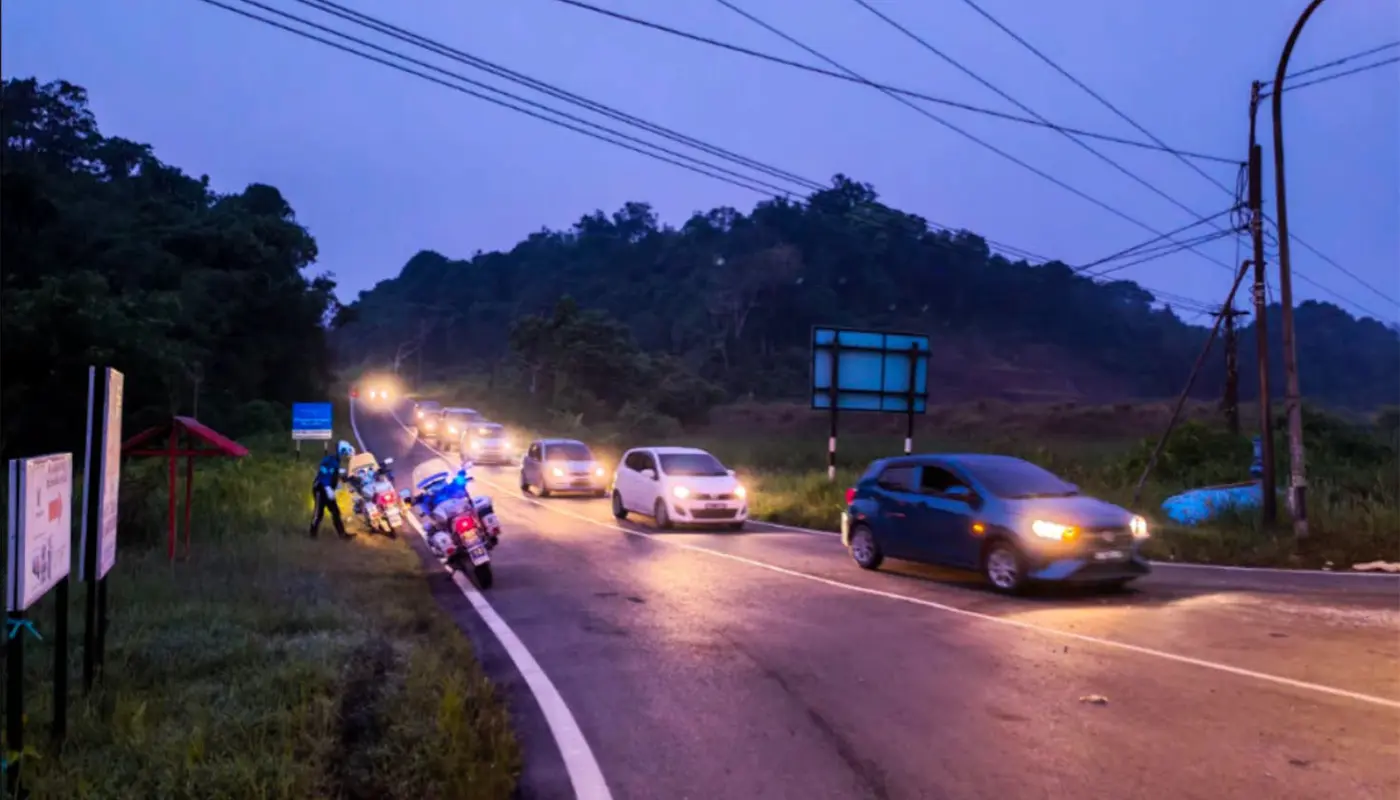
BAU – Local law enforcement personnel successfully managed vehicular movement at a critical intersection during the early morning commute on Thursday. The coordinated effort ensured that motorists experienced minimal delays as they travelled through the district’s primary transport artery.

Members of the Bau District Police Headquarters Traffic Division were deployed to execute point duty responsibilities at the Simpang Empat Jalan Jambusan and Jalan Bau-Kuching junction. This strategic location serves as a vital convergence point for residents heading towards Kuching and surrounding areas.
The assignment commenced at 6.00 am and concluded at 7.30 am on 6 August 2026. Two officers were specifically designated to oversee traffic control measures during this peak window when commuter volume typically increases significantly.
Monitoring assessments indicated that vehicle flow from Jalan Jambusan towards the main Bau-Kuching route remained uninterrupted throughout the operation. No significant bottlenecks or congestion points were recorded despite the morning rush hour timing.
Traffic density along the primary Jalan Bau-Kuching corridor was classified at Scale 1, representing low volume conditions. This classification suggests that road capacity was well within manageable limits during the observed period.
Officers implemented planned control protocols at all four arms of the intersection to facilitate orderly movement. These systematic interventions allowed vehicles from each direction to proceed safely without extended waiting times or conflicting movements.
Meteorological conditions proved favourable for both motorists and enforcement staff alike. Clear weather visibility contributed to safer driving environments and enabled officers to perform their duties without environmental hindrances.
The successful execution of this routine assignment demonstrates the effectiveness of proactive traffic management strategies. Regular point duty deployments help prevent chaos at busy intersections before problems escalate into major disruptions.
Commuters relying on this route daily benefit from consistent police presence during vulnerable travel windows. Predictable enforcement fosters driver confidence and encourages adherence to established right-of-way rules.
Traffic division leadership has reaffirmed its dedication to sustaining these monitoring efforts indefinitely. Continuous assessment allows authorities to adapt tactics based on evolving traffic patterns and infrastructure changes within the district.
Safety remains the paramount objective behind every deployment and intervention. By maintaining smooth flow, officers reduce the likelihood of frustration-induced speeding or aggressive manoeuvres that often lead to collisions.
The Simpang Empat junction handles diverse vehicle types ranging from private cars to commercial transport and motorcycles. Managing this mixed traffic composition requires skilled judgment and constant vigilance from assigned personnel.
Morning rush hour presents unique challenges due to time pressures felt by commuters racing against work or school schedules. Police presence helps temper urgency with order, creating a calmer atmosphere for all road users.
Data collected during such operations informs future resource allocation and scheduling decisions. Understanding peak flow characteristics enables more efficient deployment of limited manpower across multiple locations.
Community feedback regarding traffic conditions is valued as part of continuous improvement processes. Residents who traverse this junction regularly can provide insights that complement official monitoring observations.
Enforcement teams also remain alert for non-compliance issues beyond mere flow management. Speeding, illegal parking, and failure to yield are addressed concurrently to uphold comprehensive road discipline.
The commitment to regular point duty reflects broader institutional priorities centred on public service and safety. Visible policing reinforces social contracts between authorities and citizens sharing communal infrastructure.
Future operations may incorporate technological aids to enhance situational awareness and response capabilities. Integration of digital tools could further optimise traffic management efficiency at key nodes.
Ultimately, the goal extends beyond single-day successes to establishing enduring culture of road courtesy and compliance. Sustained engagement builds habits that persist even when officers are not physically present.
Motorists are reminded that cooperative behaviour amplifies the effectiveness of traffic control measures. Simple acts like signalling intentions and respecting gaps contribute substantially to collective smoothness.
The Bau District Police Headquarters will maintain its schedule of morning monitoring assignments at this and other strategic locations. Consistency in enforcement provides reliability that commuters depend upon for predictable journeys.
