



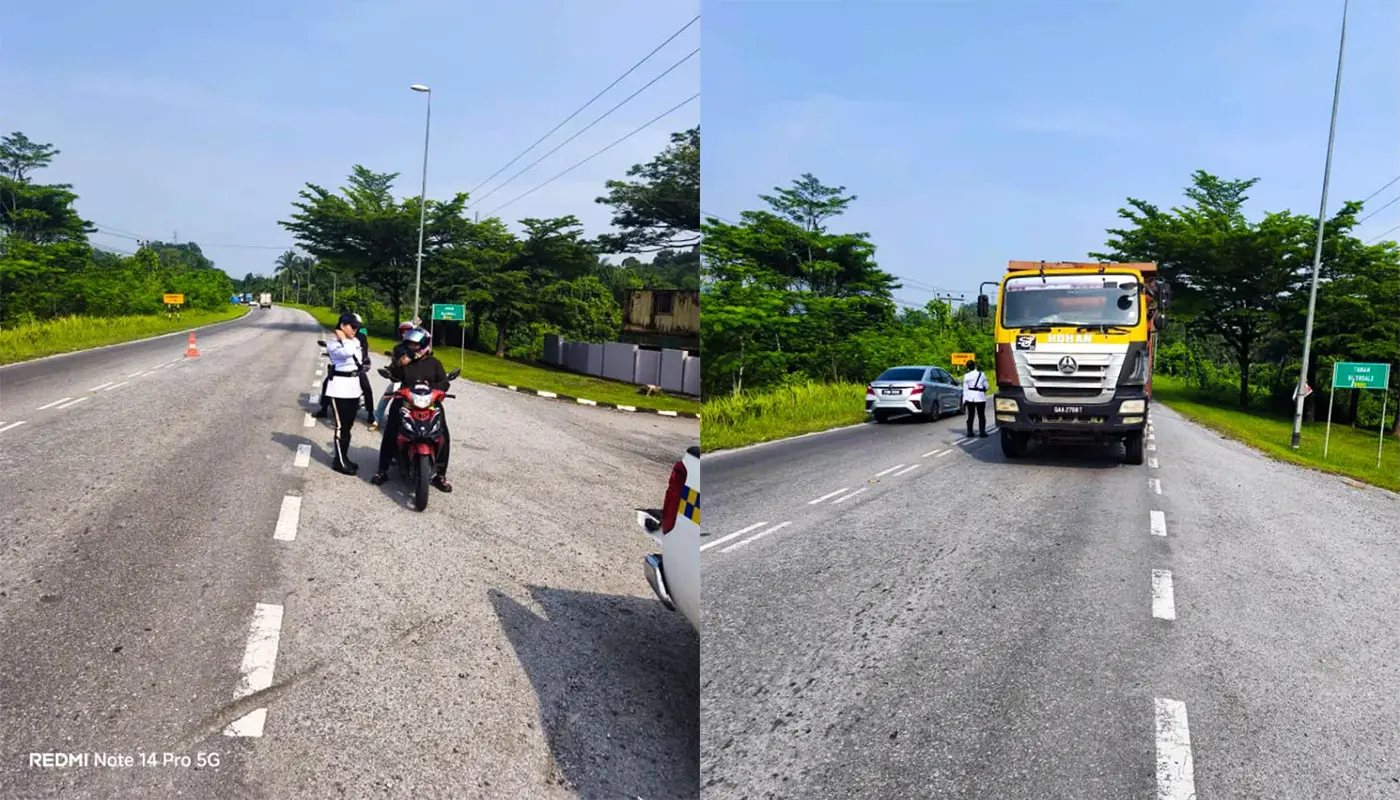
BAU – Law enforcement officers in the Bau district have ramped up their presence on key arterial roads as part of a comprehensive traffic monitoring and enforcement operation.

On Wednesday, 29 July 2026, personnel from the Traffic Investigation and Enforcement Division (BSPTD) of the Bau District Police Headquarters conducted extensive patrols aimed at ensuring road safety and maintaining public order across multiple routes.
The operation covered a wide geographical area, targeting some of the busiest thoroughfares connecting Bau to surrounding regions. Officers were deployed along Jalan Bau-Kuching, Jalan Bau-Serikin, Jalan Bau-Batu Kawa, and Jalan Bau-Lundu.
Additionally, patrols extended to Jalan Jambusan, Jalan Siniawan, and various streets within Bau Town itself. This broad coverage was designed to address potential hazards and enforce compliance across both urban and rural stretches of the district’s road network.
Beyond standard traffic checks, the mission incorporated dual objectives focused on accident prevention and crime deterrence. Personnel actively monitored for signs of street gang activities that could threaten community safety or disrupt traffic flow.
By integrating crime prevention with traffic enforcement, authorities sought to create a safer environment for all road users, addressing not only vehicular offences but also broader security concerns that can arise on public roads.
During the course of the operation, officers inspected twenty-six vehicles and checked thirty individuals. These inspections allowed police to verify documentation, assess vehicle roadworthiness, and ensure drivers were adhering to licensing requirements.
The proactive approach enabled officers to identify and address minor issues before they escalated into more serious safety risks.
As a result of these checks, three summonses were issued under the Pol.257 form using the Mobile Computerised Online Payment (MCOP) system. This digital enforcement tool allows for efficient processing of traffic violations, reducing administrative delays and ensuring accurate record-keeping.
The issuance of summonses serves as both a penalty for non-compliance and an educational measure to reinforce the importance of following traffic regulations.
Despite the relatively small team size, with only two members assigned to this particular shift, the operation demonstrated effective resource utilisation.
The focused deployment allowed officers to cover significant ground while maintaining visibility and engagement with the public. Such targeted operations are essential in districts where manpower may be limited but road safety demands remain high.
Police officials have stated that these enforcement activities will continue on an ongoing basis. The commitment to sustained monitoring reflects a long-term strategy to improve road discipline and reduce accident rates in the Bau district.
Authorities believe that consistent presence and regular checks are key to changing driver behaviour and fostering a culture of compliance among road users.
The emphasis on attitude as the foundation of safety underscores the human element in road safety efforts. While infrastructure and enforcement play critical roles, individual responsibility remains paramount.
Police urge motorists to adopt defensive driving habits, respect speed limits, and remain courteous to other road users. These behavioural changes, when adopted collectively, can significantly reduce the risk of accidents and enhance overall road safety.
Community feedback has generally supported such visible policing efforts. Residents often express appreciation for increased patrols, noting that they contribute to a greater sense of security and order.
However, authorities also stress that enforcement alone is insufficient without public cooperation. They encourage citizens to report dangerous driving or suspicious activities, thereby becoming active partners in maintaining road safety.
The integration of technology, such as the MCOP system, represents a modernisation of traditional policing methods. Digital tools not only streamline processes but also provide valuable data for analysing traffic patterns and identifying high-risk areas.
This data-driven approach enables more strategic allocation of resources and helps tailor interventions to specific local needs.
Looking ahead, the Bau District Police Headquarters plans to expand its outreach efforts alongside enforcement actions. Educational campaigns targeting schools, community groups, and transport operators may complement physical patrols, creating a multi-faceted approach to road safety.
By combining education, enforcement, and community engagement, authorities hope to achieve lasting improvements in traffic compliance and public safety.
