



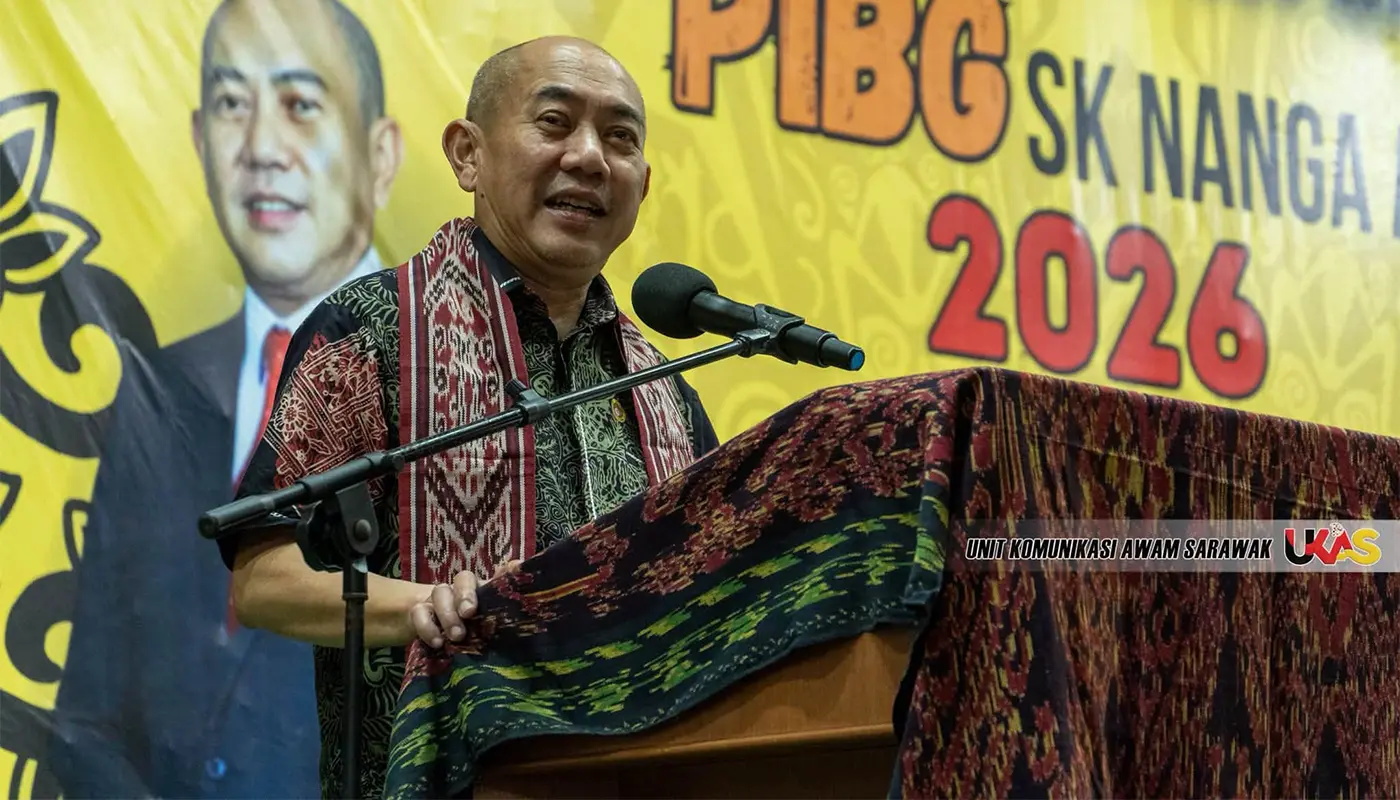
BETONG – The imperative to strengthen proficiency in multiple languages and Science, Technology, Engineering, and Mathematics (STEM) was highlighted as a critical strategy for preparing Sarawak’s youth for the demands of a modernising economy.

State leadership emphasised that these skills are essential for creating high-quality human capital capable of thriving in emerging sectors such as the digital economy, hydrogen energy, and high-tech industries.
Datuk Gerald Rentap Jabu, the Sarawak Deputy Minister of Youth, Sports and Entrepreneurship Development and Assemblyman for Layar, delivered this message while officiating the SK Nanga Ajau Parent-Teacher Association (PIBG) Merarau 2026 event.
The ceremony took place at the Tan Sri Datuk Amar Stephen Kalong Ningkan Sports Hall in Betong on Saturday.
He stressed that education remains the cornerstone of socio-economic development, particularly for rural districts aiming to integrate more fully into the state’s broader growth trajectory.
According to the Deputy Minister, the rapid evolution of Sarawak’s economic landscape requires a workforce that is not only technically skilled but also linguistically versatile.
He noted that while mastery of one’s mother tongue is vital for cultural preservation, fluency in international languages such as English and Mandarin is equally important.
These languages serve as key tools for accessing global opportunities, especially within the rapidly expanding digital sector.
“Besides mastering their mother tongue, children must also be taught fluently in international languages such as English and Mandarin to ensure they take advantage of the opportunities in the growing digital economy,” Datuk Gerald stated.
He argued that this multilingual approach, combined with strong STEM foundations, would enable the younger generation to compete effectively on a global stage.
The Deputy Minister also placed significant responsibility on educators to adapt their teaching methods to the current technological era.
He urged teachers to inspire students by integrating digital technology into their lessons, thereby making STEM subjects more engaging and relevant.
This pedagogical shift is seen as necessary to keep pace with the changing educational landscape and to foster a genuine interest in scientific and technical fields among students.
Community support was identified as another crucial pillar in achieving educational excellence. Datuk Gerald called on parents, PIBG members, and the wider community to actively participate in and support school programmes.
He believed that a collaborative environment between home and school is essential for maintaining high academic standards and ensuring that students receive the holistic support needed for success.
During the event, Betong Member of Parliament Dato Dr Richard announced an allocation of RM5,000 to the SK Nanga Ajau PIBG.
This financial support is intended to assist the school in organising future programmes and enhancing its educational facilities.
The contribution underscores the commitment of local representatives to improving infrastructure and resources for rural schools.
The ceremony also featured the presentation of the Primary Six Student Incentive 2025 awards. This initiative serves to commemorate the academic achievements of graduating students and to motivate their peers to strive for similar success.
By recognising hard work and dedication, the school aims to cultivate a culture of excellence and continuous improvement.
Several dignitaries attended the event, reflecting the broad support for educational initiatives in the district.
Among those present were Anis Madeli, the Betong District Education Officer; Kato Dorsie, representing the Betong District Officer; and Paul Langgang, Chairman of the Layar Education Development Committee (LEDC).
Also in attendance were Maxwell Harold Selamat, the Acting Principal of SK Nanga Ajau; Rahyn Iban, the PIBG Chairman; and Norman Ngumbang, a community representative from Pemancha.
The gathering of principals and head teachers further highlighted the collective effort to elevate educational standards in Betong.
As Sarawak transitions towards a knowledge-based economy, the role of rural schools in producing competent and confident graduates becomes increasingly significant.
Datuk Gerald’s remarks reinforced the idea that education is not just about academic grades but about equipping students with the practical skills needed for future employment.
By focusing on STEM and language proficiency, the state aims to bridge the gap between rural potential and urban opportunity, ensuring that no region is left behind in the march towards progress.
The event concluded with a renewed commitment from all stakeholders to work together towards a common goal: nurturing a generation that is intelligent, skilled, and ready to contribute to the sustainable development of Betong and Sarawak as a whole.
