



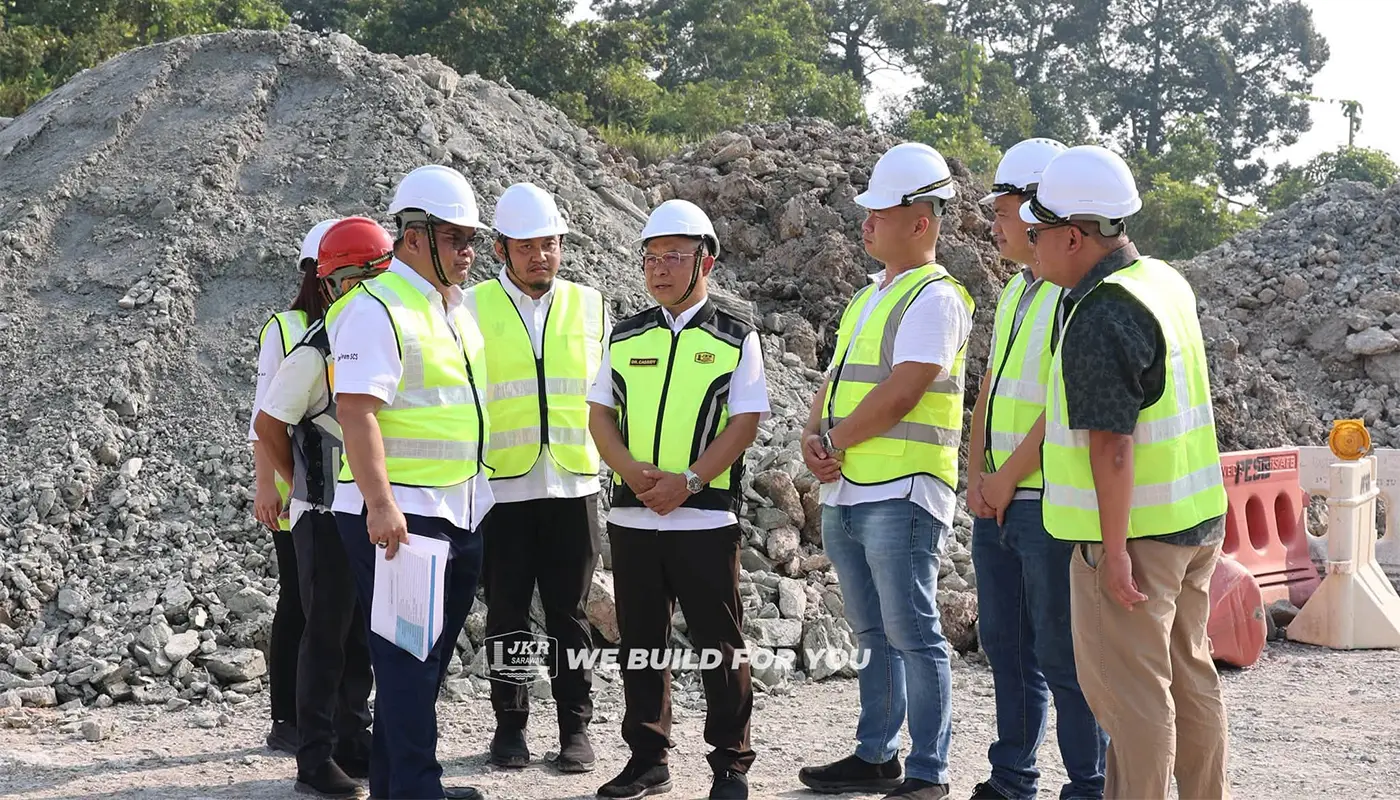
SARIKEI – Two critical infrastructure initiatives aimed at enhancing connectivity within the district received high-level scrutiny this week. The state’s top public works official conducted a comprehensive site assessment to verify that construction activities align with approved timelines and technical benchmarks.

Datu Adj. Prof. Ir. Ts. Gs. Br. PMr. QPr. Dr. Cassidy anak Morris, Director of Sarawak Public Works, led the inspection tour. His visit focused on ensuring that both projects adhere strictly to established specifications whilst maintaining scheduled progress rates.
The first project under review involves upgrading the Nyelong By-Pass into a four-lane dual carriageway. This substantial widening spans 3.6 kilometres, extending from the Meruton/Baji traffic signal intersection through to the Nyelong Industrial Estate in Meranti.
Expanding this arterial route addresses growing traffic volumes generated by industrial activity and residential expansion. The enhanced capacity promises smoother journeys, reduced congestion, and improved safety for commuters traversing this vital corridor daily.
Simultaneously, the director examined the adjacent Nyelong Bypass/Kwong Ming Minah Link Road development. This new two-kilometre connector will bridge Jalan Nyelong By-Pass with Jalan Kwong Ming Minah, creating an efficient alternative route through the district.
Designed to JKR Rural Road Type R3 standards, the link road strengthens the local network’s resilience. By distributing traffic flows more evenly, it alleviates pressure on existing roads during peak periods and supports surrounding area development.
Project teams provided detailed briefings on current work status and operational challenges encountered on-site. These updates enabled real-time evaluation of whether mitigation strategies are sufficient to keep both developments on track for timely completion.
Quality assurance featured prominently in discussions throughout the inspection. Leadership emphasised that meeting deadlines must never compromise adherence to technical specifications or long-term infrastructure durability.
Contractors received explicit instructions to bolster traffic management protocols around active work zones. Minimising disruption to motorists whilst maintaining rigorous safety standards remains a non-negotiable priority during all construction phases.
Enhanced site supervision was also mandated to sustain implementation momentum. Continuous oversight helps identify potential delays early, allowing corrective interventions before they escalate into significant schedule overruns.
Both projects exemplify the department’s strategic commitment to modernising Sarawak’s transportation backbone. Investing in quality road infrastructure directly supports socio-economic growth by improving accessibility and reducing logistics costs across the region.
The Nyelong corridor upgrade specifically targets industrial zone connectivity. Efficient freight movement is essential for business competitiveness, making this infrastructure investment economically significant beyond immediate commuter benefits.
Rural road standards applied to the link road balance functionality with cost-effectiveness appropriate for expected traffic volumes. Such a calibrated design ensures resources are allocated efficiently whilst still delivering reliable service levels.
Safety enhancements extend beyond temporary construction measures to encompass permanent design features. Wider lanes, improved sightlines, and proper drainage collectively contribute to accident reduction over the infrastructure’s lifecycle.
Community patience during construction periods is acknowledged as essential for achieving lasting improvements. Temporary inconveniences yield enduring benefits once upgraded facilities become fully operational and integrated into daily routines.
Inter-agency coordination facilitates smoother project execution across multiple jurisdictions. Aligning utility relocations, land acquisitions, and contractor schedules prevents bottlenecks that could otherwise derail progress.
Monitoring mechanisms remain active throughout the remaining construction phases. Regular reporting and site assessments ensure accountability whilst providing data for future infrastructure planning decisions.
Ultimately, these developments represent tangible investments in Sarikei’s future prosperity. Enhanced mobility enables residents to access opportunities more readily whilst positioning the district for sustained economic advancement.
The director’s personal involvement signals institutional prioritisation of rural infrastructure delivery. Such visible leadership reinforces public confidence that taxpayer funds are being utilised responsibly and effectively.
As both projects advance towards completion, their combined impact will reshape transportation patterns across Sarikei. The resulting network improvements promise safer, faster, and more reliable journeys for all road users in the district.
