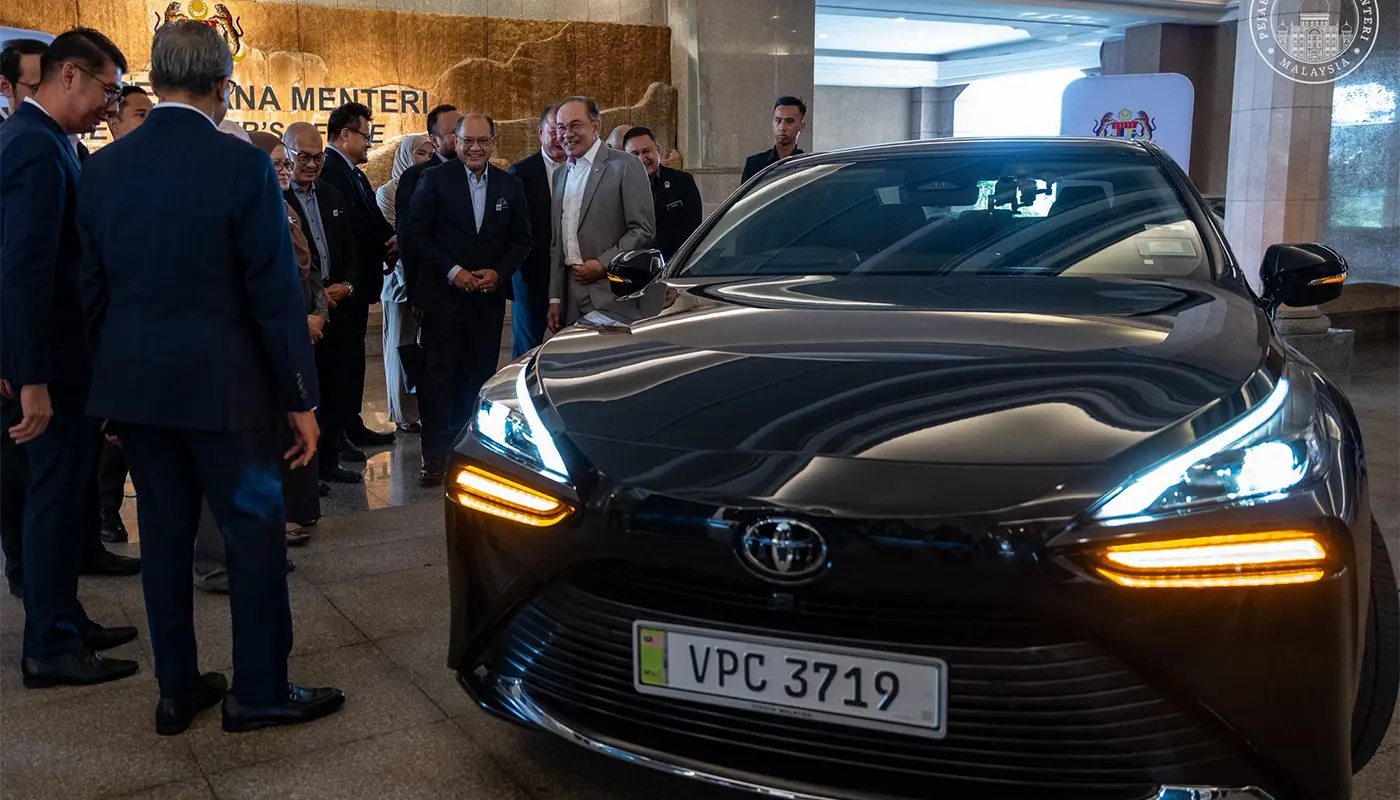
Malaysia has taken another step towards strengthening its green mobility agenda with the official handover of the Toyota Mirai Fuel Cell Electric Vehicle (FCEV) from the Ministry of Science, Technology and Innovation (MOSTI) to the Prime Minister’s Department.
The ceremony, held on 9 December, underscores the government’s commitment to advancing low-carbon technologies and positioning the nation as a leader in sustainable automotive innovation across Southeast Asia.
Prime Minister Datuk Seri Anwar Ibrahim, who received the vehicle, emphasised that the initiative reflects growing confidence among both domestic and international industry partners in Malaysia’s policies and direction.
“The government will continue to lead the region’s transition towards green and smart mobility to ensure that Malaysia is not only prepared for future needs but also becomes a leader in shaping a cleaner, safer and more sustainable mobility landscape for generations to come,” he said.
The Toyota Mirai, a second-generation hydrogen-powered FCEV, represents cutting-edge technology in zero-emission transport. Unlike conventional electric vehicles, it uses hydrogen fuel cells to generate electricity, emitting only water vapour as a by-product.
Its inclusion in the Prime Minister’s Department fleet signals Malaysia’s intent to showcase practical applications of hydrogen technology while encouraging wider adoption in the automotive sector.
Industry leaders were also present at the handover, including UMW Toyota Motor executive director Mohd Shamsor Mohd Zain, who is concurrently president of the Malaysian Automotive Association.
Their involvement highlights the collaborative effort between government agencies and industry in building Malaysia’s hydrogen ecosystem.
This ecosystem is expected to support cross-border cooperation, particularly with neighbouring countries exploring similar technologies, and to drive regional innovation in sustainable mobility.
The initiative aligns with the MADANI government’s broader vision of economic growth through sustainability.
By integrating hydrogen-powered vehicles into official use, Malaysia is signalling its readiness to embrace future mobility solutions while reducing reliance on fossil fuels.
The move also complements ongoing efforts to develop infrastructure for hydrogen production, storage, and distribution, which will be critical for scaling up adoption nationwide.
As global attention increasingly shifts towards climate action and carbon neutrality, Malaysia’s proactive stance places it among regional frontrunners in clean transport.
The Toyota Mirai handover is not merely symbolic; it represents a tangible step in demonstrating the viability of hydrogen technology and reinforcing Malaysia’s ambition to lead Southeast Asia’s transition to sustainable mobility.