



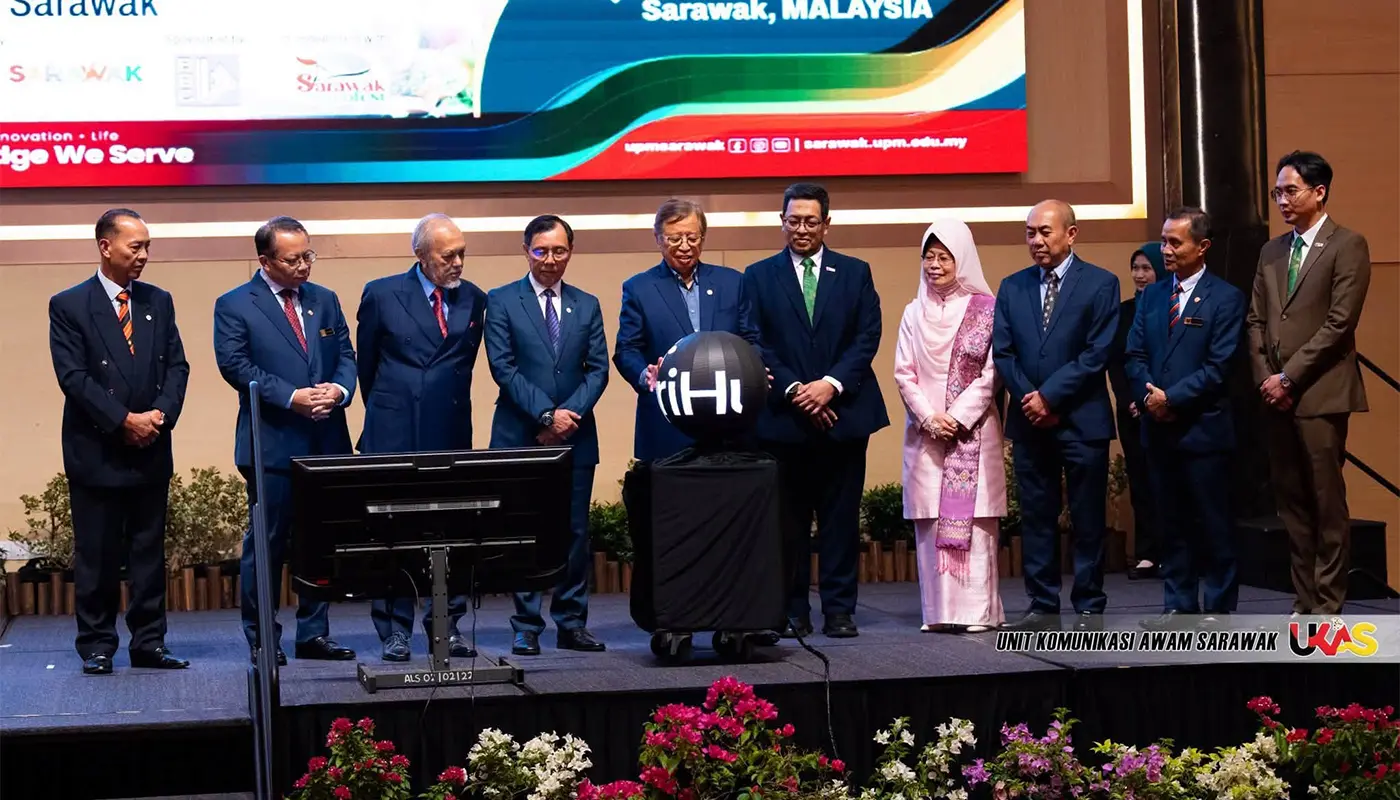
BINTULU – Achieving Sarawak’s ambition to become a recognised food exporter by 2030 will depend heavily on strategic partnerships spanning academia, industry, government bodies, and local communities. Stakeholders gathered in the city on Monday emphasised that no single entity can deliver this transformative objective in isolation, requiring instead a unified ecosystem of shared knowledge and resources.

Dato Sri Dr Stephen Rundi Utom, Minister of Consumer Industry, Commodities and Rural Development, articulated this collaborative imperative during the Third Congress on Sustainable Agriculture and Food Security (COSAFS 2026). He cautioned that relying solely on government initiatives would prove insufficient for meeting such an ambitious timeline. Success demands active integration of research outputs, technological innovation, and practical field application across all sectors.
The minister highlighted educational institutions as critical engines for generating the new knowledge required to modernise agricultural practices. Universiti Putra Malaysia (UPM) was specifically cited for its pivotal role in developing innovative technologies applicable to tropical farming conditions. However, he stressed that academic research must translate into tangible benefits through structured collaboration with industry players, policymakers, and farming communities to ensure relevance and adoption.
Practical demonstration platforms like AgriHub illustrate how innovation can be operationalised effectively within rural contexts. Dato Sri Dr Stephen noted that such initiatives offer scalable solutions capable of boosting productivity whilst simultaneously strengthening food security and supporting rural livelihoods. Expanding these models across more districts throughout Sarawak represents a key strategy for achieving statewide impact rather than isolated pockets of excellence.
Veterinary science infrastructure also received attention as foundational to export readiness. The establishment of the School of Veterinary and Animal Science (SVAS) is expected to significantly enhance domestic capacity in animal health management, food safety protocols, and biosecurity measures. These competencies are non-negotiable prerequisites for accessing international markets where regulatory compliance determines market access and premium pricing potential.
Premier Datuk Patinggi Tan Sri Dr Abang Abdul Rahman Zohari Tun Datuk Abang Openg officially opened the congress, underscoring top-level political commitment to agricultural transformation. His presence signalled that food security and export development remain central pillars of the state’s post-2030 economic strategy. High-level endorsement helps align bureaucratic priorities and resource allocation towards achieving stated national goals.
Industry representatives attending the event acknowledged that private sector investment must complement public funding to achieve scale. Commercial actors bring market intelligence, supply chain expertise, and risk capital that governments typically cannot provide. Conversely, public institutions offer regulatory frameworks, extension services, and basic research that de-risk private investments in emerging agricultural value chains. Mutual dependence characterises this relationship.
Community engagement remains equally vital for sustainable adoption of new practices. Farmers and rural residents possess indigenous knowledge and contextual understanding that external experts often lack. Inclusive co-design processes ensure that innovations respect local realities whilst introducing improvements gradually enough to maintain trust and participation. Top-down imposition of technology frequently fails without this grassroots buy-in.
Research translation mechanisms require strengthening to bridge the persistent gap between laboratory discoveries and farm-level application. Extension officers, farmer cooperatives, and digital platforms serve as intermediaries facilitating this knowledge flow. Investing in these connective tissues is as important as funding primary research itself if Sarawak hopes to convert scientific advances into competitive export commodities within the remaining timeframe.
Biosecurity standards present both challenge and opportunity for aspiring exporters. Meeting stringent international requirements necessitates systemic upgrades across production, processing, and logistics chains. SVAS graduates will play crucial roles in implementing and monitoring these standards domestically whilst building credibility with foreign regulators. Human capital development thus directly enables market access.
Climate resilience features increasingly in discussions about sustainable agriculture and long-term export viability. Extreme weather events threaten yield stability and quality consistency, undermining buyer confidence. Research institutions and farmers must collaborate on adaptive varieties, water management techniques, and insurance mechanisms that buffer against environmental volatility whilst maintaining productivity targets essential for commercial scale.
Digital technologies offer accelerants for achieving 2030 goals if deployed inclusively. Precision agriculture tools, blockchain traceability systems, and e-commerce platforms can enhance efficiency, transparency, and market reach simultaneously. Yet digital divides persist in rural areas, requiring targeted infrastructure investment and skills training to prevent technological exclusion from widening existing socioeconomic disparities within the agricultural sector.
Ultimately, Sarawak’s food export aspiration represents more than economic ambition; it embodies a vision of self-reliance intertwined with global contribution. Realising this vision demands sustained multi-stakeholder commitment beyond individual congresses or policy announcements. Only through enduring partnerships grounded in mutual respect and shared purpose can the state transform its agricultural potential into lasting prosperity for all Sarawakians.
