



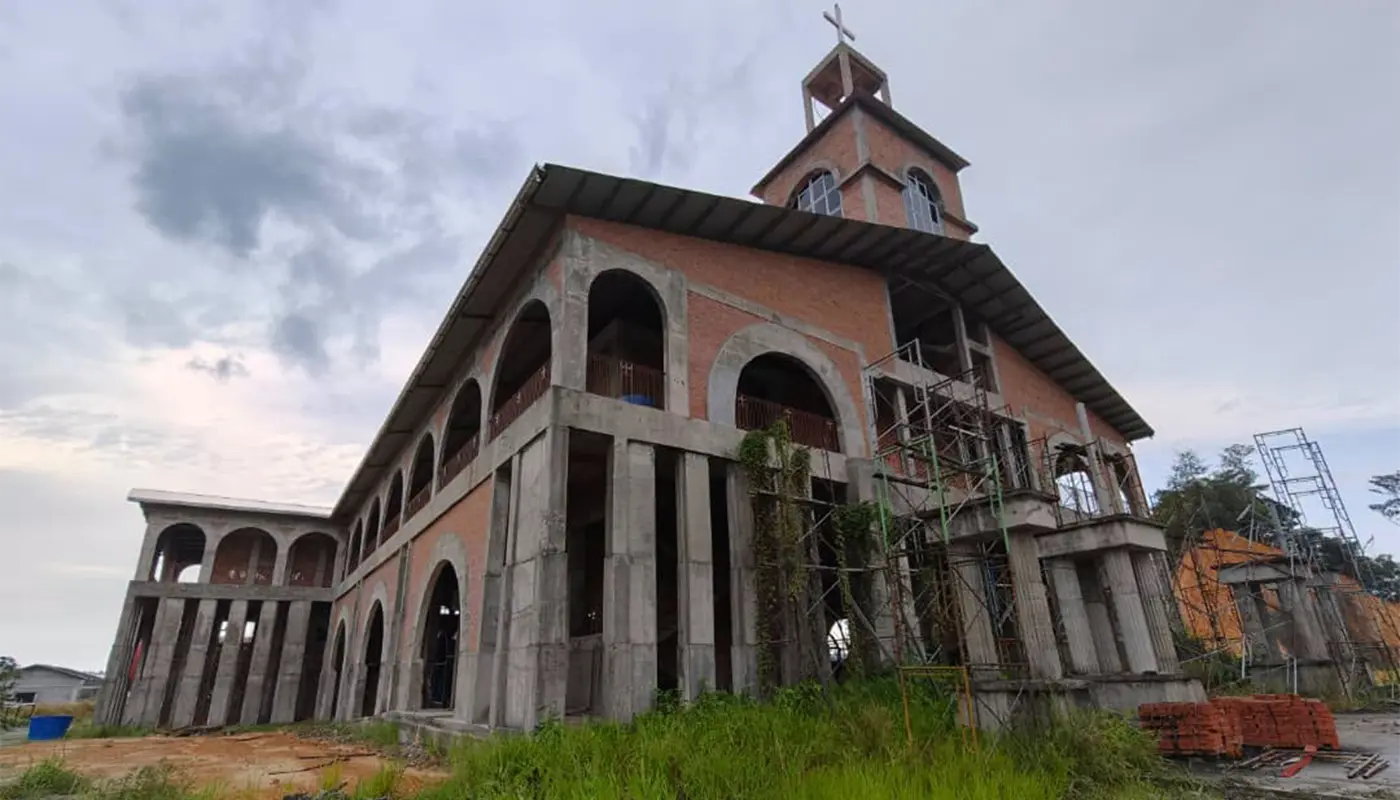
SIBU – A comprehensive verification exercise spanning three divisions has been completed by the Unit for Other Religions (UNIFOR), covering twenty-four houses of worship across Sibu, Bintulu, and Miri. Conducted between 3 August and 6 August 2026, the visit served dual purposes: assessing new funding applications and monitoring progress on previously approved projects to ensure compliance with established guidelines.

Mr George Yeong, Assistant Director at UNIFOR, led the delegation alongside Mr Mark Macdougall, Administrative Assistant from the Monitoring and Compliance Division. Their presence underscored the unit’s commitment to rigorous oversight and direct engagement with beneficiary communities. Field verification remains essential for validating documentation and observing actual conditions that paperwork alone cannot capture.
Technical expertise was integrated into the Miri Division segment through participation of quantity surveyors from the Sarawak Public Works Department (JKR). Mr Basil and Ms Agnes provided professional assessment capabilities regarding construction quality, cost reasonableness, and scope adherence. This inter-agency collaboration ensures that infrastructure-related evaluations meet engineering standards whilst respecting religious sensitivities.
Nine sites were inspected within the Sibu Division during the four-day programme. These included St Michael Sibu Jaya, Ai Ming Methodist Church, City Harvest Christian Fellowship, Tien Sik Methodist Church, Gurdwara Sahib Sibu Sikh Temple, Namo Buddhist Society Monastery, Association of Da Wang Gong Salim Believers, Chapel St Gerald at Sekuau Scheme, and Church of St Charles in Selangau. The diversity of denominations visited reflects UNIFOR’s mandate to serve all non-Islamic faith communities equitably.
Bintulu Division received attention at six locations comprising Emmanuel Methodist Church, Bintulu Buddhist Association, Pek Kong Bintulu Old Believers Organization, The Church of God in Bintulu, Bintulu BEM Church conducting services in Iban language, and Bintulu SDA Church. Geographic spread across urban centres and rural settlements demonstrates systematic coverage rather than selective sampling based on accessibility or prominence.
Miri Division accounted for another nine inspection sites, highlighting the region’s extensive religious infrastructure needs. Locations visited included Batu Tellingai BEM Church, Sungai Manong BEM Glory Church in Batu Niah, Former Sibuti BEM Church, Church of Mater Dei in Lutong, Miri Thian Chun Tien Buddhist Temple, Kampung Muhibbah BEM Church at Kuala Baram, St Patrick Church Uma Akeh building in Baram Tengah, BEM Sungai Nat Church in Ulu Teru Tinjar, and Good Shepherd’s Church in Marudi. Remote interior access required logistical planning and coordination with local congregations.
Verification visits function as accountability mechanisms protecting both public funds and beneficiary interests. Careful assessment prevents misallocation whilst ensuring deserving projects receive appropriate support. Monitoring confirms that disbursed funds achieve intended outcomes according to approved scopes, maintaining credibility of assistance programmes amongst taxpayers and recipients alike.
Transparency in fund management builds trust between government institutions and religious communities. When oversight processes are visible, consistent, and fairly applied, suspicions of bias or favouritism diminish. Demonstrated impartiality strengthens social cohesion by affirming that all faith groups receive equitable treatment under established policies.
Governance strengthening extends beyond individual project compliance to systemic improvement. Patterns identified across multiple sites inform policy refinements, procedural adjustments, and capacity-building initiatives. Aggregate data reveals common challenges, best practices, and emerging needs that guide strategic resource allocation and programme development.
Religious infrastructure development contributes to community wellbeing beyond spiritual functions. Worship spaces often serve as venues for education, social services, cultural preservation, and emergency response coordination. Supporting their maintenance and expansion indirectly invests in broader social capital and community resilience across diverse population segments.
Professional quantity surveyor involvement signals technical seriousness underlying financial assistance decisions. Construction projects require specialised evaluation to prevent cost overruns, substandard workmanship, or scope creep that could compromise safety or sustainability. Expert input protects both public investment and congregational welfare over facility lifespans.
Direct site engagement fosters relationships between administrators and grassroots communities that transcend transactional interactions. Face-to-face meetings allow officials to understand contextual factors influencing project implementation whilst enabling beneficiaries to voice concerns or suggestions. Relational governance complements procedural compliance, creating feedback loops that improve service delivery continuously.
UNIFOR’s stated commitment to strengthened governance, transparency, and accountability represents ongoing institutional evolution rather than static achievement. Each verification cycle generates lessons that refine future operations and deepen understanding of diverse community needs. Continuous improvement ensures that assistance programmes remain responsive, effective, and trusted over time.
The completion of this multi-division verification marks one phase in a perpetual cycle of application, assessment, disbursement, monitoring, and evaluation. Sustained attention throughout project lifecycles, not merely at approval or completion stages, ensures that public support translates into lasting community benefit. Diligent stewardship honours both fiscal responsibility and Sarawak’s tradition of interfaith harmony.
