



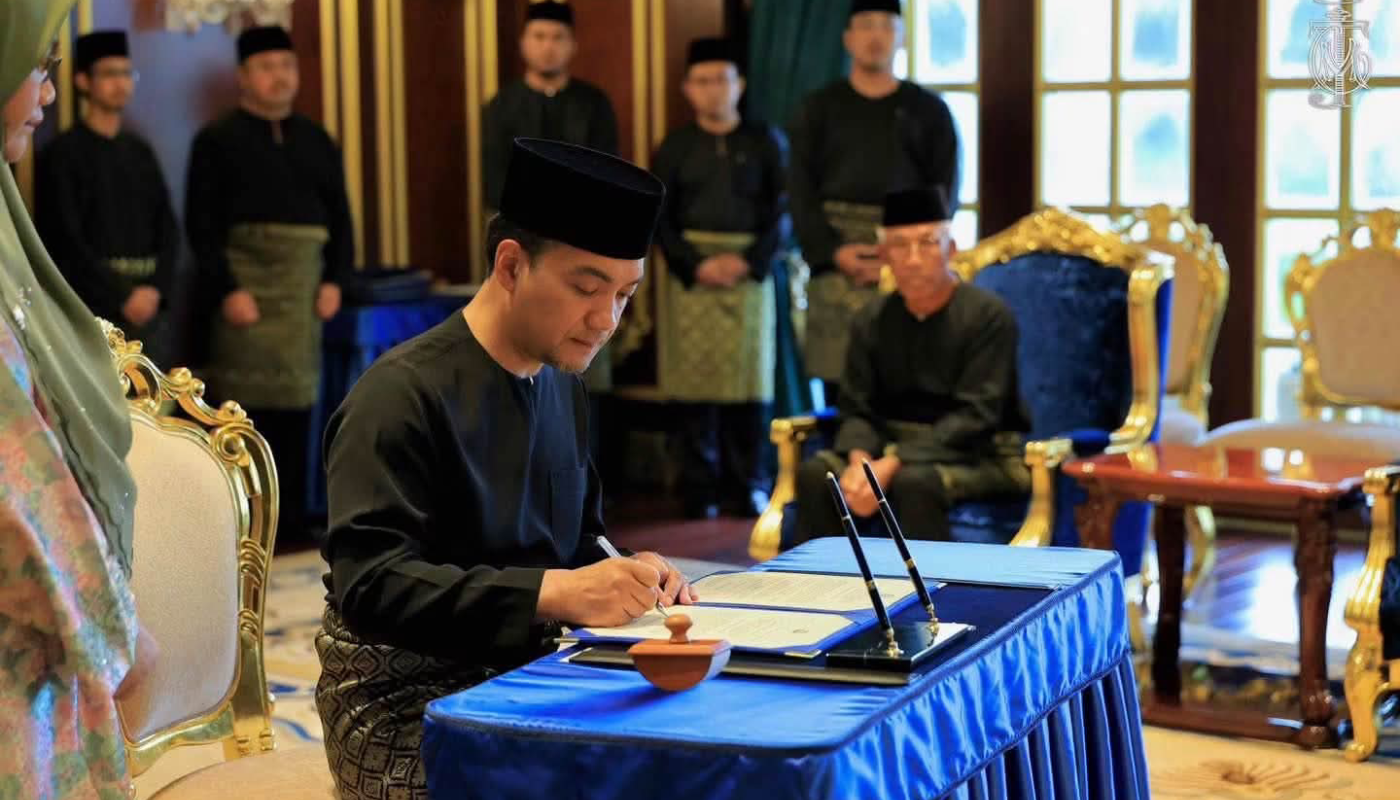
JOHOR BAHRU – Following the conclusion of the highly anticipated sixteenth Johor State Election, the newly appointed Menteri Besar has officially taken office, marking the beginning of a fresh administrative chapter for the southern Malaysian state.

In one of his first official executive acts as the head of the state government, a special public holiday has been declared for Monday, 13 July 2026.
This decision serves as a formal gesture of appreciation towards the voting public who actively participated in the recent democratic process.
The official declaration of the holiday came shortly after the leader received the formal royal consent required to establish the new state administration.
Taking to the public to address his new political mandate, the state leader shared his profound appreciation for the trust placed in him by the nation’s royal institution.
”I express my deepest gratitude to His Majesty the Yang di-Pertuan Agong, Sultan Ibrahim for his gracious approval of my appointment as Menteri Besar of Johor,” he stated during his inaugural public address.
He further extended his utmost respects to the Regent of Johor, Tunku Mahkota Ismail, acknowledging the vital role of the palace in the transition of power.
The new chief minister noted that the Regent’s endorsement allows him to continue bearing the heavy administrative responsibilities required to lead the state towards future prosperity.
He pledged unwavering loyalty to the state, emphasising his commitment to ensuring the continuous socioeconomic advancement of the region and safeguarding the general welfare of its residents.
Recognising the immense weight of his executive duties, the leader highlighted the broad impact his upcoming policy decisions will have on the general population.
”I am aware that every decision that will be made from now on will affect the lives of millions of Johoreans,” he remarked, underscoring the gravity of his leadership role.
”Therefore, I pray that Allah SWT will continue to guide every step, grant wisdom in making decisions and set my heart to always be fair, trustworthy and sincere in shouldering this responsibility.”
The announcement of the state holiday was made with the direct consent and generous permission of the Regent of Johor.
Government offices, public schools, and numerous private sector businesses across the region are expected to observe the closure, offering a brief respite for the population following an intense election period.
The state government framed this impromptu holiday as a tribute to the civic responsibility demonstrated by the electorate throughout the campaigning and voting phases of the state election.
Political observers note that the smooth transition of power and the swift appointment reflect the inherent stability of the state’s constitutional monarchy system.
In Malaysia, the appointment of a Menteri Besar requires the careful consideration of the state ruler, who must identify a legislative candidate believed to command the confidence of the assembly’s majority.
Johor holds a strategic economic position within the nation, often serving as a primary hub for international investment and cross-border trade, largely due to its proximity to Singapore.
Consequently, the leadership of this specific state is heavily scrutinised by both domestic stakeholders and foreign corporate investors.
A stable state government is widely considered essential for maintaining economic growth, executing long-term infrastructure projects, and attracting vital foreign direct investment into key industrial zones.
The incoming administration is anticipated to focus heavily on economic expansion, modernising local infrastructure, and addressing the daily financial pressures faced by ordinary citizens.
The sixteenth state election was closely watched across the country, serving as a critical indicator of political sentiment and voter priorities in the southern region.
Voter turnout and public engagement were central themes leading up to polling day, with extensive logistical efforts made to ensure a transparent and accessible voting process for all registered citizens.
The declaration of a sudden holiday is not entirely unprecedented in Malaysian political culture, often used as a practical mechanism to allow those who travelled back to their hometowns ample time to return to their primary residences.
For Johor, a state characterised by a large working diaspora navigating both interstate and cross-border travel, such a holiday is considered highly beneficial for logistics and traffic management.
It significantly alleviates the immediate pressure of highway congestion and the transport challenges typically associated with the days following a major state event.
The new Menteri Besar steps into the role at a pivotal moment for the regional economy, inheriting several ongoing development mandates.
Johor is currently navigating multiple massive economic initiatives, which require careful oversight and strategic planning from the highest levels of the state government.
The state leader will be directly responsible for ensuring that the local workforce is adequately prepared to meet the demands of emerging high-tech and industrial sectors within the region.
Furthermore, critical public issues such as affordable housing, environmental sustainability, and the expansion of public transportation networks remain high on the agenda for the incoming government.
The electorate has repeatedly voiced the need for pragmatic solutions to urban congestion, particularly in the densely populated commercial districts surrounding Johor Bahru.
The newly appointed leader’s emphasis on fairness and trustworthiness suggests an acute awareness of the public’s demand for transparent governance and equitable resource distribution across all districts.
The administration is expected to face immediate pressure to deliver on manifesto promises while managing the state’s fiscal responsibilities in a prudent manner.
Concluding his formal remarks, the Menteri Besar called upon the public for their continued support as his team begins the work of governing.
He expressed a sincere hope that his administration would operate with utmost integrity and that all future state affairs would be facilitated smoothly for the maximum benefit of the people.
As the state officially moves past the electoral season, all eyes will now turn to the composition of the new state executive council and the initial policy directions the chief minister will champion in the coming legislative term.
