



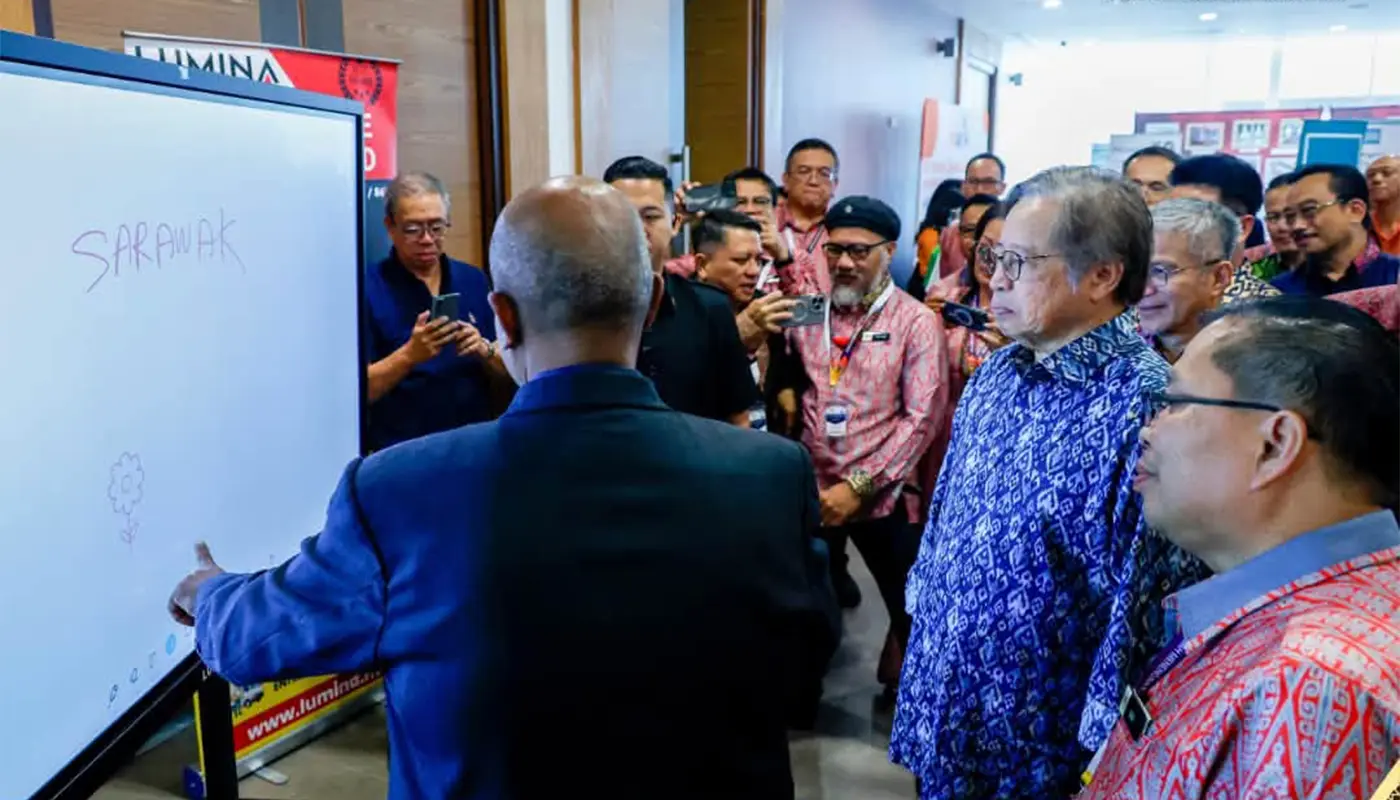
SIBU – The state government of Sarawak has announced a comprehensive overhaul of its educational framework, placing science, technology and artificial intelligence at the heart of its strategy to prepare the next generation for emerging global challenges.

This strategic pivot aims to cultivate a workforce capable of navigating the complexities of climate change and a rapidly evolving digital economy.
Speaking at the 61st Sarawak Secondary School Principals’ Education Management Conference 2026, held at the Kingwood Hotel, Sarawak Premier Datuk Patinggi Tan Sri (Dr) Abang Haji Abdul Rahman Zohari Tun Datuk Abang Haji Openg outlined the administration’s commitment to modernising human capital development.
He emphasised that while the region is blessed with abundant natural resources, there remains a critical gap in technological mastery and advanced knowledge application.
The Premier noted that the global economic landscape is increasingly driven by disruptive technologies. These include artificial intelligence, drone operations, hydrogen energy, carbon capture and storage systems, and even space technology.
To remain competitive on the international stage, he argued that local students must acquire proficiency in these cutting-edge fields.
“We have strength in terms of natural resources, but the gap that needs to be filled is knowledge and mastery of technology. Sarawakian children must master the latest technology to be able to develop the state and compete globally,” Abang Johari stated during his address.
To support this vision, the state has launched several key initiatives. Among the most significant is the establishment of the Sarawak Science Centre, a project valued at over RM200 million.
Developed in collaboration with scientific institutions from Singapore, Finland and Germany, the centre is designed to provide early exposure to science, technology, engineering and innovation for students.
It features modern facilities and includes dormitory accommodation, ensuring that pupils from rural areas can access comprehensive learning programmes without geographical barriers.
In addition to physical infrastructure, the government is implementing the Sarawak Learning and Innovation Programme (SLIP) and the Digital Learning Transformation (DLT) initiative.
These programmes aim to integrate digital tools into the classroom and foster a culture of innovation among educators and students alike.
Access to education in remote interior regions has also been prioritised. The administration has continued to improve connectivity by constructing roads, extending water and electricity supplies, and repurposing logging roads to facilitate easier access to rural schools.
This infrastructural development is seen as vital to ensuring that no student is left behind due to their location.
Financial support for higher education remains a cornerstone of the state’s policy. This year, the Sarawak government has allocated RM260 million to sustain its free higher education policy within state-owned universities.
Currently, approximately 10,000 students are benefiting from this scheme across 64 different fields of study.
The Premier described this expenditure as a long-term investment intended to produce skilled professionals in essential sectors such as science, finance, banking, law and psychology.
On the subject of fiscal health, Abang Johari highlighted the state’s improved revenue performance. Through integrity-based governance, Sarawak’s annual revenue has doubled from RM7 billion to RM14 billion.
Part of this surplus is being directed into a sovereign wealth fund, established to secure financial stability for future generations.
The Premier concluded by urging educators, school principals and Parent-Teacher Associations to act as strategic partners in this national transformation.
He stressed that the ambition to build a world-class developed economy in Sarawak could only be realised through a robust education system, effective school leadership and a societal commitment to lifelong learning.
The collective effort of all stakeholders is required to prepare the youth for the demands of the AI era and the digital economy.
