



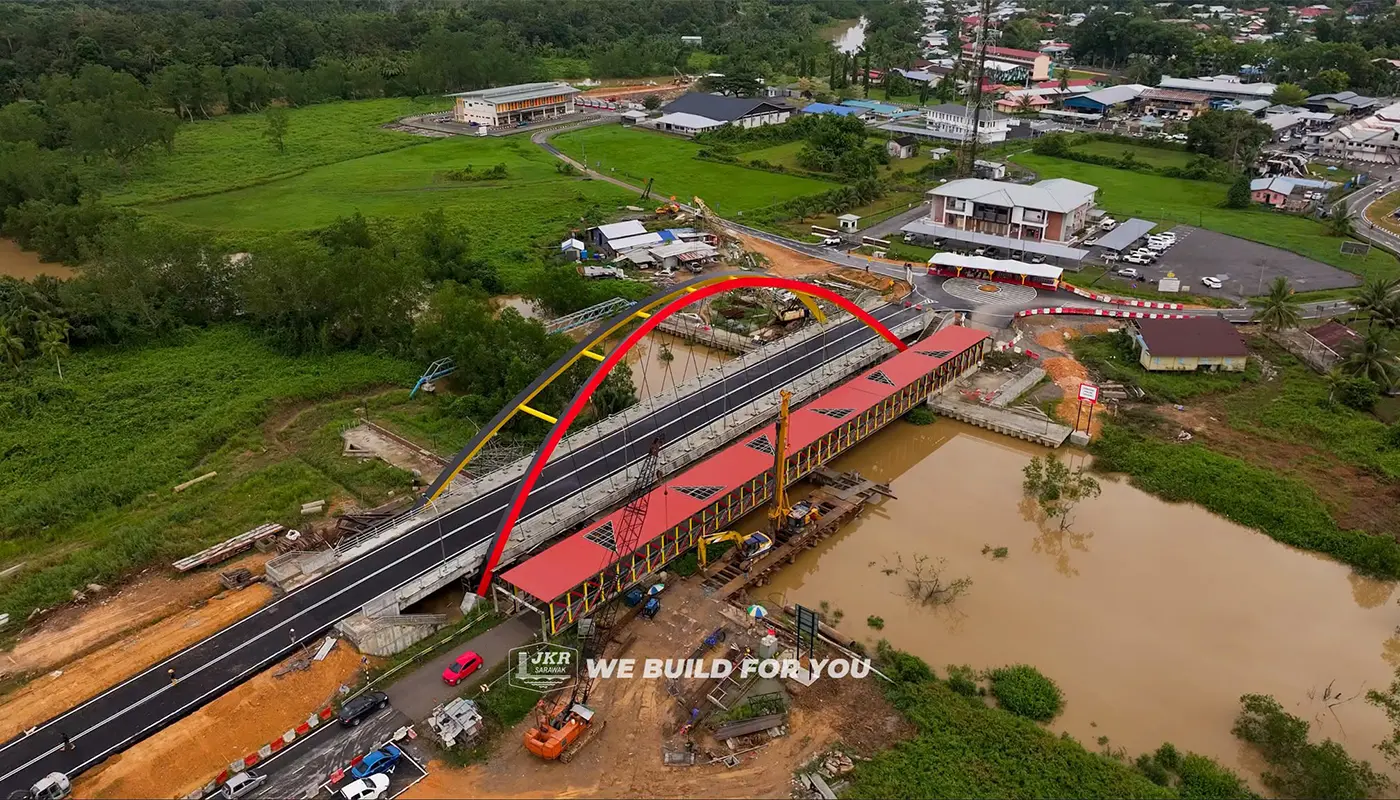
SPAOH – A significant milestone in regional infrastructure development was reached on the final day of July 2026, as the newly constructed Sungai Paku Bridge officially opened its gates to vehicular traffic. The ceremony, held at Jalan Tanjung Sebekut in the heart of Spaoh, marked the culmination of extensive engineering efforts aimed at enhancing connectivity within the Betong Division.

The event was officiated by Datuk Amar Douglas Uggah Embas, the Deputy Premier of Sarawak, who presided over the proceedings that signal a new era of mobility for local residents. This development is not merely an addition to the road network but represents a strategic move by the state government to fortify communication links and stimulate socio-economic growth in the area.
For decades, commuters travelling between Spaoh and Betong have navigated a challenging route that often resulted in delays and inconvenience. The inauguration of this modern structure promises to alleviate these longstanding issues, offering a smoother, safer, and more efficient journey for thousands of daily users. The bridge stands as a testament to the administration’s commitment to improving the quality of life for rural and semi-urban communities across Sarawak.
The architectural design of the Sungai Paku Bridge is striking, featuring a distinctive steel arch concept that spans one hundred metres across the river. This iconic structure is set to become a defining landmark for Spaoh, blending functional utility with aesthetic appeal. Its completion addresses critical bottlenecks that had previously hindered the free flow of traffic, particularly during peak hours when congestion was a common occurrence.
Jalan Tanjung Sebekut serves as a vital alternative corridor connecting Betong with Spaoh. Prior to this upgrade, the reliance on the older infrastructure meant that drivers were subject to a restrictive “stop and give way” system. The previous crossing consisted of a single-lane steel bridge, which necessitated that vehicles from opposing directions take turns to pass. This arrangement frequently caused frustration and extended travel times, especially for those transporting goods or commuting for work.
With the new dual-lane facility now operational, the need for such halts has been entirely eliminated. The improved alignment allows for uninterrupted movement, significantly reducing the time required to traverse the distance. Estimates suggest that travellers can save up to thirty minutes per trip compared to using the main route, a substantial benefit for both personal and commercial transport.
The positive impact of this project extends beyond immediate convenience. It serves more than twenty longhouses in the vicinity, providing reliable access for residents who depend on this route for their daily activities. Furthermore, the enhanced connectivity offers crucial links to neighbouring areas such as Debak and coastal settlements extending towards Pusa. This broader network integration is expected to foster greater social cohesion and economic interaction among these communities.
Heavy vehicles and logistics operators stand to gain considerably from the upgrade. Previously, larger trucks and goods transporters were often forced to detour via longer, less direct routes due to weight restrictions or width limitations on the old bridge. The new structure is designed to accommodate such traffic, allowing for the seamless movement of commercial goods without the need for cumbersome diversions. This efficiency is likely to lower operational costs for local businesses and encourage further commercial activity in the region.
The scope of the undertaking was comprehensive, involving much more than just the erection of the main span. The project, executed by D.A.L Keluarga Sdn Bhd, included the widening of approach roads to meet JKR R3 standards, ensuring that the surrounding infrastructure could handle increased traffic volumes safely. Additionally, two mini-roundabouts were constructed to manage traffic flow at key intersections, while a river bank protection wall stretching approximately one hundred and fifty metres was built to safeguard the structural integrity of the bridge against erosion.
Utility relocation formed another critical component of the works. Engineers had to carefully move existing riverbed pipes, electricity poles, and underground cables to accommodate the new foundation and alignment. Electrical systems were also installed on both the new bridge and the adjacent existing steel structure, ensuring adequate lighting and safety features for night-time usage.
In a move that balances progress with heritage preservation, the old one-lane steel bridge has not been demolished. Instead, it is undergoing conversion into a dedicated pedestrian walkway. This adaptive reuse strategy preserves a piece of local history while repurposing the structure for community benefit. The transformed walkway is anticipated to become a popular spot for locals, offering a unique vantage point over the river and the new bridge.
The development of the riverbank area surrounding the bridge has also been prioritised. The creation of recreational spaces aims to provide residents with areas for jogging, fishing, and family gatherings. With the majestic steel arch of the Sungai Paku Bridge serving as a backdrop, the waterfront is poised to become a hub for leisure and tourism. This enhancement aligns with broader efforts to boost the local economy through tourism-related activities, inviting visitors to appreciate the natural beauty and engineering marvels of the district.
During his address following the ceremony, Datuk Amar Douglas Uggah Embas highlighted the profound significance of the project for the people of Spaoh. He noted that the bridge had been long awaited by the community, who had endured the limitations of the previous infrastructure for many years.
“This bridge has been awaited by the residents for a long time,” the Deputy Premier stated. “Previously, road users had to deal with the stop and give way system on the old bridge. Now the journey is smoother, safer and more comfortable. In fact, heavy vehicles can also use this route without having to go through alternative roads that are further away.”
His remarks underscored the practical benefits experienced by daily commuters, emphasising the elimination of previous constraints. He further elaborated on the broader economic implications, suggesting that improved connectivity would act as a catalyst for development in the subdistrict.
“In addition to improving connectivity and facilitating people’s movement, this bridge will also open up more development opportunities in Spaoh,” Uggah explained. “The old bridge will be turned into a pedestrian walkway, while the development of the waterfront will create a recreational space and become another new landmark. I am confident that this project will bring benefits to the community and boost the local economy.”
The total investment for the project amounted to RM36.9 million, a figure that reflects the scale and complexity of the works involved. The allocation demonstrates the state government’s willingness to invest in high-impact infrastructure that delivers tangible returns in terms of public welfare and economic potential.
The opening ceremony was attended by several key figures in the state administration and local leadership. Among those present were Datuk Gerald Rentap Jabu, the Deputy Minister of Youth, Sports and Entrepreneur Development, and Dato Dr Richard Rapu, the Member of Parliament for Betong. Their presence highlighted the cross-sectoral importance of the project, linking infrastructure development with youth engagement and parliamentary representation.
Senior civil servants also attended the event, including Datu Chiew Chee Yau, the Permanent Secretary of the Sarawak Ministry of Infrastructure and Port Development, and Datu Richard Michael Abunawas, the Resident of Betong Division. Datu Dr Cassidy Morris, the Director of the Public Works Department (JKR) Sarawak, was also in attendance, representing the technical agency responsible for overseeing the construction and maintenance of such vital assets.
Community leaders and representatives from various government agencies joined the dignitaries, reflecting the collaborative nature of the project. The involvement of local stakeholders ensures that the infrastructure meets the specific needs of the population it serves. Their participation in the ceremony symbolises a shared sense of achievement and ownership over the new facility.
The completion of the Sungai Paku Bridge is part of a wider strategy to modernise Sarawak’s road network. By addressing critical gaps in connectivity, the government aims to reduce regional disparities and ensure that remote areas are integrated into the mainstream economy. The Betong Division, in particular, has seen several such initiatives in recent years, aimed at unlocking its agricultural and tourism potential.
As traffic begins to flow freely across the new span, the immediate effects are already being felt by residents. The reduction in travel time and the increase in safety standards are expected to encourage more frequent movement between towns, fostering stronger social ties and commercial exchanges. The ability to transport perishable goods quickly and reliably is also likely to benefit local farmers and producers, who can now reach markets with greater ease.
Looking ahead, the focus will shift to maintaining the new infrastructure and maximising its potential. The conversion of the old bridge into a pedestrian zone and the development of the waterfront require ongoing management to ensure they remain safe and attractive public spaces. Community engagement will be crucial in sustaining these areas as vibrant hubs for recreation and social interaction.
The Sungai Paku Bridge stands as a symbol of progress for Spaoh. It represents not just a physical crossing over a river, but a bridge to greater opportunities, improved livelihoods, and a more connected future. As the sun sets on the steel arch, casting long shadows over the calm waters below, the structure remains a silent yet powerful testament to the transformative power of strategic infrastructure investment.
For the people of Spaoh, Betong, and the surrounding districts, the opening of this bridge is more than a news headline; it is a daily reality that promises convenience, safety, and prosperity. The journey forward is now clearer, smoother, and filled with the promise of new horizons.
