



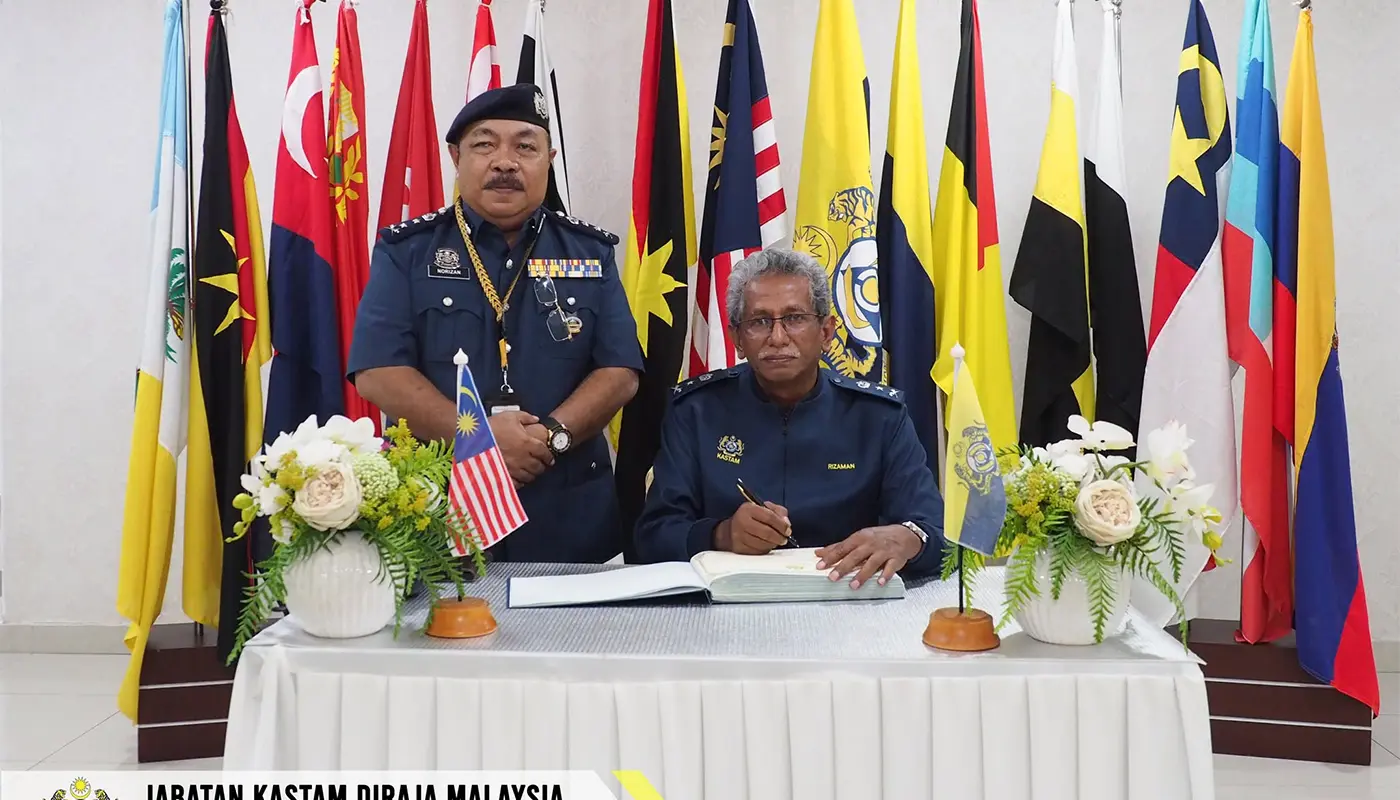
KUCHING – Inter-agency cooperation and private sector engagement took centre stage this week as senior customs officials convened for strategic discussions. The meeting facilitated important dialogue regarding automotive logistics and regulatory compliance within the state.

YBhg. Datuk Haji Norizan bin Haji Yahya, Director of Sarawak State Customs, received a visiting delegation at his office on Wednesday. The courtesy call served multiple purposes, combining relationship-building with operational coordination ahead of scheduled inspections.
Tuan Rizaman bin Abd Rahman led the visiting contingent in his capacity as Deputy Director of State Customs for Customs and Domestic Taxes from JKDM Melaka. His presence highlighted the importance of inter-state knowledge sharing and procedural harmonisation across regional offices.
Encik Nabil Fikri Yaakub accompanied the federal officers as Assistant Manager representing Honda Malaysia Sdn Bhd. The manufacturer’s participation underscored the collaborative approach adopted when addressing industry-specific regulatory matters affecting vehicle importation and storage.
The timing of this engagement coincided with a working visit focused on inspecting Honda’s vehicle storage warehouses in Sarawak. Such facilities play critical roles in supply chain management, requiring careful oversight to ensure adherence to customs regulations and security protocols.
Pre-inspection meetings allow stakeholders to clarify expectations and address potential concerns proactively. This preparatory dialogue helps streamline subsequent field assessments whilst minimising disruptions to commercial operations during verification exercises.
Automotive sector logistics present unique challenges due to high-value inventory and complex documentation requirements. Coordinated approaches between regulators and manufacturers help maintain efficient clearance processes without compromising enforcement integrity.
Knowledge exchange between Melaka and Sarawak customs divisions enriches institutional capabilities through shared best practices. Different states often develop specialised expertise based on local trade patterns that can benefit counterparts elsewhere in the federation.
Honda’s longstanding presence in Malaysia makes its warehouse operations significant reference points for automotive compliance standards. Regular inspections verify that storage conditions, record-keeping systems, and security measures meet prescribed regulatory benchmarks consistently.
The inclusion of private sector representatives in official engagements reflects evolving governance philosophies emphasising partnership over pure enforcement. Constructive relationships yield better compliance outcomes than adversarial approaches alone could achieve.
Vehicle storage facilities must balance accessibility for distribution with safeguards against unauthorised removal or tampering. Inspections assess whether physical infrastructure and procedural controls adequately address these dual imperatives simultaneously.
Domestic tax implications associated with vehicle storage warrant particular attention during such reviews. Accurate classification and timely duty payments remain fundamental obligations that protect national revenue interests whilst enabling legitimate commerce.
Cross-jurisdictional visits also foster personal connections that facilitate future communications. Familiarity between officers reduces friction when resolving issues that arise during routine operations or exceptional circumstances requiring urgent coordination.
Sarawak’s geographic position creates distinct logistical considerations compared to Peninsular Malaysia. Understanding these contextual differences enables Melaka-based officials to appreciate why certain procedures may vary despite operating under common legislative frameworks.
Manufacturers benefit from predictable regulatory environments where rules are applied consistently and transparently. Engagement sessions demonstrate government commitment to maintaining business-friendly conditions whilst upholding statutory responsibilities.
Documentation standards for stored vehicles form another key inspection focus area. Proper records enable auditors to trace vehicle movements accurately and verify that all applicable duties have been accounted for appropriately.
Security protocols at storage sites protect both government revenue and corporate assets from loss or theft. Adequate surveillance, access controls, and inventory reconciliation procedures collectively mitigate risks inherent in holding high-value goods.
The courtesy call format allows broader policy discussions beyond immediate inspection parameters. Strategic conversations about emerging trends, technological developments, and regulatory reforms help align stakeholder expectations for future engagements.
As automotive markets evolve with electric vehicles and new mobility solutions, customs frameworks must adapt accordingly. Continuous dialogue ensures regulations remain relevant whilst supporting innovation rather than inadvertently stifling progress.
Ultimately, such collaborative engagements strengthen Malaysia’s overall trade facilitation ecosystem. When regulators and businesses work together constructively, the entire nation benefits through enhanced competitiveness and investor confidence.
