



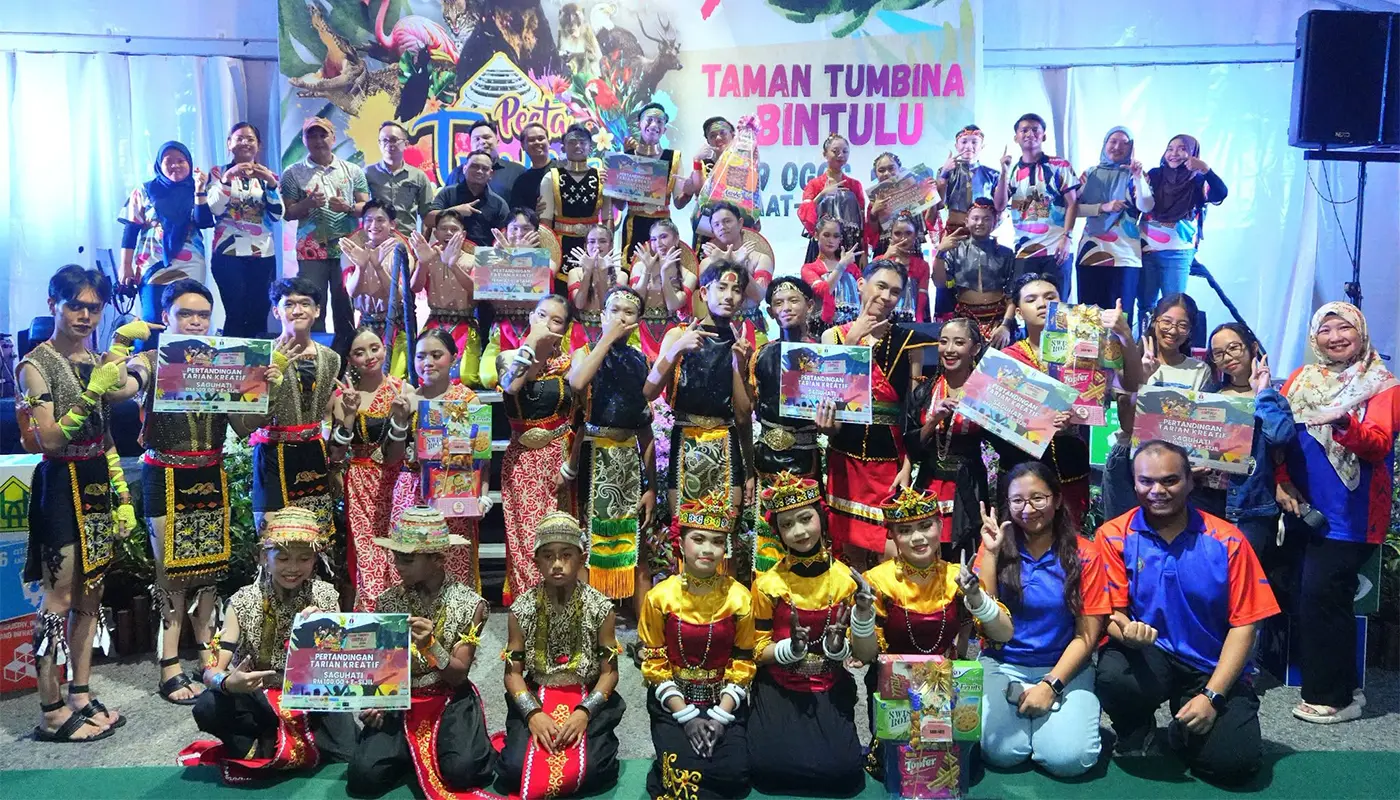
BINTULU – The results of the 2026 Tumbina Festival Creative Dance Competition have been officially released, concluding a vibrant showcase of local artistic talent. Organisers from the Bintulu Development Authority (BDA) extended their congratulations to all participating groups who delivered performances marked by exceptional energy and cultural dedication throughout the event.
Gema Warisan Baru emerged as the champion of this year’s competition, securing first place with a performance that stood out amongst a highly competitive field. Their victory reflects both technical proficiency and creative interpretation, setting a benchmark for future participants in this annual cultural celebration.
Artization Dance Group claimed second place, demonstrating remarkable skill and artistic vision that earned them recognition from the judging panel. Their performance contributed significantly to the overall high standard of entries witnessed during the festival, highlighting the depth of dance talent currently active within the region.
Third place was awarded to Kastri, a group representing Mukah, underscoring the geographical reach of the competition beyond Bintulu itself. Their achievement demonstrates how the Tumbina Festival serves as a platform for cultural exchange across different communities within Sarawak, bringing diverse artistic traditions together on a shared stage.
Six groups received consolation prizes in recognition of their commendable efforts and contributions to the event’s success. Bandarian Arts Group, Sebaru D, Revolution Dancer, Astra Seni South Creation, Adiwarna Tari, and Cupid were all acknowledged for their commitment and artistry. These recipients demonstrated that excellence in cultural performance extends beyond podium placements.
The competition served as more than a contest; it functioned as a living exhibition of heritage preservation through contemporary expression. Participating groups displayed extraordinary creativity whilst maintaining respect for traditional forms, illustrating how cultural arts can evolve without losing their foundational identity. This balance between innovation and tradition remains central to the festival’s mission.
Judges faced the challenging task of evaluating performances that varied widely in style, theme, and execution. Their expertise ensured fair assessment based on established criteria encompassing choreography, costume design, musicality, and stage presence. The integrity of the competition depends upon such rigorous evaluation processes that maintain credibility amongst participants and audiences alike.
Behind every successful cultural event stands an extensive support network often unseen by spectators. Appreciation was formally extended to the secretariat, administrative staff, technical crews, and volunteers whose dedicated efforts enabled seamless execution. Their behind-the-scenes contributions form the essential infrastructure upon which public celebrations depend.
Dance competitions like this one provide crucial platforms for emerging artists to gain performance experience and public exposure. For many participants, the Tumbina Festival represents their first opportunity to present original work before substantial audiences and receive professional feedback. Such experiences accelerate artistic development and build confidence that carries forward into future creative endeavours.
Cultural empowerment through dance strengthens community identity and intergenerational knowledge transfer. When young performers engage deeply with traditional movement vocabularies, they become active custodians of intangible heritage rather than passive observers. This embodied learning ensures cultural continuity in ways that classroom instruction alone cannot achieve.
The BDA’s continued investment in arts programming signals institutional commitment to holistic regional development. Economic growth and infrastructure expansion must be accompanied by cultural vitality to create truly liveable communities. Festivals that celebrate local creativity contribute to social cohesion and civic pride in measurable ways.
Participants were encouraged to maintain their creative momentum beyond the competition stage. Sustained artistic practice requires discipline, collaboration, and resilience—qualities developed through competitive experiences but nurtured through ongoing engagement. The festival serves as a catalyst rather than a destination in each artist’s journey.
Audience members who attended witnessed firsthand the richness of Sarawak’s contemporary dance landscape. Public attendance validates performers’ efforts and demonstrates community appetite for cultural programming. Strong spectator turnout justifies continued institutional support and encourages sponsors to invest in future editions.
Looking ahead, organisers will likely review this year’s outcomes to refine subsequent competitions. Participant feedback, audience responses, and operational observations inform continuous improvement of format, judging criteria, and logistical arrangements. Adaptive management ensures the Tumbina Festival Creative Dance Competition remains relevant and impactful for generations of artists yet to emerge.
