



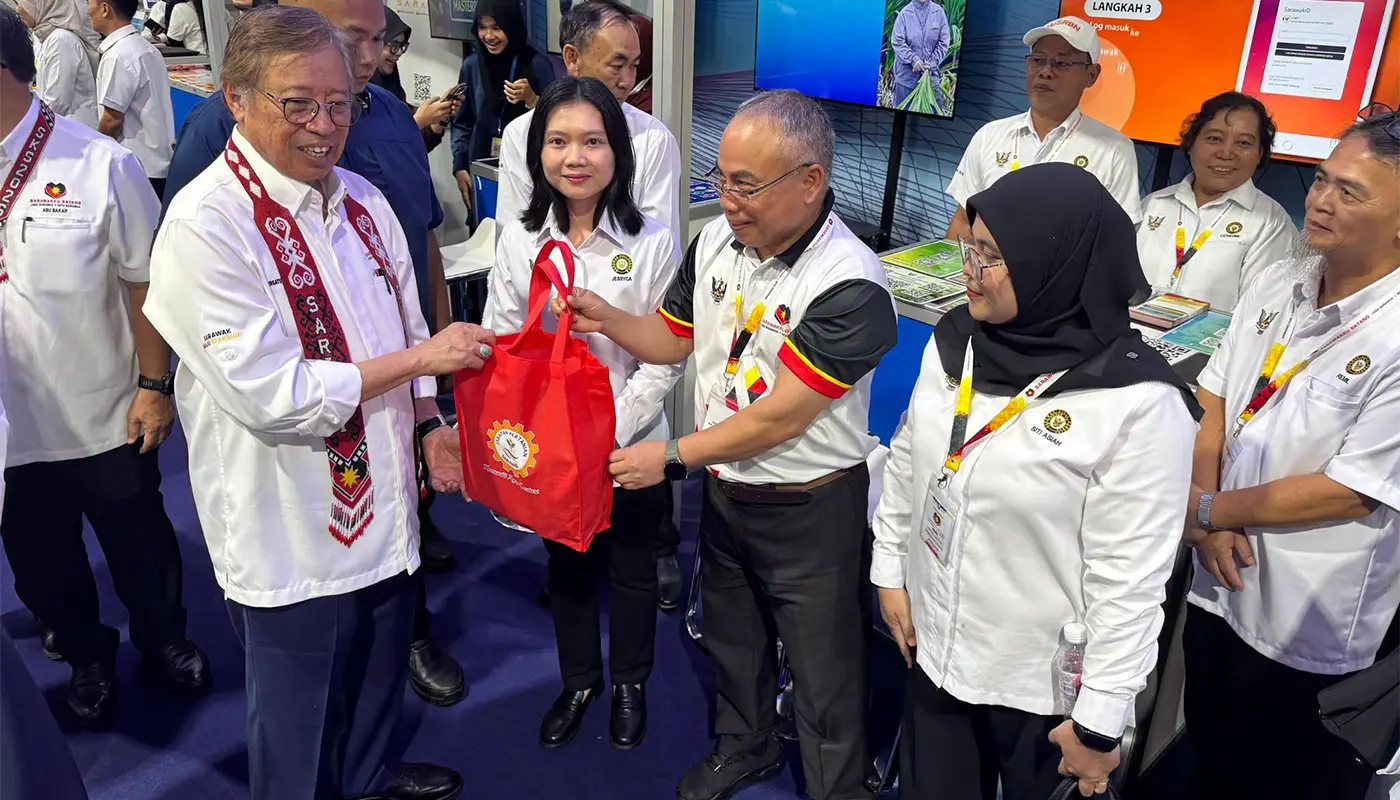
SARIKEI – Direct engagement between state leadership and agricultural stakeholders took centre stage on Saturday as the Premier of Sarawak made a dedicated stop at a departmental exhibition. Datuk Patinggi Tan Sri Abang Haji Abdul Rahman Zohari bin Tun Datuk Abang Haji Openg visited the Sarawak Agriculture Department booth during the ongoing Sarawakku Sayang Sarikei Division programme, underscoring the administration’s focus on rural economic sectors.

The Premier was received upon arrival by Puan Jessyca anak Andrew Mujah, the Sarikei Division Agriculture Officer, who led the welcome delegation. She was accompanied by Mr Badin, Principal Assistant Director of the Corporate Communications, Digitalization and Transformation Division, alongside various department staff members stationed at the site. Their presence reflected coordinated efforts across multiple administrative units to facilitate meaningful interaction with visiting dignitaries.
This booth participation forms part of a deliberate strategy to decentralise government services and bring them physically closer to farming communities. Rather than requiring rural residents to travel to urban administrative centres for information or assistance, the department establishes temporary presences at community events where people already gather. This outreach model reduces access barriers and demonstrates institutional commitment to serving dispersed populations.
Information dissemination constituted a primary objective of the department’s exhibition presence. Staff provided detailed explanations of current agricultural development programmes available to local farmers, including eligibility criteria, application procedures, and expected timelines. Such face-to-face communication often proves more effective than printed materials or digital platforms for conveying complex programme details to audiences with varying literacy levels and technological access.
The Sarawakku Sayang series functions as a mobile governance platform connecting state resources with divisional needs. By embedding departmental booths within these larger community celebrations, authorities create informal environments where citizens feel comfortable asking questions and sharing feedback. These relaxed settings frequently yield insights that formal consultations might miss due to power dynamics or procedural constraints.
Agricultural officers stationed at the booth offered personalised guidance tailored to specific crops, livestock systems, and farm sizes prevalent in the Sarikei region. Localised advice carries greater practical value than generic recommendations because it accounts for soil conditions, climate patterns, market access, and cultural practices unique to the area. Contextual relevance determines whether technical knowledge translates into actual adoption.
Digital transformation initiatives featured prominently in discussions, reflecting the department’s modernisation agenda. Mr Badin’s presence signalled integration of communication technology with traditional extension services, suggesting hybrid approaches that combine physical outreach with digital follow-up capabilities. Such combinations extend reach beyond event durations whilst maintaining human connection essential for trust-building.
Community members attending the programme gained direct access to decision-makers and technical experts simultaneously. This convergence accelerates problem resolution by eliminating intermediate bureaucratic layers that typically slow information flow. Farmers experiencing challenges could describe situations directly to knowledgeable staff who possess authority to initiate responses or escalate issues appropriately.
The Premier’s personal visit communicates symbolic importance attached to agricultural development within state priorities. When senior leaders allocate time to engage with sector-specific exhibitions, it signals to both civil servants and constituents that food security and rural livelihoods remain central policy concerns. Symbolic gestures reinforce substantive commitments when consistently aligned with resource allocations and programme implementations.
Feedback collected during such interactions informs future programme design and resource allocation decisions. Ground-level perspectives reveal implementation gaps, emerging needs, and unintended consequences that headquarters-based planning may overlook. Responsive governance depends upon systematic incorporation of field intelligence into strategic decision-making processes.
Department staff benefit from exposure to diverse farmer experiences and innovative local practices encountered during outreach events. Extension work flows bidirectionally; whilst officers share technical knowledge, they simultaneously learn from practitioners whose experiential wisdom complements scientific training. Mutual learning strengthens service quality and maintains professional humility amongst technical personnel.
Sarikei’s agricultural significance within Sarawak makes it a logical focal point for intensified engagement efforts. The division contributes substantially to state food production and rural employment, warranting sustained attention from policymakers and implementing agencies alike. Geographic targeting ensures resources align with areas of greatest impact potential.
Continuity of outreach beyond single-day events remains essential for lasting impact. Follow-up mechanisms, referral pathways, and scheduled return visits transform episodic contacts into enduring relationships. Trust develops through consistency rather than intensity, requiring sustained presence that reassures communities of genuine long-term commitment.
Saturday’s visit exemplifies governance approaches that prioritise accessibility, responsiveness, and relational engagement over purely transactional service delivery. When leaders and institutions meet people where they are, both literally and figuratively, public service transforms from abstract bureaucracy into tangible partnership supporting shared prosperity.
