



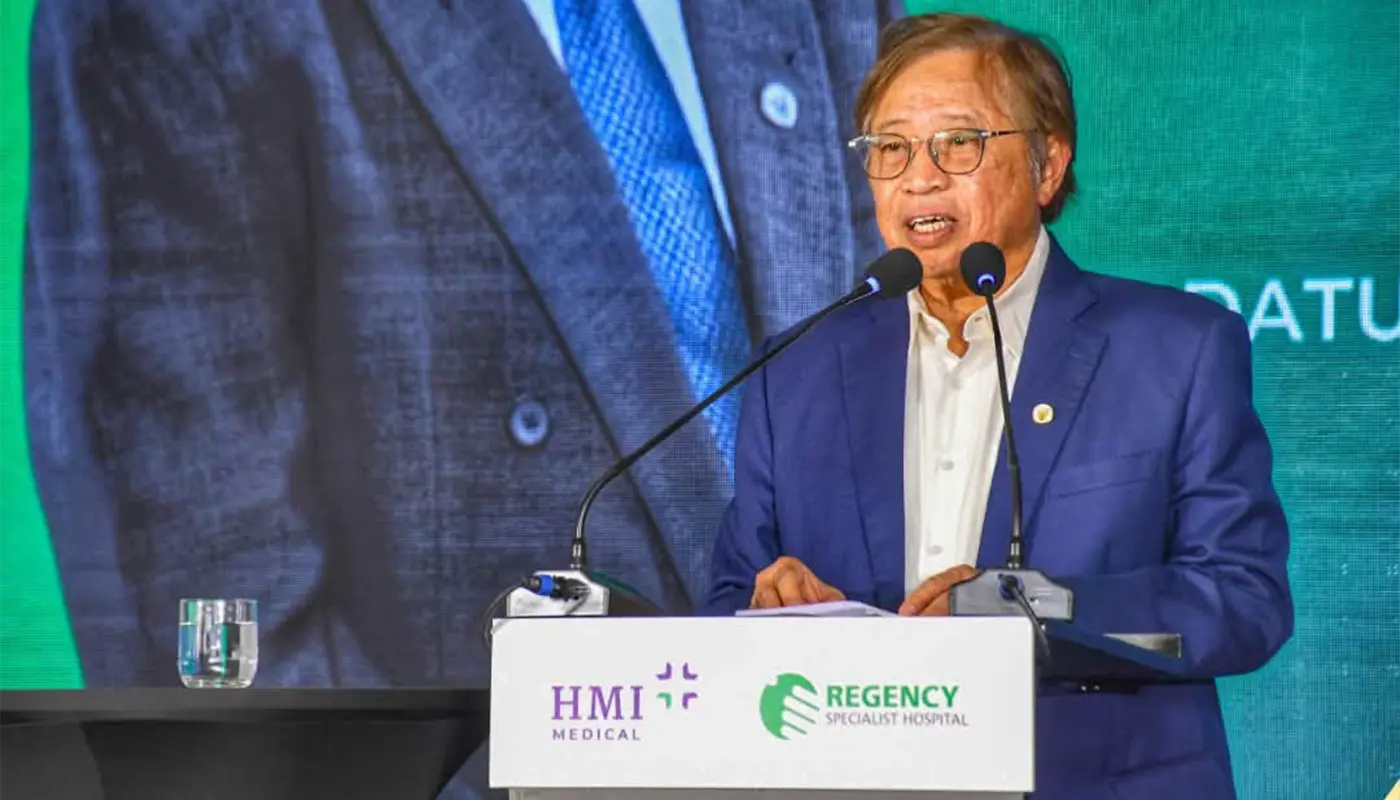
KUCHING – The development of Regency Specialist Hospital Kuching is expected to strengthen Sarawak’s healthcare infrastructure and support the state’s efforts to establish itself as a regional centre for advanced medical services, research and digital health innovation.
The specialist hospital is being developed by Health Management International (HMI) Medical at the NorthBank project site along the Kuching-Samarahan Expressway.
The project is expected to be launched in 2029 and was officially marked by a groundbreaking ceremony attended by Premier of Sarawak Datuk Patinggi Tan Sri (Dr) Abang Haji Abdul Rahman Zohari bin Tun Datuk Abang Haji Openg on 10 August 2026.
Abang Johari described the project as a long-term investment in Sarawak’s healthcare infrastructure as well as the development of its human capital.
He said the project should not be viewed simply as the construction of another hospital, but as part of a wider effort to strengthen confidence in Sarawak’s ability to provide high-quality healthcare.
“This is not merely about constructing another hospital. It is about building confidence that Sarawak has the economic fundamentals to support world-class healthcare and that our people deserve access to quality medical services closer to home, for generations to come,” he said.
The Premier said HMI Medical’s investment also demonstrated increasing confidence in Sarawak as a destination where healthcare services, international investment and local expertise could develop alongside one another.
He noted that healthcare was increasingly becoming more than a public service, with the sector also contributing to economic activity, innovation, employment and investment.
Under the Post COVID-19 Development Strategy 2030, healthcare has been identified as an area with potential to create high-income employment, attract investment and improve Sarawak’s economic competitiveness.
The new hospital is expected to incorporate a range of modern technologies and medical approaches.
These include artificial intelligence, big data, robotics, telemedicine, genomics and precision medicine.
Abang Johari said Sarawak’s objective was not simply to keep pace with developments in healthcare technology, but to play a role in shaping the sector’s future.
“Sarawak intends not merely to follow these trends; we intend to participate in shaping them. Our ambition is clear. We want Sarawak to become a regional center for advanced healthcare, medical education, biomedical research and digital health innovation,” he said.
He said the achievement of this objective would require cooperation involving the state government, private sector, universities, research institutions and technology providers.
Such partnerships, he said, would be important in connecting healthcare delivery with education, research and technological development.
The Premier also pointed to the potential for Sarawak to further expand its medical tourism industry.
More than 100,000 medical tourists have travelled to Sarawak for treatment over the past two decades, while also contributing to the state’s tourism and hospitality sectors.
Abang Johari said Sarawak could build on this existing market by combining medical treatment with suitable post-treatment recovery experiences.
He highlighted the state’s coastal and forest-based destinations as possible components of a wider medical tourism offering.
The hospital could also have a role in research into tropical diseases through potential collaboration with the Sarawak Tropical Disease Research Centre.
Abang Johari proposed that Regency Specialist Hospital Kuching explore cooperation with the centre, particularly in research related to tropical diseases and the use of Sarawak’s biodiversity in scientific work.
The state government has invested more than RM300 million in establishing the research centre, which is nearing completion and includes advanced research facilities.
Sarawak’s geographical position within ASEAN was also highlighted as an advantage for the new healthcare facility.
According to Abang Johari, continued investment in connectivity could help the hospital attract patients from other parts of the region.
He also linked healthcare development with the wider visitor experience available in Kuching and Sarawak.
“I am sure people want to get good treatment from your hospital. They are welcome to Kuching and, at the same time, can enjoy our laksa while recovering from their illness,” he said.
The groundbreaking ceremony also included the launch of the HMI Malaysia Skill and Workforce Development Budget 2030.
Abang Johari said the workforce initiative complemented the hospital project by focusing on the development of human capital.
He described the two initiatives as investments in different aspects of Sarawak’s future, with the hospital focusing on healthcare infrastructure and capacity while the workforce programme focuses on people and skills.
The development of Regency Specialist Hospital Kuching therefore forms part of a broader effort to expand Sarawak’s healthcare capabilities while creating opportunities linked to investment, employment, technology and research.
The project is also expected to contribute to the state’s longer-term plans to develop advanced healthcare services and strengthen its position within the regional medical sector.
Also attending the ceremony were Deputy Premier Sarawak and Minister for Public Health, Housing and Local Government Datuk Amar Professor Dr Sim Kui Hian, Minister for Tourism, Creative Industry and Performing Arts Dato Sri Haji Abdul Karim Rahman Hamzah and Deputy Minister for Tourism, Creative Industry and Performing Arts Datuk Sebastian Ting Chiew Yew.
Mayor of Kuching South Dato Wee Hong Seng and HMI Singapore Group Chief Executive Officer Chin Wei Jia were also present at the ceremony.
