



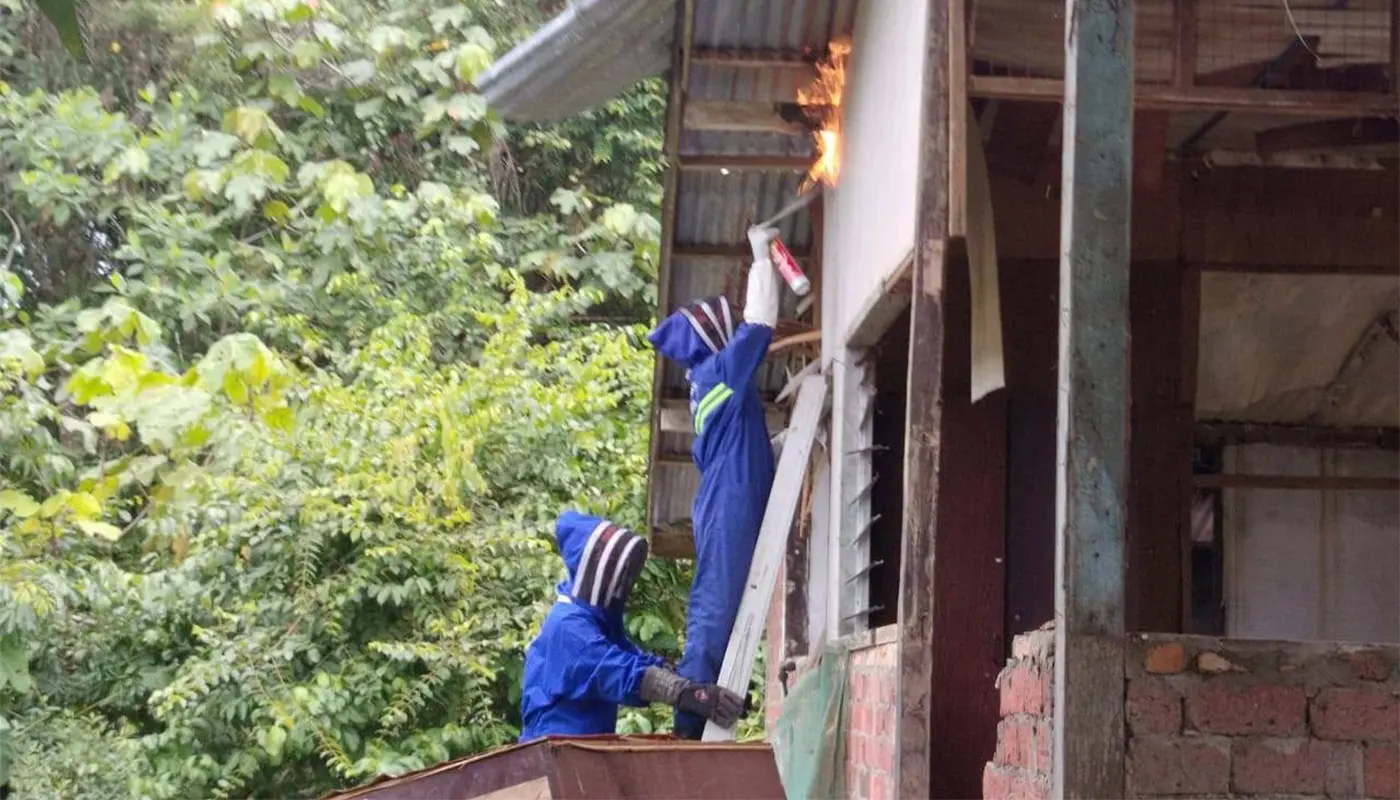
SARATOK – Pupils and staff at SK Ulu Budu Krian can return to classes without fear of stinging insects following a targeted intervention by local emergency responders on Sunday.

The Saratok District Civil Defence Force successfully neutralised a honey bee colony that had established itself within the structural cavity of a school building, eliminating a potential hazard to the educational environment.
The operation was initiated after school administrators formally reported the presence of the hive to authorities. Recognising the elevated risk posed by bees nesting inside occupied structures, particularly where children gather daily, the district control centre immediately authorised a specialist response.
Three personnel from Charlie Squad were dispatched to the site equipped with appropriate protective gear and eradication tools suitable for confined spaces.
Upon arrival, the team located the nest embedded deep within the wall fabric of the school premises. This positioning presented unique challenges compared to external hives, as direct access was limited and structural integrity needed preservation.
Responders employed a combination of chemical treatment using Ridsect spray alongside controlled burning techniques to ensure complete elimination of the colony while minimising damage to the building materials.
Safety protocols were strictly observed throughout the procedure to prevent accidental stings or fire hazards. The successful completion of the task without incident demonstrates the technical proficiency maintained by Saratok’s civil defence volunteers in handling wildlife-related emergencies.
Such operations require careful balancing of effectiveness with environmental responsibility, ensuring that beneficial pollinators are only removed when they pose genuine threats to human safety.
School management received formal guidance post-operation regarding ongoing vigilance and early reporting procedures. Authorities emphasised that prompt notification upon discovering insect activity significantly reduces escalation risks and simplifies removal processes.
Regular inspection of building exteriors, especially after rainy seasons when bees frequently seek sheltered nesting sites, remains a recommended preventive measure for all educational institutions in rural Sarawak.
Honey bee incidents in school environments carry particular urgency due to children’s heightened vulnerability to allergic reactions and panic-induced accidents. Unlike adult populations, pupils may lack awareness of safe behaviour around agitated insects, increasing injury potential during unexpected swarming events.
Civil defence units across Sarawak prioritise educational facility calls precisely because of these compounded risk factors affecting young community members.
The use of integrated eradication methods reflects evolving best practices in urban wildlife management within Malaysian civil defence frameworks. Chemical treatments alone sometimes fail to reach queen bees hidden in wall voids, allowing colonies to regenerate weeks later.
Combining sprays with thermal techniques addresses this limitation by destroying both visible insects and concealed reproductive individuals, providing longer-term protection for affected buildings.
Community members throughout Saratok district are encouraged to view civil defence as accessible partners in maintaining neighbourhood safety beyond traditional disaster scenarios.
Wildlife encroachments, fallen trees blocking access routes, and minor flooding all fall within their operational scope when public welfare is compromised.
Building familiar relationships with local APM offices through non-emergency interactions fosters trust that proves invaluable during genuine crises requiring rapid coordinated action.
Preventive maintenance of school infrastructure also plays a crucial role in reducing future wildlife conflicts. Sealing cracks, repairing damaged eaves, and installing mesh barriers over ventilation points deny bees entry opportunities before colonies establish.
Facilities teams working alongside civil defence advisors can identify vulnerability hotspots during routine inspections, transforming reactive responses into proactive safeguarding strategies that protect both students and native insect populations.
Sunday’s successful intervention at SK Ulu Budu Krian exemplifies how specialised volunteer services fill critical gaps in rural community protection networks.
Where municipal pest control resources may be stretched thin across vast geographical areas, trained civil defence squads provide timely, locally informed solutions tailored to specific environmental conditions.
Their continued readiness ensures that Saratok’s schools remain safe learning environments despite the natural challenges inherent to Sarawak’s biodiverse landscape.
