



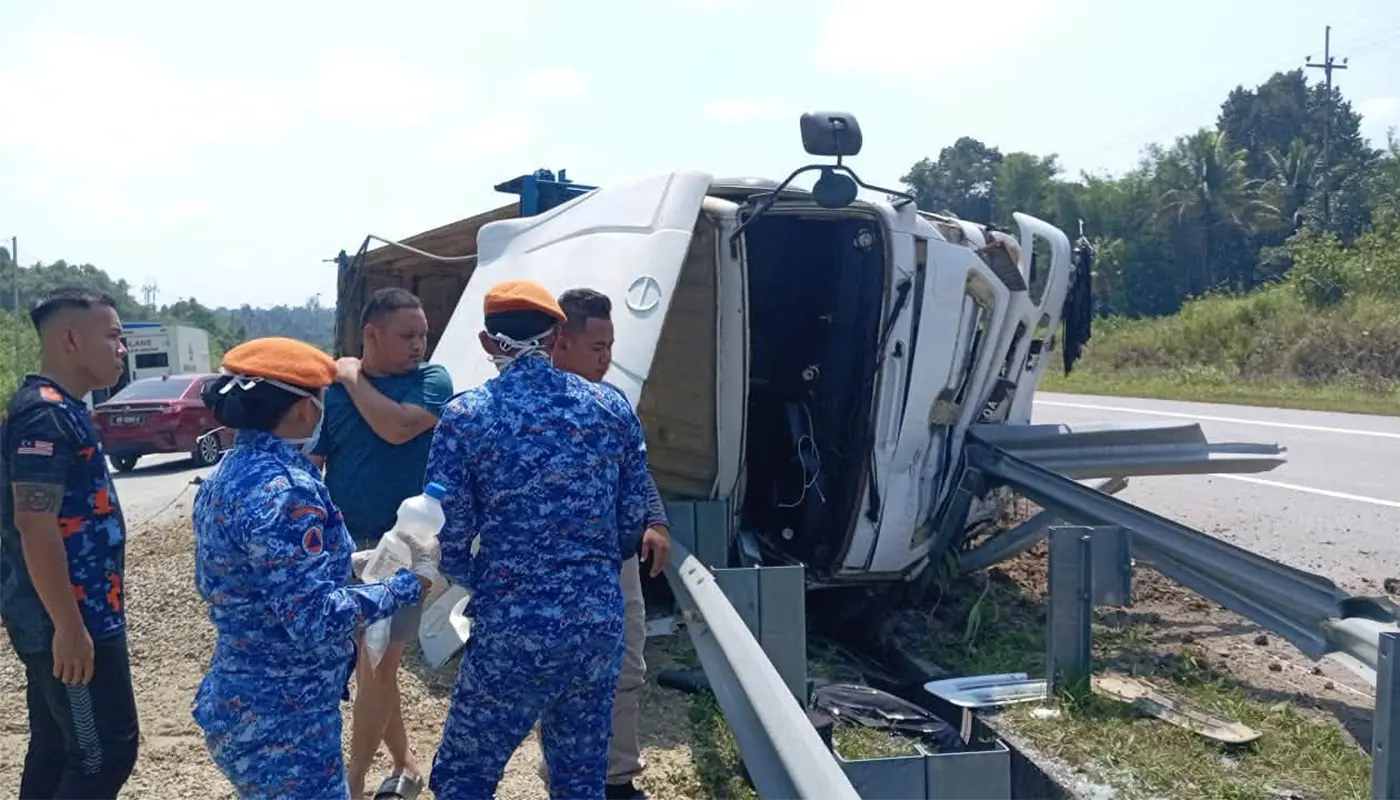
DEBAK – A traffic collision involving a heavy goods vehicle resulted in damage to public infrastructure and minor injuries to the driver on Friday. The incident occurred when a lorry struck a roadside safety barrier, prompting an immediate response from local emergency services to secure the area and assist those involved.

The sole occupant of the vehicle, an adult male, was confirmed safe following the impact despite sustaining slight physical trauma. Medical personnel from the Debak Civil Defence Force arrived promptly at the scene to provide initial assessment and first aid treatment. His condition did not require hospitalisation, indicating that protective safety mechanisms within the cab likely mitigated more severe harm.
Civil defence officers undertook essential site management duties upon reaching the location. Their primary objective was to ensure the accident zone remained controlled and hazard-free for both responders and passing motorists. This included positioning warning signage and directing traffic flow around the damaged section of roadway to prevent secondary incidents.
Infrastructure damage was confined primarily to the metal guardrail system designed to absorb vehicular impact energy. While the barrier sustained visible deformation, its structural performance arguably fulfilled its intended purpose by decelerating the errant vehicle before it could leave the carriageway entirely. Repair crews will need to assess whether partial replacement or full reconstruction is necessary.
Preliminary observations suggest the lorry may have veered off its intended path prior to contacting the fixed obstruction. Exact causation factors remain under review, though common contributors in similar cases include driver fatigue, mechanical failure, adverse road conditions, or momentary distraction. Comprehensive investigation will determine the precise sequence of events leading to the collision.
Emergency responders emphasised the importance of maintaining vigilance when navigating rural highway sections like Simpang Debak. Long straightaways can sometimes induce complacency amongst drivers, increasing susceptibility to lapses in attention or speed misjudgement. Regular rest breaks and adherence to posted limits remain fundamental preventative measures for commercial transport operators.
Vehicle maintenance standards also warrant ongoing scrutiny within the logistics sector. Brake systems, steering components, and tyre integrity directly influence a driver’s ability to retain control during unexpected situations. Fleet managers bear responsibility for ensuring rigorous inspection schedules are followed to minimise mechanical-related accident risks.
Public infrastructure resilience depends heavily on proper installation and periodic upkeep of safety barriers. Engineering specifications dictate placement angles, post spacing, and material grades based on anticipated traffic volumes and vehicle weights. Compliance with these standards ensures protective systems perform reliably when called upon during real-world impacts.
Community awareness regarding accident reporting protocols enhances overall emergency response efficiency. Witnesses who promptly notify authorities with accurate location details enable faster deployment of appropriate resources. Mobile phone coverage improvements along rural corridors have significantly reduced notification delays compared to previous decades.
Post-incident site clearance proceeded smoothly once medical and safety assessments concluded. Debris removal and temporary traffic restoration allowed normal flow to resume without prolonged disruption. Efficient coordination between civil defence, police, and public works departments facilitates rapid recovery from such unplanned events.
Data collection from individual collisions contributes to broader road safety analytics used for policy development. Identifying recurring problem locations or vehicle types helps target enforcement campaigns and engineering interventions where they yield greatest benefit. Evidence-based approaches outperform generic awareness efforts in reducing casualty rates over time.
Driver training programmes continue evolving to address modern challenges facing commercial transport professionals. Defensive driving techniques, hazard perception skills, and fatigue management strategies form core curriculum elements for licensing and refresher courses. Continuous professional development reinforces safe behaviours throughout career spans.
Insurance and liability considerations inevitably follow any incident involving public property damage. Documentation generated during emergency response supports subsequent claims processing and cost recovery procedures. Transparent record-keeping protects all parties whilst ensuring accountability for infrastructure restoration expenses.
Environmental safeguards around accident sites prevent fluid leaks or debris from contaminating adjacent land and waterways. Responders routinely check for fuel spills, hydraulic fluid discharge, or scattered cargo that might pose ecological hazards. Containment and cleanup actions align with broader sustainability commitments embedded in emergency service protocols.
Long-term infrastructure planning incorporates lessons learned from collision histories at specific locations. Repeated barrier strikes may indicate need for geometric redesign, enhanced signage, or supplementary warning systems. Proactive adaptation prevents recurrence rather than merely reacting after damage occurs.
