



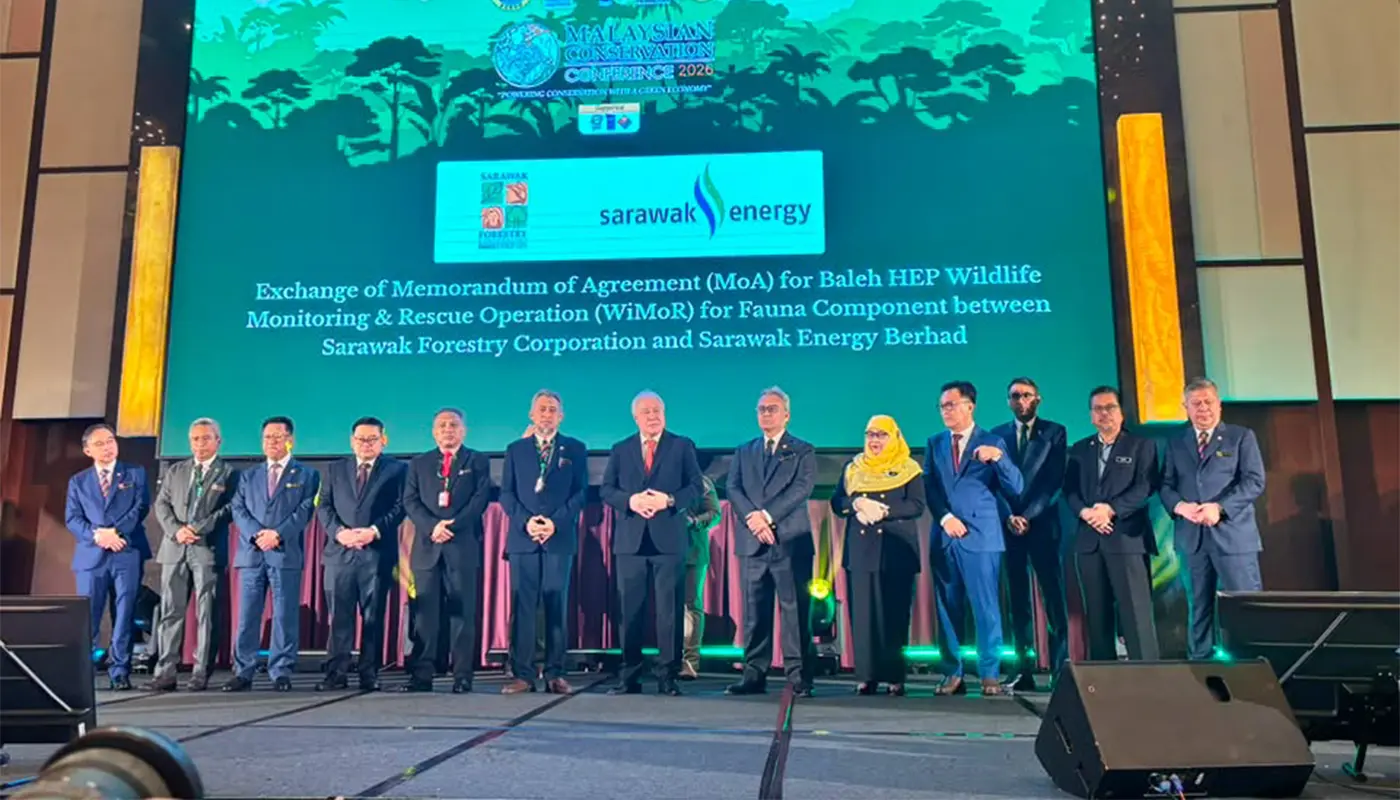
KUCHING – The Malaysian Conservation Conference (MCC) 2026 officially began today at the Imperial Hotel, Kuching, bringing together experts and stakeholders to explore sustainable solutions for biodiversity conservation under the theme “Powering Conservation with a Green Economy.”

The three-day event, hosted by the Sarawak Forestry Corporation (SFC), has drawn between 150 and 200 delegates from 37 organisations, including government agencies, conservation practitioners, researchers, academic institutions, and industry representatives. A total of 25 technical papers will be presented, reflecting the breadth of expertise and perspectives on conservation challenges.
The opening ceremony was officiated by Deputy Premier of Sarawak, Datuk Amar Awang Tengah Ali Hasan, who represented the Premier of Sarawak. In his keynote address, Datuk Amar emphasised that conservation and economic growth should not be seen as conflicting priorities. Instead, he stressed that both agendas can reinforce one another when managed through responsible policies, sound governance, and long-term planning.
He noted that Sarawak, with its rich biodiversity and natural resources, has a responsibility to balance development with conservation. He urged participants to consider innovative approaches that integrate environmental sustainability into economic strategies, ensuring that conservation efforts contribute to national progress.
The conference will focus on five thematic areas:
- Biodiversity Conservation and sustainable utilisation
- Circular Economy
- Implementing Conservation
- Climate Change and nature
- Conservation Finance
General Manager of SFC, Abang Arabi Abang Aimran, highlighted that meaningful conservation outcomes depend on rigorous science, reliable data, and strong collaboration across sectors. He stressed that partnerships between government, academia, industry, and communities are essential to achieve sustainable results.
Delegates are expected to deliberate on practical strategies for conservation, including sustainable financing models, innovative governance structures, and community-driven initiatives. The conference also aims to strengthen regional and international cooperation, positioning Malaysia as a leader in conservation and green economy practices.
Observers note that the MCC 2026 comes at a critical time, as Malaysia faces increasing pressures from climate change, deforestation, and biodiversity loss. The integration of conservation with economic planning is seen as vital to ensuring long-term resilience and sustainability.
The event is also expected to provide a platform for young researchers and practitioners to share new ideas, fostering innovation and capacity-building in conservation science. By encouraging diverse participation, the conference seeks to build a strong foundation for future conservation leadership.
The opening day concluded with optimism that MCC 2026 will generate actionable recommendations and strengthen Sarawak’s role in advancing conservation within Malaysia and the wider region.
