



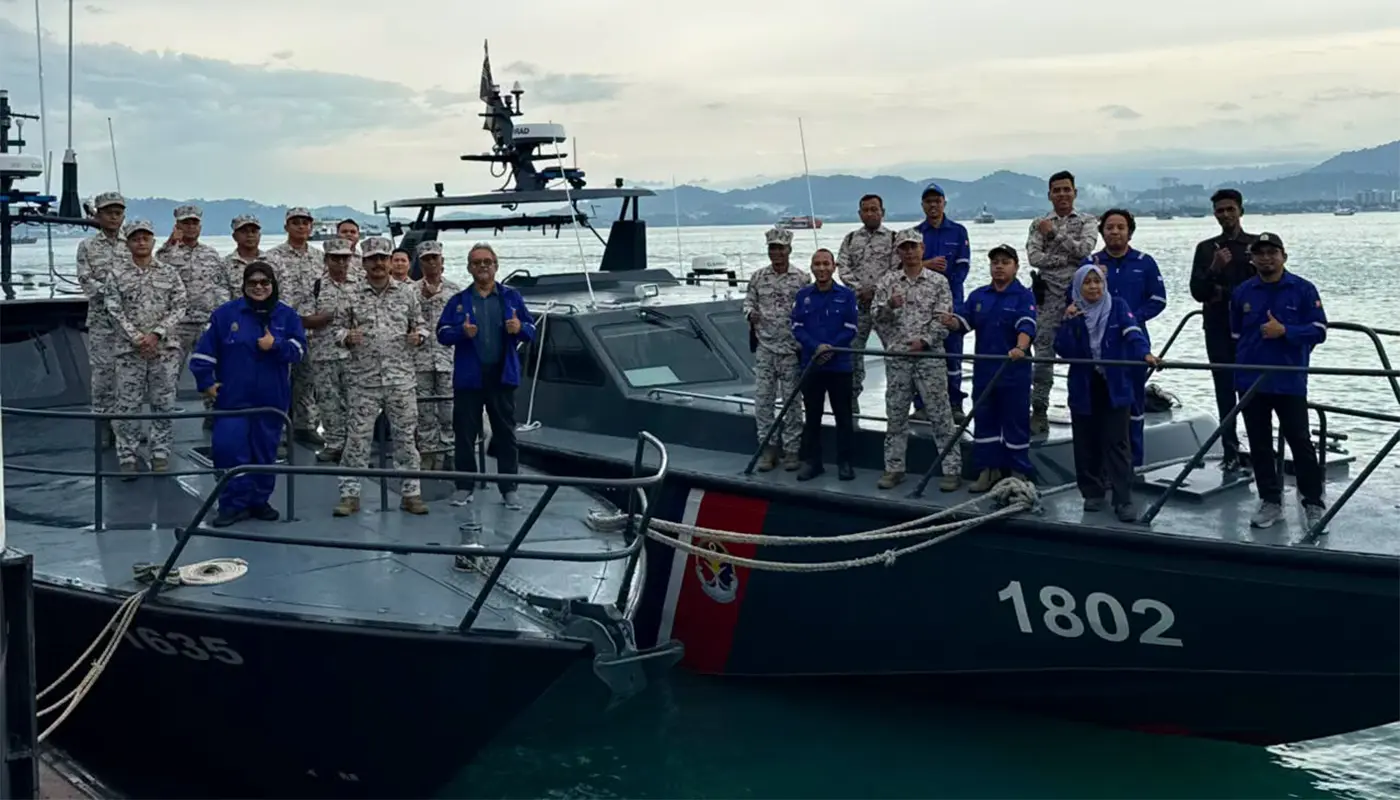
LANGKAWI – Maritime safety and enforcement in northern waters received a significant boost this week as the Malaysian Maritime Enforcement Agency (Maritime Malaysia) and the Malaysian Maritime Department (JLM) intensified their cooperation through a joint operation and a regional working committee meeting.

The two-day Joint Operation Programme, held from 14 to 15 July 2026, involved 40 officers and personnel from both agencies. Three assets from Maritime Malaysia and one from JLM were deployed to monitor navigation safety, enforce maritime laws, and conduct vessel inspections around Langkawi. The operation underscored the agencies’ shared commitment to safeguarding Malaysia’s maritime domain.
During the operation, 34 vessels were inspected and searched to ensure compliance with navigation regulations. Authorities issued two compounds for violations, while further checks revealed that several boats had failed to meet legal requirements. As a result, JLM directed the owners or operators of 11 vessels to report to its office within 14 days for investigation and follow-up action under existing maritime laws.
The enforcement exercise was followed by the Northern Region Working Cooperation Committee (JKK) meeting on 16 July, which served as a platform to strengthen operational coordination. Discussions centred on intelligence sharing, standardisation of procedures, joint training initiatives, and improvements to enforcement mechanisms. The meeting reinforced the Whole of Government approach, ensuring agencies work in unison to address increasingly complex maritime challenges.
First Admiral (Maritime) Romli bin Mustafa, Director of Maritime Malaysia for Kedah and Perlis, emphasised the importance of collaboration in maintaining maritime governance. “The implementation of joint operations and the JKK Meeting is a manifestation of the commitment of both agencies in strengthening maritime law enforcement, increasing operational readiness, streamlining coordination and strengthening the sharing of expertise to ensure that the country’s waters remain safe, orderly and sovereign,” he said.
Echoing this sentiment, Northern Region JLM Director Tuan Haji Abd. Majid bin Haji Rais highlighted the strategic role of the JKK platform. “Strategic cooperation between JLM and the Malaysian Maritime Department will continue to be strengthened through integrated operations, joint training and regular coordination meetings to ensure navigation safety, maritime management efficiency and the maritime community’s confidence in the national security system continues to be improved,” he explained.
The synergy between Maritime Malaysia and JLM reflects a broader national strategy to integrate enforcement, safety, and economic priorities. By combining resources and expertise, the agencies aim to ensure Malaysia’s waters remain secure, while also supporting the growth of the maritime economy and tourism industry.
Langkawi, a key maritime hub and tourist destination, benefits directly from such initiatives. Enhanced enforcement and safety measures not only protect local communities and maritime operators but also contribute to the confidence of international visitors and investors. The joint operation and JKK meeting demonstrate how coordinated action can reinforce Malaysia’s reputation as a safe and reliable maritime nation.
The collaboration also highlights the importance of continuous training and knowledge-sharing among enforcement agencies. By standardising procedures and conducting joint exercises, officers are better prepared to respond to emergencies, enforce laws effectively, and adapt to evolving maritime challenges.
Looking ahead, both agencies have pledged to maintain regular coordination meetings and integrated operations. This long-term commitment ensures that Malaysia’s maritime governance remains robust, responsive, and aligned with national development goals.
The joint operation and JKK meeting in Langkawi mark another step forward in Malaysia’s efforts to strengthen maritime security and efficiency. With enforcement agencies working hand in hand, the nation’s waters are better protected, ensuring safety for navigation, resilience in maritime management, and confidence in the country’s security systems.
