



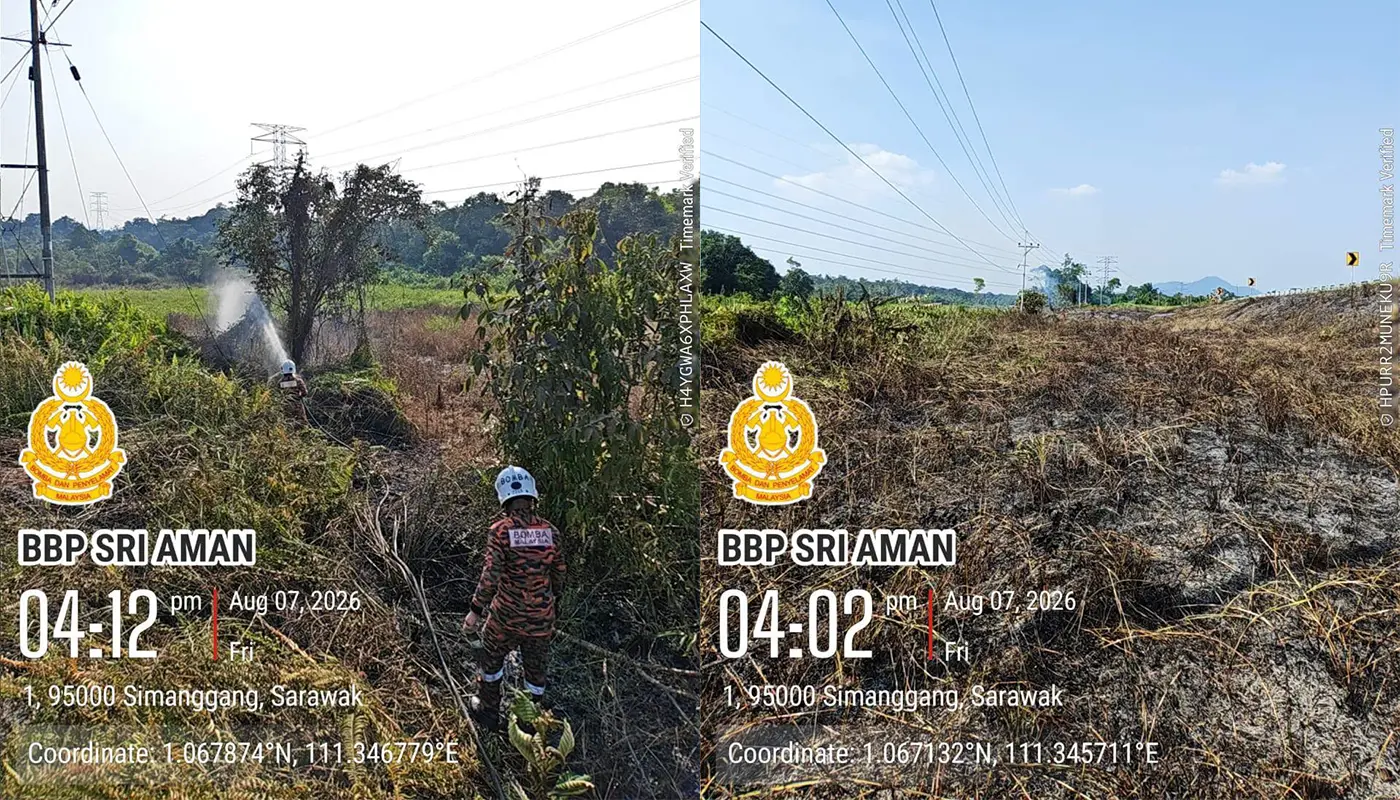
SRI AMAN – Emergency services responded to a significant vegetation fire along a roadside in the Selepong Jagu area on Friday afternoon. The blaze, which consumed approximately four acres of land, required coordinated suppression efforts from local firefighters and community members working together under challenging logistical conditions.

The alarm was raised at 3:30 pm when a member of the public named Michel reported the incident to the control room. Operator Alvin Klungop received the call and immediately initiated dispatch procedures for the nearest available resources. Rapid notification proved essential given the remote location and extent of the burning area.
Personnel from Bravo Team at the Sri Aman Fire and Rescue Station were mobilised to attend the scene situated twenty-two kilometres from their base. The response convoy comprised a Scania fire rescue tender bearing registration BME 7039 crewed by five officers, alongside an emergency medical rescue vehicle registered as BMY 4446 with two personnel aboard. This combination ensured both firefighting capability and medical standby coverage.
Noor Faqriakmal served as the operation commander overseeing tactical decisions throughout the intervention. Upon arrival, he conducted a thorough size-up assessment whilst wearing full personal protective equipment. This initial evaluation confirmed the presence of active flames spanning four acres adjacent to the roadway, validating the original report.
Suppression operations faced immediate challenges due to infrastructure limitations at the site. No fire hydrants or accessible open water sources existed within proximity of the burning area. Consequently, crews had to rely entirely on water carried aboard their appliances, necessitating careful conservation and strategic application during extinguishment activities.
Access difficulties further complicated the response effort. Vehicles were required to navigate a two-kilometre detour involving a P-turn manoeuvre before reaching the actual fire ground. This indirect routing added valuable minutes to transit time and highlighted the importance of pre-incident planning for remote locations with limited road connectivity.
Despite these constraints, firefighters established a single hose line to deliver water onto the flames. Crews worked methodically across the affected zone, prioritising containment lines to prevent lateral spread into unaffected vegetation. Systematic overhaul followed active suppression to eliminate hidden hotspots beneath surface fuel loads.
Community participation played a vital supporting role during the operation. Local residents volunteered assistance to firefighters, helping with equipment handling and perimeter monitoring tasks. Such grassroots cooperation significantly enhanced operational effectiveness and demonstrated strong civic engagement in emergency situations.
The combined efforts of professional responders and civilian helpers eventually brought the blaze under complete control. Once all visible flames were extinguished and no residual dangers remained, the operation commander declared the site safe. All personnel and apparatus subsequently returned to station without further incident.
Vegetation fires in rural areas frequently present unique tactical dilemmas compared to structural incidents. Absence of fixed water supplies demands greater reliance on tanker shuttles or onboard reserves, extending operational timelines considerably. Pre-positioning additional water-carrying assets during dry seasons can mitigate such vulnerabilities.
Roadside ignitions pose particular risks due to potential traffic hazards and smoke obscuration affecting motorists. Incident commanders must balance fire suppression priorities with public safety considerations related to passing vehicles. Temporary traffic controls or police support may become necessary when flames encroach upon travel corridors.
Post-incident analysis will likely examine response efficiency and resource adequacy for similar future events. Lessons learned regarding access routes and water availability can inform updated standard operating procedures and training scenarios. Continuous refinement of tactics ensures adaptation to evolving environmental and infrastructural conditions.
Public education remains crucial for preventing accidental ignitions in vulnerable landscapes. Awareness campaigns targeting agricultural burning practices, campfire safety, and discarded cigarette disposal help reduce human-caused fire starts. Collaborative prevention initiatives between authorities and communities yield sustainable risk reduction outcomes.
Equipment maintenance and crew readiness directly influence response capabilities in demanding environments. Regular servicing of pumps, hoses, and vehicles ensures reliability when deployed far from workshop support. Physical fitness and technical proficiency training prepare personnel for strenuous manual labour under adverse conditions.
Inter-agency coordination frameworks enhance overall emergency management capacity even when no external partners are activated for specific incidents. Established protocols enable seamless integration should circumstances escalate beyond single-agency capabilities. Preparedness through planning prevents delays during complex multi-hazard scenarios.
Community resilience strengthens when residents understand how to assist safely during emergencies. Basic guidance on evacuation routes, reporting procedures, and appropriate volunteer roles empowers citizens to contribute constructively without compromising personal safety or operational integrity. Mutual trust between services and public fosters collaborative problem-solving.
Data collection from incidents like this supports evidence-based resource allocation decisions. Historical patterns of fire occurrence, response times, and suppression durations guide station placement and staffing models. Strategic investment aligned with actual demand maximises public safety returns across diverse geographical contexts.
