



KUCHING – The Sarawak government has reaffirmed its commitment to financial independence by proceeding with major infrastructure developments using state-generated revenue rather than relying on federal allocations.

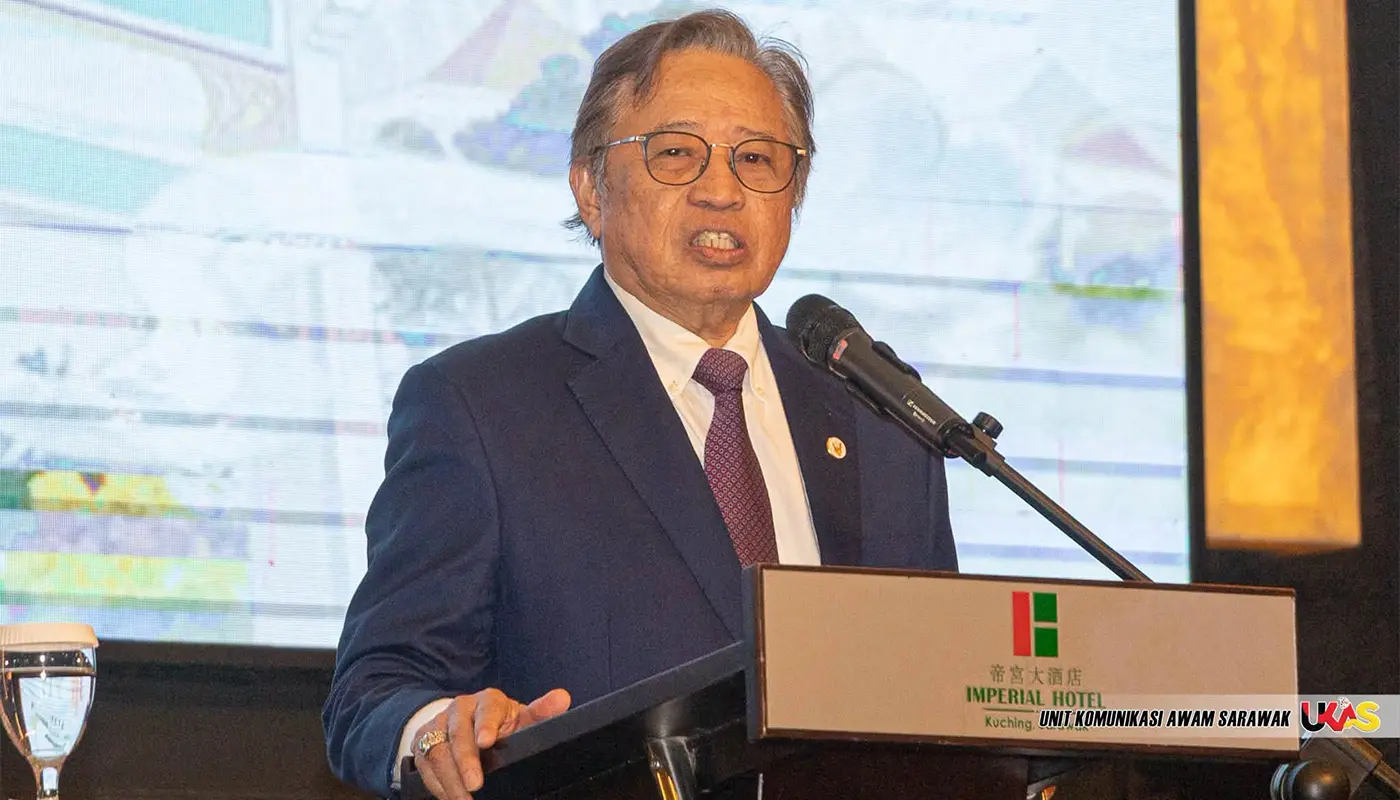
Premier Datuk Patinggi Tan Sri (Dr) Abang Abdul Rahman Zohari Tun Datuk Abang Openg highlighted this strategic shift during his address at the Nanyang University Alumni Reunion Dinner held in the state capital recently.
A flagship example of this self-reliance is the Automated Flow Transit System (ART) currently under construction in Kuching.
Unlike similar public transport initiatives in other states, the Sarawak ART project is being fully funded by the state treasury.
The Premier drew a comparison with Penang’s Light Rail Transit (LRT) development, noting that while he congratulated Penang on their progress, their project relies heavily on funding from Kuala Lumpur.
“Sarawak is difficult to get funds because our friends in Kuala Lumpur sometimes want to give, sometimes do not give,” Abang Johari stated, illustrating the unpredictability of federal disbursements.
He emphasised that Sarawak’s approach eliminates this uncertainty, allowing for consistent and timely project execution.
“But now, Sarawak has a strong state revenue and the ART project is funded by the Sarawak Government. Congratulations to Penang for developing ART or Light Rail Transit (LRT), but Penang gets funding from Kuala Lumpur and we do not,” he added.
This ability to self-fund large-scale infrastructure is attributed to the significant growth in state revenue over the past few years.
Through prudent fiscal management and the maximisation of local resources, Sarawak has built a robust financial foundation that supports its development agenda without external dependency.
This financial autonomy empowers the state to prioritise projects that align closely with local needs and long-term strategic goals.
Beyond urban transport, the Premier outlined Sarawak’s aggressive expansion into the clean and renewable energy sector.
The state is positioning itself as a regional leader in green technology, with substantial investments directed towards solar energy, biomass, ammonia, and hydrogen production.
These industries are viewed as critical drivers of the new economy, offering high-value opportunities that will further boost state income and create skilled employment.
The government’s policy focuses on strengthening the economy by adding value to local products and resources.
By moving up the value chain, Sarawak aims to transition from a resource-based economy to one driven by innovation and advanced manufacturing.
This strategy not only diversifies revenue streams but also enhances the state’s resilience against global market fluctuations.
The emphasis on renewable energy aligns with global sustainability trends and positions Sarawak as an attractive destination for green investments.
The development of hydrogen and ammonia hubs, in particular, opens doors to international partnerships and export markets, contributing to the state’s ambition of becoming a key player in the global energy transition.
Abang Johari’s remarks underscore a broader narrative of state empowerment and self-determination. By leveraging its natural wealth and strategic location, Sarawak is charting a unique path towards prosperity that serves as a model for other regions seeking greater fiscal autonomy.
The success of the ART project and the burgeoning green energy sector stand as testaments to the effectiveness of this approach.
As these projects progress, they are expected to deliver tangible benefits to the people of Sarawak, including improved mobility, cleaner air, and enhanced economic opportunities.
The Premier’s confidence in the state’s financial health reflects a well-executed strategy that balances immediate infrastructure needs with long-term economic sustainability.
The move to self-fund development also strengthens Sarawak’s negotiating position within the federation, demonstrating that the state is capable of managing its own affairs efficiently.
This capability reinforces the argument for greater decentralisation and resource rights, which have been central to recent political discussions between the state and federal governments.
Looking ahead, the Sarawak government plans to continue exploring innovative financing models and investment opportunities to sustain its growth trajectory.
The focus remains on delivering high-impact projects that improve quality of life while ensuring that the state’s wealth is retained and reinvested for the benefit of its citizens.
