



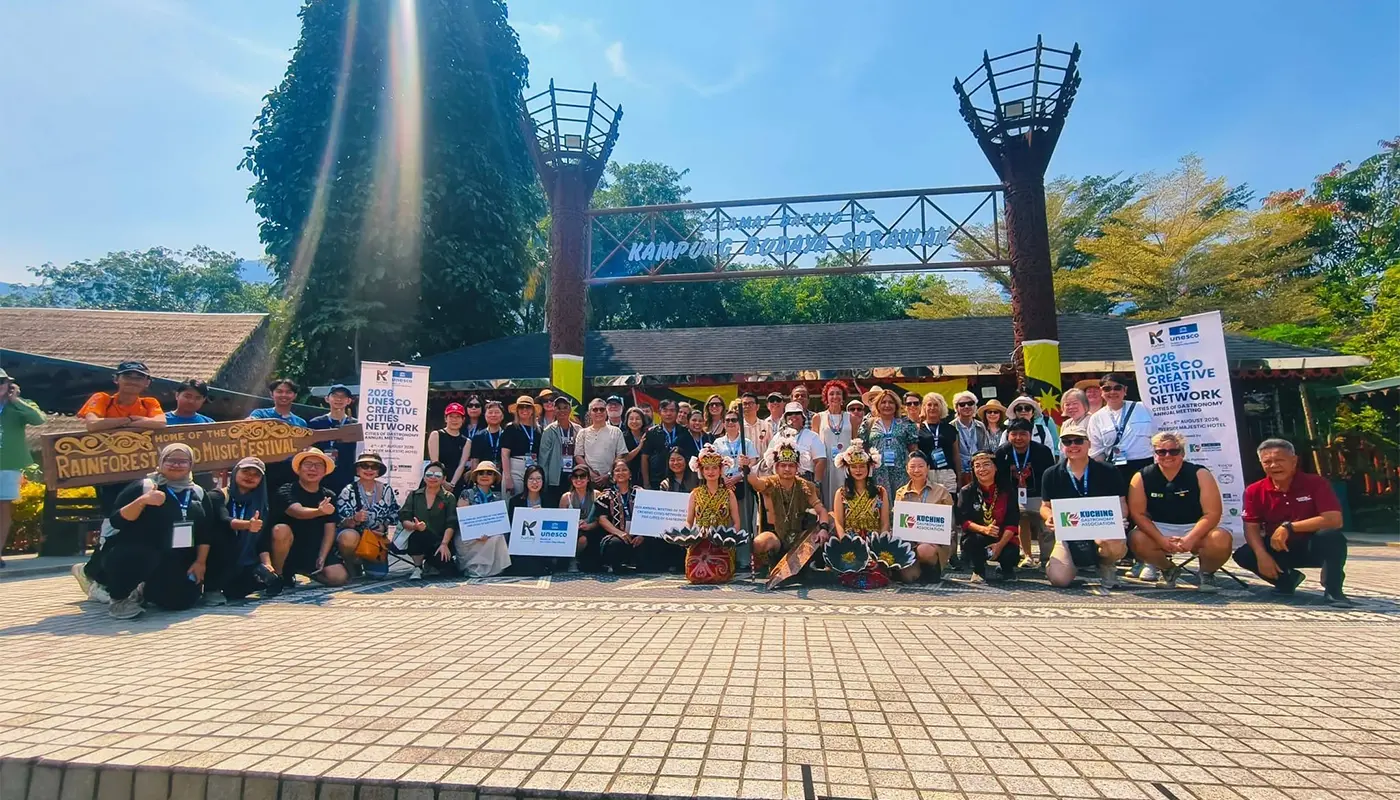
KUCHING – Sixty international delegates representing the UNESCO Creative Cities Network (UCCN) Cities of Gastronomy visited the Sarawak Cultural Village on 6 August 2026 as part of their official programme in the state capital. The excursion served as a curated introduction to Sarawak’s living heritage, combining ceremonial welcome rituals with hands-on culinary demonstrations and guided cultural interpretation.

The delegation was received at the Grand Entrance with a traditional Orang Ulu welcoming ceremony that set the tone for the day’s engagements. Such protocols carry deep significance within indigenous hospitality traditions, signalling respect for guests and establishing relational foundations before formal activities commence. Ceremonial openings transform routine visits into meaningful cross-cultural exchanges grounded in mutual recognition.
Live cooking demonstrations formed the experiential core of the visit, showcasing preparation techniques unique to Sarawak’s diverse ethnic communities. Chef Laura Jane Bara and Chef Sanni Kalol from the Cultural Village prepared Manok Pansoh, a signature dish featuring chicken cooked inside bamboo segments over open flame. They also demonstrated chicken cooked within banana stem, illustrating alternative vessel-based cooking methods that impart distinctive flavours through natural material infusion.
Mdm Mina Trang Witte contributed Kelabit culinary expertise by preparing Senape, a traditional kelupis variety specific to highland communities. Her demonstration highlighted regional variations within broader Sarawakian foodways, countering tendencies to homogenise indigenous cuisines under singular labels. Specificity honours distinct cultural identities whilst enriching visitors’ understanding of gastronomic diversity.
Delegates observed not merely finished dishes but entire preparation processes including ingredient selection, tool usage, fire management, and timing judgments embedded in embodied knowledge systems. Such tacit expertise resists codification in recipe books yet constitutes essential cultural capital transmitted through apprenticeship and practice. Witnessing these processes fosters appreciation beyond superficial consumption.
A guided tour of the Cultural Village followed the culinary segment, providing architectural and spatial context for the foods previously demonstrated. Traditional dwellings represent integrated lifeways where domestic architecture, food storage, processing areas, and communal spaces reflect holistic cultural logics. Understanding built environments deepens comprehension of why certain dishes exist and how they function socially.
The visit concluded with lunch at Budaya Restaurant, where delegates sampled Highlander Ethnic Cuisine alongside offerings from the Sarawak Ethnic Kitchen. Communal dining created informal interaction opportunities between international guests and local hosts that structured programming cannot facilitate. Shared meals build interpersonal connections that sustain professional networks long after formal events end.
UNESCO Creative Cities Network membership connects Sarawak to global communities committed to leveraging culture and creativity for sustainable urban development. Gastronomy designation recognises food systems as vital cultural infrastructure rather than mere tourism commodities. International validation strengthens local pride whilst creating accountability for heritage safeguarding.
Cultural villages function as interpretive interfaces between living traditions and external audiences seeking authentic engagement. Curated experiences must balance accessibility with integrity, avoiding exoticisation whilst making complex practices comprehensible to unfamiliar observers. Skilled mediators navigate this tension through respectful translation that preserves meaning across cultural boundaries.
Indigenous chefs serving as cultural ambassadors occupy crucial positions within heritage transmission ecosystems. Their dual fluency in traditional knowledge and contemporary presentation enables effective communication without dilution or distortion. Professional recognition validates culinary expertise as legitimate cultural labour deserving institutional support and fair compensation.
Visitor feedback gathered during such exchanges informs future programme refinement and community benefit-sharing arrangements. Responsive curation ensures that cultural tourism serves resident interests alongside visitor satisfaction rather than extracting value unidirectionally. Reciprocal relationships distinguish ethical heritage interpretation from exploitative spectacle.
Sarawak’s gastronomic heritage encompasses far more than individual recipes; it embodies ecological knowledge, social organisation, spiritual beliefs, and historical memory encoded in food practices. Sharing this heritage responsibly requires contextualisation that prevents decontextualised appropriation whilst enabling genuine cross-cultural learning. Depth distinguishes meaningful exchange from superficial sampling.
The Cultural Village’s expressed pride in sharing Sarawak’s traditions reflects confidence born from secure cultural ownership rather than defensive preservationism. Openness premised on self-determination creates conditions for equitable dialogue where host communities control narratives about their own heritage. Agency transforms vulnerability into strength in intercultural encounters.
Looking ahead, partnerships forged through UCCN engagements may yield collaborative research, chef exchanges, documentation projects, or joint advocacy initiatives benefiting all participating cities. Sustained connection converts single visits into enduring networks that amplify local voices within global conversations about cultural sustainability and creative economies.
